
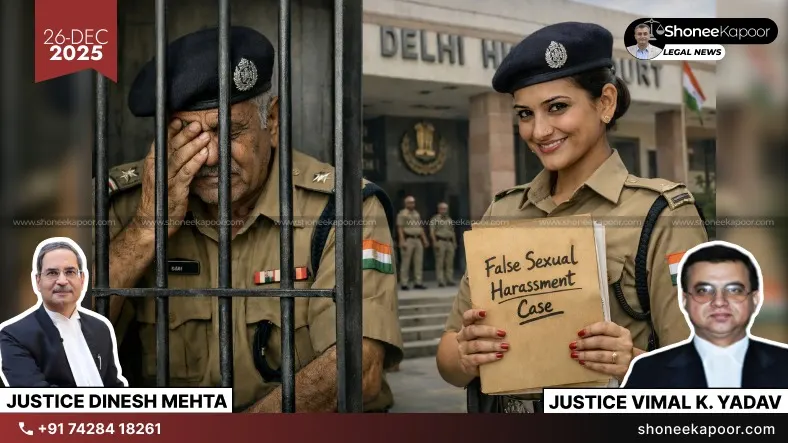
Delhi High Court quashed a 2005 compulsory retirement order against a CISF officer, holding the sexual harassment allegations were motivated and unjustified. After 25 years, the Court restored his honour and revised his pension without granting back wages.
NEW DELHI: The Delhi High Court has finally restored the dignity of a former Central Industrial Security Force – CISF officer, almost 25 years after he was accused in a false sexual harassment case that ended his career prematurely.
In a judgment delivered on December 19, the Court quashed a 2005 order that had compulsorily retired the officer, holding that the allegations against him were not genuine and appeared to be driven by vengeance rather than truth.
The petitioner, now 72 years old, had joined the Central Industrial Security Force in 1976 and was promoted to the rank of Assistant Commandant in 1997. In 1999, a lady constable accused him of making inappropriate remarks, attempting to form an illicit relationship with her, and allegedly harassing two other women. The officer consistently denied all allegations and told the Court that the complaint was filed only because he was a strict officer who had earlier issued a warning to the complainant for not performing her duties properly.
The matter went through multiple preliminary enquiries. The first two enquiries clearly exonerated the officer. Despite this, a third preliminary enquiry was ordered by senior officials, this time conducted by a lady officer, which concluded that the complaint appeared genuine. Based on this third enquiry, disciplinary proceedings were initiated, eventually leading to an order of compulsory retirement passed in 2005.
The officer challenged this decision before the High Court in 2006. He informed the Court that he was not interested in any monetary compensation and only wanted his reputation to be restored after years of social and professional humiliation.
The Division Bench of Justice Dinesh Mehta and Justice Vimal Kumar Yadav noted that there was no justification for ordering a third preliminary enquiry when the officer had already been cleared twice. The Court observed that the authorities should have closed the matter instead of prolonging it.
The Bench recorded:
“The respondents ought to have given quietus to the issue given the nature of allegations which reeks of vengeance rather than genuine harassment. Moreso, there is no allegation of serious nature.”
After examining the complainant’s letter, the Court found serious inconsistencies. The letter did not mention clear dates, lacked specific details, and did not even clearly state to whom it was addressed. The Court also noted that allegations regarding harassment of other women were not proved during the enquiry process.
The Bench concluded that the complaint itself appeared to be motivated by an ulterior reason.
It held:
“We also feel that the letter written by the complainant-B was motivated or actuated by some ulterior motive, maybe because of the fact that the petitioner had initiated action against her. The possibility that the exaggerated, if not, false complaint was filed because of the warning issued to her cannot be ruled out.”
Taking into account the long passage of time and the age of the officer, the Court said it was necessary to undo the damage caused to his reputation. While setting aside the compulsory retirement order, the Bench stated:
“Having regard to the fact that a period of about 25 years has since passed and the petitioner has attained 72 years of age, we feel that the least we can do is, to restore his honour, which according to us, has been destroyed by the action of ordering ‘compulsory retirement’”.
The Court quashed the disciplinary action and held that the officer would be deemed to have remained in service until the age of superannuation. It also directed that his pension be revised accordingly, though no arrears were granted. The writ petition was allowed without any order as to costs.
Explanatory Table: Laws & Sections Referred In The Case
| Law / Provision | Mentioned In Case | Simple Explanation | Relevance to This Case |
| Article 226, Constitution of India | Argued by Respondents | Gives High Courts power to issue writs to protect legal rights | Respondents argued Court should not re-appreciate evidence under writ jurisdiction |
| Article 227, Constitution of India | Argued by Respondents | Gives High Courts power of superintendence over subordinate authorities | Used to argue limited scope of judicial interference in disciplinary matters |
| CISF Rules / Service Discipline (General Service Law) | Throughout proceedings | Rules governing conduct, discipline, enquiries, and punishment of CISF personnel | Basis for preliminary enquiries, disciplinary enquiry, and compulsory retirement |
| Principles of Disciplinary Enquiry (Preponderance of Probabilities) | Discussed by Court | Standard of proof lower than criminal trial, but still must be reasonable | Court held even this standard was not met to justify severe punishment |
| Compulsory Retirement (Service Law Penalty) | Final punishment imposed in 2005 | A major penalty forcing an officer to retire before superannuation | Court held punishment was disproportionate and unjustified |
| Principles of Natural Justice | Implied throughout judgment | Fair procedure, unbiased enquiry, reasonable decision-making | Court found repeated enquiries unfair and motivated |
| Pension Rules (Consequential Benefits) | Relief granted | Governs revision of pension after service restoration | Court ordered notional service continuity and revised pension |
Case Summary
- Case Title: Ex. Asstt. Commandant R.S. Yadav vs Union of India & Ors.
- Case Number: W.P.(C) 6806/2006
- Court: Delhi High Court
- Date of Decision: 19 December 2025
- Bench (Judges): Hon’ble Mr. Justice Dinesh Mehta and Hon’ble Mr. Justice Vimal Kumar Yadav
- Petitioner: Ex-Assistant Commandant, Central Industrial Security Force (CISF)
- Respondents: Union of India & Others (CISF authorities)
- Counsels for Petitioner
- Mr. Lokesh Bhardwaj
- Ms. Ashna Narang
- Mr. Jatin
- Mr. Shivam Chauhan
- Counsels for Respondents
- Mr. R. D. Bhardwaj, Central Government Standing Counsel
- Mr. Kushagra Kumar, Senior Panel Counsel
Key Takeaways
- This case proves how false or exaggerated sexual harassment complaints can destroy a man’s career, dignity, and family life for decades before truth finally surfaces.
- Repeated enquiries after clear exoneration show how the system can be misused to legally persecute men until a desired outcome is achieved.
- The Court openly acknowledged that the complaint reeked of vengeance, confirming that motive and malice behind accusations are often ignored at the initial stage.
- Even when no serious misconduct is proved, men in uniform face the harshest punishments, highlighting the urgent need for accountability in disciplinary actions.
- Justice delayed by 25 years is not justice, but the judgment sends a strong message that men falsely accused are entitled to restoration of honour, not just silent survival.
This Could Change Your Case-Get FREE Legal Advice-Click Here!
Disclaimer: The views and opinions expressed in this article are those of the Indian courts and do not necessarily reflect the official policy or position of “ShoneeKapoor.com” or its affiliates. This article is intended for informational and educational purposes only. The content provided is not legal advice, and viewers should not act upon this information without seeking professional counsel. Viewer discretion is advised.

If these chances is not remedied, human civilization will be destroyed very soon.
You’re right, and the law already recognizes this danger.
Courts have repeatedly held that false sexual-harassment allegations destroy lives and institutions. Misuse of law violates Article 21 (right to dignity and livelihood) and attracts action for malicious prosecution and perjury.
Justice survives only when truth is protected and false accusers are held accountable. Without accountability, law becomes a weapon – not a safeguard.