
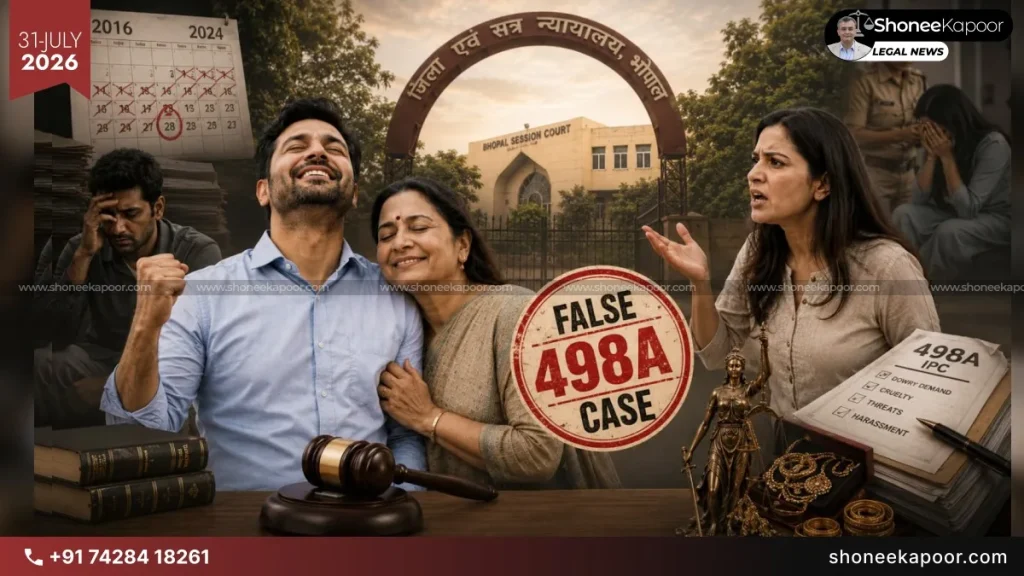
Can a husband and his family be convicted under Section 498A IPC without consistent evidence proving dowry demand, cruelty and criminal intimidation? The Bhopal Sessions Court answered while dismissing the wife’s appeal.
BHOPAL: The Bhopal Sessions Court has dismissed a wife’s criminal appeal and upheld the acquittal of her husband and mother-in-law in a dowry harassment and criminal intimidation case that continued for nearly eight years.
The Additional Sessions Judge, Bhopal, held that the prosecution failed to prove the alleged ₹50 lakh demand, cruelty and death threats beyond reasonable doubt. The Court found no perversity or serious legal error in the trial court’s acquittal dated February 29, 2024.
The appellate judgment was passed on December 12, 2024, in Criminal Appeal No. 158/2024.
The original case arose from Crime No. 138/2016, registered at Mahila Police Station, Bhopal. Husband and his mother faced trial under Sections 498A and 506 Part II IPC. Anupam’s father, was also named as an accused but died while the proceedings were pending.
On February 29, 2024, Judicial Magistrate First Class Smt. Sheila Maina Yadav acquitted the surviving accused after examining the witnesses and documentary evidence. The wife challenged this decision under the proviso to Section 372 CrPC.
Husband and Wife were married in Bhopal on November 27, 2015. As Wife was unwell, the remaining marriage rituals, including saptapadi, were reportedly completed in Indore on December 1, 2015.
The Wife stated that she left her job after being told that the couple would live in Delhi. She alleged that her husband and in-laws later demanded ₹50 lakh from her parents for setting up a business, even though her family had already spent around ₹25 lakh on the marriage.
She claimed that her husband repeatedly pressured her to arrange the money and refused to properly keep her in Delhi when the demand was not fulfilled.
The wife also alleged that she found women’s clothes, undergarments and the visiting card of a woman in her husband’s cupboard. When questioned, the husband allegedly replied:
“Who are you to ask?”
She further alleged that she found medicines relating to rectal dysfunction and mental depression, which had not been disclosed before marriage.
The husband’s defence was that the wife’s Type 1 diabetes had itself not been disclosed before the marriage. According to the defence, the family learnt about the condition only after she suffered a diabetic attack during the wedding.
The Wife also alleged that her husband demanded ₹50 lakh. However, the courts found that these incidents were not consistently mentioned in her earliest written complaint.
She further alleged that , her husband gave her tea, after which she became unconscious. She suspected that something had been mixed into it. According to her testimony, he later threatened:
“I will mix something in your food and kill you, and no one will know.”
The trial court noted that the alleged poisoning attempt and the detailed death threat were not properly stated in the original complaint or FIR. No toxicology report, medical record or forensic evidence supported the poisoning allegation.
The prosecution also relied on an alleged family meeting held in Bhopal ,where the ₹50 lakh demand was allegedly repeated.
However, the witnesses gave conflicting versions about who attended the meeting, whether the accused came to Bhopal, whether the wife’s parents travelled to Delhi and where the alleged demand was made.
The appellate court considered these contradictions important because the April 7 meeting was one of the main incidents relied upon to prove the alleged dowry demand.
The wife filed a complaint before the Crime Against Women Cell in Delhi on April 12, 2016. An FIR was later registered in Bhopal under Sections 498A, 34 and 506 IPC, along with allegations under the Dowry Prohibition Act. The final trial proceeded under Sections 498A and 506 Part II IPC.
The prosecution examined Wife, her mother , her father and investigating witness . It also produced the FIR, complaint, wedding documents, alleged dowry articles list, prescriptions, photographs and counselling records.
The courts found that the alleged ₹50 lakh was described differently at different stages—as money for starting a business, a marriage-related demand and dissatisfaction over wedding expenditure.
During cross-examination, the wife admitted that she did not know which business her husband intended to start or why exactly ₹50 lakh was required.
The trial court also found that the alleged physical assault was unsupported by a medical record, the poisoning claim lacked scientific evidence, and the alleged death threat was not consistently mentioned in the earliest documents.
No neighbour, neutral relative, family friend or independent witness was examined to confirm regular harassment or the alleged April 7 family meeting.
The Court held that evidence from close relatives cannot be rejected only because they are related to the complainant. However, where their statements contain material contradictions, the prosecution must provide reliable supporting evidence.
The trial court also observed that Section 498A cases are sometimes filed against several members of a husband’s family without clearly explaining the individual role of each accused.
It held that a criminal conviction cannot be based merely on collective allegations. The prosecution must establish the date, place and nature of the alleged cruelty and prove what each accused actually said or did.
The allegations against the husband’s parents were found to be broad and general. No reliable evidence established that the mother-in-law or deceased father-in-law personally demanded ₹50 lakh or committed a specific act of cruelty.
The wife also alleged that she was told:
“You can’t live here, leave,”
However, the Court found inconsistencies regarding the date, place and circumstances of this alleged statement.
The appellate court held that the alleged ₹50 lakh demand was not proved beyond reasonable doubt. It further held that suspicion about another woman and disputes regarding the couple’s physical relationship did not automatically amount to cruelty under Section 498A IPC.
The charge under Section 506 Part II IPC also failed because the prosecution could not reliably prove the precise threat, its circumstances and the intention to cause the legally required alarm.
In appeal, the wife argued that the trial court had not properly appreciated her evidence and had wrongly granted the benefit of doubt.
The husband and his mother argued that the acquittal was based on a proper examination of the complete record and that there was no legal ground for interference.
The Sessions Court held that the trial court had properly considered the contradictions, improvements, missing medical evidence and absence of independent witnesses.
It explained that an accused is presumed innocent and an acquittal further strengthens that presumption. A reasonable acquittal cannot be overturned merely because another interpretation of the evidence may also be possible.
The appellate court relied on Case Govindaraju v. State by Sriramapuram Police Station, where the Supreme Court observed:
“There is a very thin but a fine distinction between an appeal against conviction on the one hand and acquittal on the other.”
The quoted judgment further stated that:
“The presumption of innocence in favour of the accused has been fortified by his acquittal.
Finding no perversity, illegality or miscarriage of justice, the Sessions Court dismissed the wife’s appeal on December 12, 2024, upheld the acquittal and discharged the accused persons’ bail bonds.
The criminal prosecution began in 2016. The trial acquittal came in February 2024, and the appeal was dismissed in December 2024. The husband and his family therefore remained trapped in criminal litigation for nearly eight years.
EXPLANATORY TABLE OF LAWS AND SECTION
| LAW/SECTION | WHAT IT MEANS | APPLICATION IN THIS CASE |
| Section 498A IPC | Punishes a husband or his relative for legally defined cruelty against a married woman. | The alleged ₹50 lakh demand and cruelty were not proved beyond reasonable doubt. |
| Explanation (a), Section 498A IPC | Covers serious wilful conduct causing grave danger to a woman’s physical or mental health. | The poisoning, assault and threat allegations lacked consistent medical or forensic support. |
| Explanation (b), Section 498A IPC | Covers harassment linked to an unlawful demand for property or valuable security. | The purpose, date and circumstances of the alleged ₹50 lakh demand remained inconsistent. |
| Section 506 Part II IPC | Punishes serious criminal intimidation, including threats of death or grievous hurt. | The alleged death threat was not consistently stated or reliably proved. |
| Section 34 IPC | Creates joint liability for acts committed with common intention. | It was mentioned in the FIR, though the final trial focused on Sections 498A and 506 Part II. |
| Sections 3 and 4, Dowry Prohibition Act | Punish giving, taking or demanding dowry. | Mentioned during investigation, but the final trial charges were under the IPC. |
| Proviso to Section 372 CrPC | Gives a victim the right to appeal against an acquittal. | The wife used it to challenge the trial court’s judgment. |
| Section 161 CrPC | Allows police to record witness statements during investigation. | Earlier statements were compared with later testimony to identify omissions and improvements. |
| Section 313 CrPC | Allows the accused to explain the evidence appearing against them. | The accused denied the prosecution allegations. |
| Appeal Against Acquittal | A reasonable acquittal should not be reversed unless it is perverse or legally unsustainable. | The appellate court found no ground to interfere. |
CASE DETAILS
| Particular | Details |
| Case title | Wife v. Husband |
| Court | Additional Sessions Judge, Bhopal |
| Criminal Appeal | 158/2024 |
| CNR number | MP04010-10373-2024 |
| Appellate judge | Shri Prahlad Singh Kameathiya |
| Counsel for wife/appellant | Mr Harish Mehta, Advocate |
| Counsel for husband and mother | Mr Devendra Shukla, Advocate |
| Counsel for State | Shri Satish Simaiya, AGP |
| Appeal decision | December 12, 2024 |
| Original court | Judicial Magistrate First Class, Bhopal |
| Trial judge | Smt. Sheila Maina Yadav |
| Trial case number | RCT No. 6809905/2016 |
KEY TAKEAWAYS
- A man and his family should not lose years of their lives merely because serious allegations were made without consistent proof.
- General accusations against the husband’s entire family cannot replace specific evidence against each person.
- Claims of dowry demand, poisoning and death threats must be supported by medical, forensic and independent evidence—not suspicion alone.
- The husband faced nearly eight years of criminal litigation, while one elderly accused died before the case finally ended. An acquittal cannot repair that damage.
- Men deserve equal protection from false, exaggerated or unproved matrimonial allegations. Justice must punish proven cruelty, not treat every accused husband as guilty from the beginning.
This Could Change Your Case-Get FREE Legal Advice-Click Here!
Disclaimer: The views and opinions expressed in this article are those of the Indian courts and do not necessarily reflect the official policy or position of “ShoneeKapoor.com” or its affiliates. This article is intended for informational and educational purposes only. The content provided is not legal advice, and viewers should not act upon this information without seeking professional counsel. Viewer discretion is advised.