
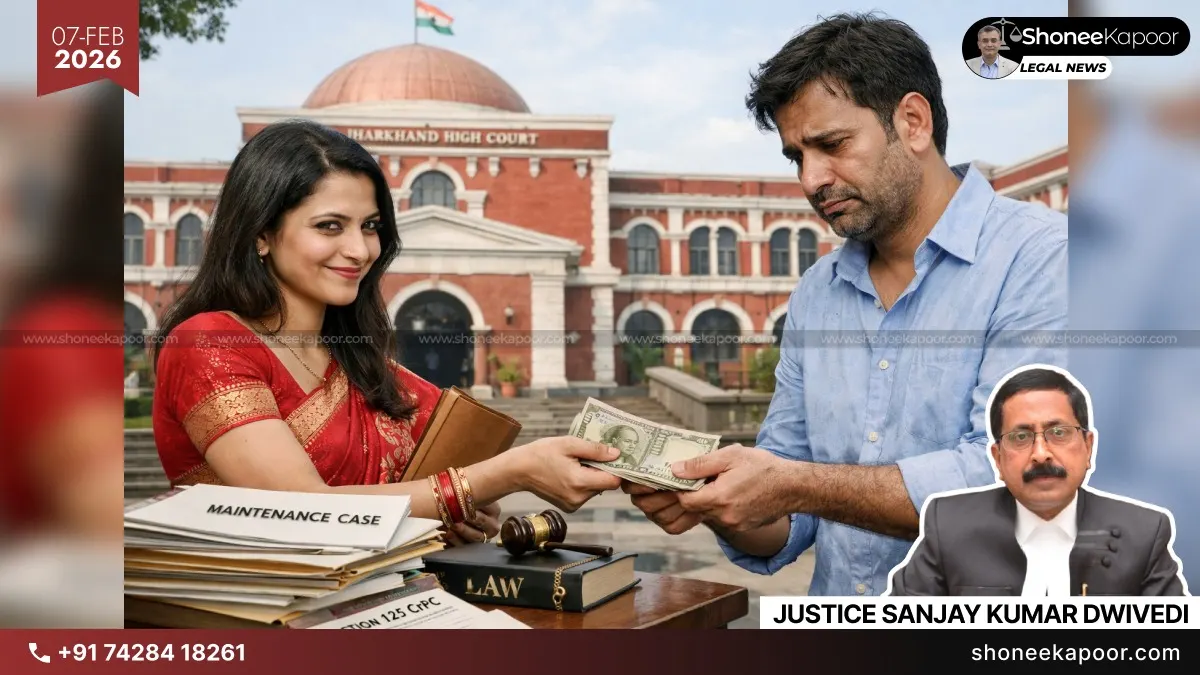
The Jharkhand High Court held that payment of alimony and grant of divorce do not automatically end a husband’s duty to pay maintenance under Section 125 CrPC. The Court reaffirmed that maintenance to the wife can continue despite one-time alimony, keeping the focus on preventing destitution rather than providing financial closure to the husband.
RANCHI: The Jharkhand High Court, through Justice Sanjay Kumar Dwivedi, delivered an important ruling on maintenance under Section 125 of the Criminal Procedure Code, clearly stating that a wife cannot be pushed into financial helplessness after separation.
The Court was hearing two revision petitions filed by both husband and wife against a Family Court order from Ranchi.
The case relates to a couple married in 1985. Over the years, their relationship broke down, and the wife left the matrimonial home. Claiming that she had no independent income and was struggling to sustain herself, she approached the Family Court under Section 125 CrPC seeking financial support. After prolonged proceedings, the Family Court at Ranchi awarded her ₹24,000 per month from the date of filing the application.
The wife challenged this order before the High Court, arguing that the amount was too low. She claimed that her husband was a medical professional earning several lakhs per month, running a clinic and nursing home, owning multiple vehicles in the past, and enjoying a comfortable lifestyle.
According to her, the Family Court relied too heavily on income tax returns and failed to consider his actual earning capacity and overall status.
The husband, however, presented a very different version. He stated that his income had declined sharply and that he was no longer earning what his wife alleged. He told the Court that he was dependent on his daughters and had already paid large sums over the years, including interim maintenance. He emphasised that his financial responsibilities had never ended and had continued uninterrupted.
A crucial development during the maintenance proceedings was the dissolution of the marriage. In a separate divorce case, the Family Court granted a divorce in favour of the husband and directed him to pay ₹20 lakh as permanent alimony.
The husband complied with this order and deposited the entire amount within the time fixed by the court. He informed the High Court that, taken together, nearly ₹30 lakh had already been paid by him towards maintenance and alimony.
Despite this, the wife did not withdraw the deposited alimony and continued to seek higher monthly maintenance. The husband argued that continuing monthly maintenance payments, even after such a substantial one-time payment, placed him in a financially vulnerable position, particularly given that his earning capacity was disputed and future liabilities remained.
After examining the record, Justice Sanjay Kumar Dwivedi noted that although the wife could not conclusively prove an extremely high income, the husband’s own admissions showed that he remained in the medical profession.
The Court observed that the Family Court had taken into account the liabilities on both sides, including the husband’s payment of the daughters’ education expenses and the elder daughter’s marriage expenses.
The Court made detailed observations on the purpose of Section 125 CrPC. It reiterated that maintenance proceedings are summary in nature and are meant to prevent vagrancy and destitution. The Court observed that sustenance does not mean forcing a woman to live “like an animal” or making her feel like “an unperson to be thrown away from grace”.
It further remarked that the law does not permit a situation where a wife is compelled to resign herself to misery and think of life as “dust unto dust”. The judgment stressed that a husband cannot take excuses or adopt technical defences to escape his legal obligation.
At the same time, the Court clearly recorded that the husband had already complied with the divorce decree by depositing ₹20 lakh as permanent alimony and that the wife was free to withdraw that amount.
The Court clarified that if the wife was dissatisfied with the permanent alimony, her remedy lay in challenging that order separately, rather than seeking modification of a properly reasoned maintenance order.
In the final analysis, the High Court found no illegality or perversity in the Family Court’s decision. It held that ₹24,000 per month was a balanced figure in the facts of the case and refused to either increase or cancel the maintenance. Both revision petitions were dismissed, and the maintenance order was allowed to continue, even as the husband’s financial vulnerability after paying heavy alimony remained evident on record.
The judgment underlines a deeper imbalance in Indian maintenance law, where husbands continue to face overlapping financial liabilities even after divorce. Monthly maintenance is allowed to run alongside long litigation timelines, while substantial one-time alimony, though ordered, often remains unutilised or unresolved.
This leaves many husbands carrying indefinite financial burdens with no clear closure, as courts consistently prioritise the statutory goal of preventing destitution without offering equal weight to finality, proportionality, or the husband’s right to financial certainty and post-marital stability.
Explanatory Table: Laws & Sections Involved
| Law & Section | Purpose | How Applied in This Case |
| Code of Criminal Procedure, 1973 – Section 125 | To provide quick monthly financial support to a wife, children, or parents so they do not fall into destitution or vagrancy | The wife filed a maintenance case under this section, and the court upheld ₹24,000 per month as necessary for dignified survival |
| Code of Criminal Procedure, 1973 – Nature of Section 125 Proceedings | To act as a summary and speedy remedy rather than a prolonged trial | The High Court criticised the eight-year delay in deciding the maintenance case, stating it defeated the object of the law |
| Family Courts Act, 1984 – Object and Spirit | To ensure family disputes are resolved sensitively, efficiently, and without unnecessary delay | The Court observed that the Family Court failed to act in line with the spirit of the Act by allowing prolonged proceedings |
| Hindu Marriage Act, 1955 – Permanent Alimony | To provide financial settlement after divorce through a one-time lump sum | The husband was directed to pay ₹20 lakh as permanent alimony, which was deposited in court but not withdrawn by the wife |
| Indian Evidence Act – Admissions in Cross-Examination | To treat statements made by a party during testimony as evidence against them | The husband’s admission that he was still engaged in medical practice weakened his claim of low or no income |
| Income Tax Act – Income Tax Returns | To assess actual income and earning capacity through financial disclosures | The Court relied on the husband’s income tax returns to conclude that his income had increased over time |
Case Details
- Case Title: Chetna Kumar vs Dr. Prasoon Kumar With Dr. Prasoon Kumar vs State of Jharkhand & Anr.
- Case Numbers: Criminal Revision No. 1036 of 2023 With Criminal Revision No. 570 of 2023
- Court: Jharkhand High Court
- Bench: Hon’ble Mr. Justice Sanjay Kumar Dwivedi
- Date of Judgment: 02 February 2026
- Neutral Citation: 2026:JHHC:2667
- Counsels:
- For Wife: Mr. Nikhil Ranjan, Advocate
- For Husband: Mrs. Vani Kumari, Advocate
- For the State: Mr. Achinto Sen, Advocate
Key Takeaways
- Monthly maintenance can continue even after divorce, creating parallel financial liability for husbands despite payment of permanent alimony.
- Courts focus on a man’s earning capacity, not declared income, making it difficult for husbands to reduce maintenance even after career decline or retirement.
- Long delays in Section 125 cases defeat fairness, yet the financial burden during these years is carried almost entirely by husbands.
- One-time alimony, even when deposited, does not automatically bring closure or adjustment against ongoing monthly maintenance.
- The law prioritises prevention of destitution but offers no clear endpoint or financial certainty for husbands, leaving them exposed to prolonged obligations.
This Could Change Your Case-Get FREE Legal Advice-Click Here!
Disclaimer: The views and opinions expressed in this article are those of the Indian courts and do not necessarily reflect the official policy or position of “ShoneeKapoor.com” or its affiliates. This article is intended for informational and educational purposes only. The content provided is not legal advice, and viewers should not act upon this information without seeking professional counsel. Viewer discretion is advised.
