
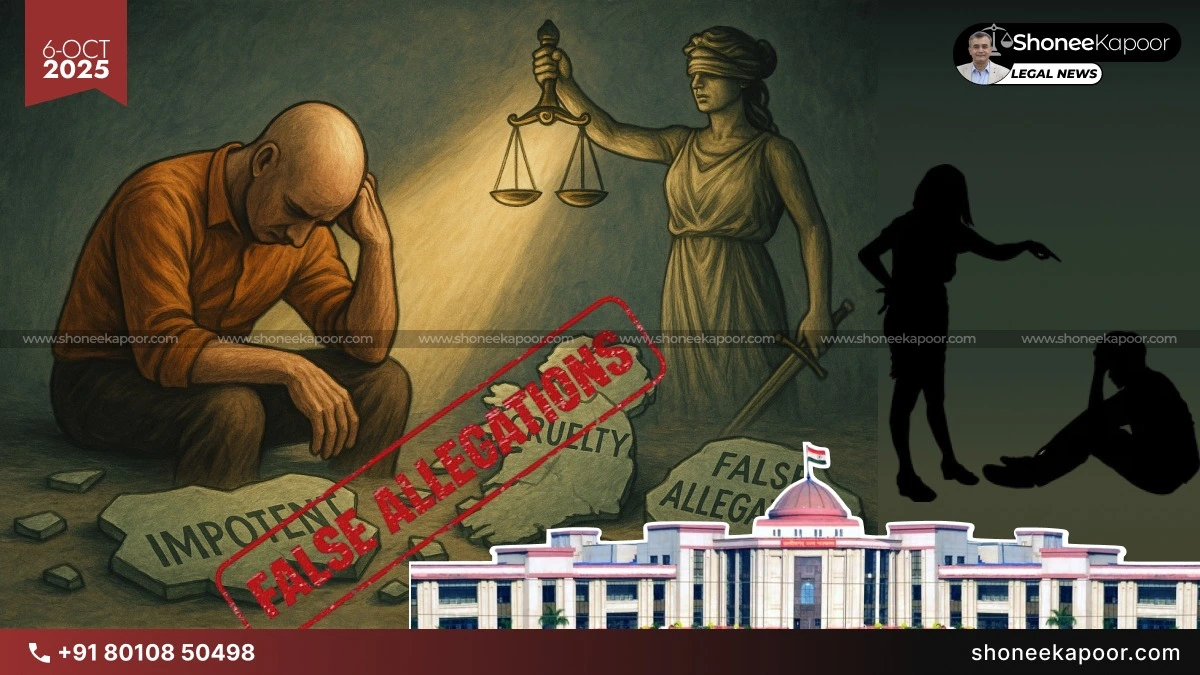
False Impotency Allegation Is Mental Cruelty: Chhattisgarh High Court Grants Husband Divorce After 8 Years of Separation

Written and analysed by Vaibhav Ojha
Head Of Legal CommunicationsIn a landmark ruling, the Chhattisgarh High Court held that a wife’s baseless claim of her husband’s impotency amounts to mental cruelty. The Court dissolved the marriage, declaring that false and humiliating accusations can destroy a man’s dignity and marital bond.
Chhattisgarh High Court Grants Husband Divorce: In a precedent-setting judgment that resonates with every man wrongly defamed under the guise of marriage, the High Court of Chhattisgarh at Bilaspur has declared that a false and baseless charge of impotency levelled against a husband is grave mental cruelty under Section 13(1)(ia) of the Hindu Marriage Act, 1955.
Delivering judgment in Govind Narayan v. Smt. Rakhi Choubey, a Division Bench of Justice Rajani Dubey and Justice Amitendra Kishore Prasad overturned the Family Court’s order and granted the husband a decree of divorce, emphasizing that reputation, dignity, and emotional peace of men cannot be trampled by unverified accusations.
The appellant, Govind Narayan, 41, resident of Janjgir-Champa, married Rakhi Choubey, 36, on June 2, 2013, in Balrampur District, Chhattisgarh. The couple had no children. After marriage, Govind was posted at Charcha Colliery, Baikunthpur, around 200 km away from his wife’s parental home. His wife allegedly pressured him to transfer or leave his job, frequently left the matrimonial home, and later filed a false molestation complaint, which she subsequently withdrew. She also accused him of an affair with a neighbour, causing social humiliation and psychological trauma.
In 2014, the husband filed a petition under Section 9 of the Hindu Marriage Act (Restitution of Conjugal Rights) on her assurance that she would return, but she never resumed cohabitation. In 2017, she stayed with him for only a week and since then, there has been no physical relationship or marital companionship.
Rakhi Choubey denied cruelty and accused in her Written Statement, her husband of being impotent, claiming that their marriage was never consummated. However, under cross-examination, she admitted: There was no medical evidence of impotency, She never informed anyone or sought medical verification and her claim was based purely on her own assumption. She also alleged harassment by the husband’s family but produced no supporting proof.
The Family Court dismissed Govind’s divorce petition on September 22, 2023, holding that he failed to prove cruelty or desertion. It accepted the wife’s professed willingness to stay with him, ignoring years of separation and unfounded character assaults. This pushed Govind to file an appeal before the High Court.
After a detailed review, the High Court found that:
- The wife’s false charge of impotency was completely unsubstantiated.
- Such allegations cause deep emotional pain, humiliation, and social stigma.
- The couple had lived apart since 2017, proving desertion.
- Allegations of an illicit affair with no evidence amounted to grave cruelty.
“An unfounded allegation of impotency can constitute a ground for divorce under the Hindu Marriage Act, specifically under the concept of cruelty. Making such allegations without supporting evidence can be considered mental cruelty, causing emotional distress, humiliation, and irreparable damage to reputation,” the Bench observed.
The Court emphasized that “cruelty need not be physical false, malicious accusations that destroy trust and reputation are equally serious”.
The bench observed, “As regards the wife’s allegation against the appellant-husband that he is impotent, such a baseless and unfounded claim amounts to cruelty. These accusations not only cause severe mental agony but also tarnish the appellant’s reputation and prestige among his friends, the public, and society at large.”
Explanatory Table of All Laws and Sections in This Case
| Law / Section | Provision / Meaning | Relevance in the Case |
| Section 13(1)(ia), Hindu Marriage Act, 1955 | Divorce on ground of cruelty. | Main provision invoked for relief. |
| Section 9, Hindu Marriage Act, 1955 | Restitution of conjugal rights. | Earlier attempt by husband for reconciliation. |
| V. Bhagat v. D. Bhagat (1994) | Supreme Court precedent defining mental cruelty. | Guided interpretation of cruelty. |
| Samar Ghosh v. Jaya Ghosh (2007) | SC case illustrating examples of mental cruelty. | Supported findings on long separation and false claims. |
| Devki Nandan Das v. Manorama Das (2022) | Chhattisgarh HC case on false impotency allegations. | Reinforced reasoning for divorce. |
Case Title: Govind Narayan v. Smt. Rakhi Choubey
Bench: Hon’ble Mr. Justice Vikram Nath and Hon’ble Mr. Justice Sandeep Mehta
Details
- Court: High Court of Chhattisgarh, Bilaspur
- Case Number: FA (MAT) No. 283 of 2023
- Originating Case: Civil Suit No. 133-A/2022, Family Court, Janjgir
- Date of Judgment: July 15, 2025
- Statutory References:
- Hindu Marriage Act, 1955 (Sections 9, 13(1)(ia))
- V. Bhagat v. D. Bhagat (1994)
- Samar Ghosh v. Jaya Ghosh (2007)
- Devki Nandan Das v. Manorama Das (2022)
- High Court Judgment:
- Reinforces that men’s dignity and emotional suffering are legally protected.
- Establishes that false sexual allegations = mental cruelty = valid ground for divorce.
- False and unproven sexual allegations cause mental agony and social humiliation, qualifying as cruelty under Section 13(1)(ia) of HMA.
Disclaimer: The views and opinions expressed in this article are those of the Indian courts and do not necessarily reflect the official policy or position of “ShoneeKapoor.com” or its affiliates. This article is intended for informational and educational purposes only. The content provided is not legal advice, and viewers should not act upon this information without seeking professional counsel. Viewer discretion is advised
Related Articles
Real Court Cases Where False Allegations Backfired On Wife
Real Indian court cases where false 498A, dowry, cruelty and defamatory allegations against husbands backfired, leadi...
Share Your Thoughts
Comments are moderated before publication.