
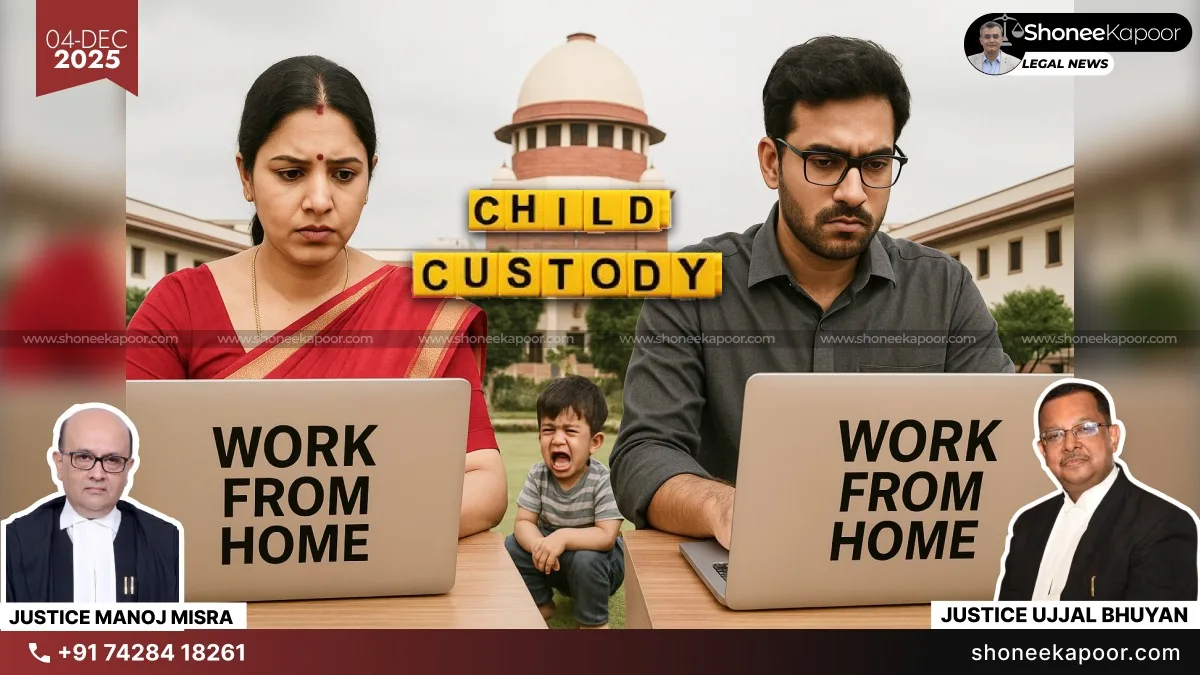
Work-From-Home Doesn’t Make You a Better Parent: Supreme Court Upholds Child Custody in Favour of the Father

Written and analysed by Shonee Kapoor
Legal Consultant, Author & Men's Rights ActivistThe Supreme Court has made it clear that simply working from home does not give any parent an automatic advantage in child custody battles. The Court said custody must depend on the child’s welfare, not on where a parent works.
NEW DELHI: The Supreme Court of India delivered an important ruling on child custody, clarifying that a parent cannot claim custody rights only because he or she works from home. The Court said a parent’s workplace—home or office—does not decide their ability to care for a child. What matters is the child’s welfare and emotional comfort, not the parent’s job location.
This decision came in the case Poonam Wadhwa vs Ajay Wadhwa, where the mother challenged a 2024 order of the Punjab & Haryana High Court that shifted the custody of their son Arjun from her to the father.
Before deciding the matter, the Supreme Court interacted with both parents and the children several times and even paused all related cases for three months to encourage settlement. But by November 2025, the parties informed the Court that no compromise was possible.
Supreme Court Makes Key Observations
While examining the High Court order, the Bench of Justice Manoj Misra and Justice Ujjal Bhuyan rejected the idea that remote working gives any parent a natural edge. The Court stated clearly:
“This cannot be a ground to place the custody of the child with the one who may be temporarily working from home because it is a matter of common knowledge that to meet individual as well as family aspirations married couples have to work to build a proper home and most importantly to secure better education for their ward which is getting costlier day by day.”
The Bench further added:
“We, therefore, do not subscribe to the view that if one parent is working from home and the other not (i.e., has to visit his office for work) then it has to be inferred that child’s interest would be better served if he is placed in the custody of one who does not go to office for work.”
The Court highlighted that both parents in this case are working, and therefore neither can be physically present all the time. So, using “work-from-home” as a reason for custody is not a sound or fair legal approach.
Distance From School Not a Deciding Factor
The Supreme Court also rejected the High Court’s reasoning regarding travel time between home and the child’s school. It held:
“Distance from home to school is not a relevant consideration particularly when both sides reside in National Capital Region and the child is required to travel some distance for better education. Moreover, it hardly matters whether travel time is few minutes less or more.”
Mother’s Travel Abroad During COVID Not Irresponsible
The High Court had earlier noted that the mother traveled abroad during peak COVID and called it “irresponsible”. The Supreme Court disagreed, saying such reasoning should not influence custody decisions. The Bench said that even if the travel was not job-related:
“Be that as it may, even vacations are important and necessary for a person to maintain a proper frame of mind.”
Thus, no negative inference could be drawn against the mother for that reason.
Child’s Preference Influenced the Final Decision
Even though the Supreme Court disagreed with certain observations of the High Court, it did not disturb the existing custody arrangement. This was mainly because:
- Arjun is now above 5 years old
- He studies in the same school as before
- He expressed a clear preference to stay with his father
- The father’s home has grandparents who support and care for the child
The Court noted that the boy was “not willing to part company of his father”, which weighed heavily in deciding the issue.
Thus, the Bench held that the High Court’s operative order should continue.
Visitation Rights Will Continue
The father had requested the Supreme Court to cancel the mother’s visitation rights. The Court rejected this request and decided that visitation must continue exactly as previously ordered:
- Every Saturday 12 noon to Sunday 6 PM
(as per the earlier order dated 3 May 2024)
The Court also made it clear that the mother is still free to pursue her custody claim under the relevant laws, as the High Court has not finally closed the issue.
Final Outcome
- Supreme Court dismissed the mother’s appeal.
- High Court order placing the child with the father remains in force.
- Mother’s visitation rights remain active.
- Custody issue still open for a final decision before the family court.
- Each party will bear their own costs.
Explanatory Table Of All Laws & Legal Principles Involved
| Law / Principle | Explanation | How It Was Applied in This Case |
| Guardians and Wards Act, 1890 (Implicit jurisdiction) | Provides the legal framework for deciding custody, guardianship, visitation, and welfare of minors. | High Court left it open for both parents to pursue custody before Family Court under relevant statutes. Supreme Court reaffirmed that the custody issue is still open for final determination. |
| Parens Patriae Doctrine | The Court acts as guardian of all minors and prioritises welfare over parental claims. | Supreme Court personally interacted with the children to assess emotional comfort and preference, not just legal technicalities. |
| Welfare of the Child Principle | The child’s welfare overrides all other considerations like property, income, job location, travel distance etc. | Court held that work-from-home status, job type, school distance, travel time, Covid travel cannot outweigh the child’s emotional comfort with the father. |
| Visitation Rights under Custody Jurisdiction | Non-custodial parent must be ensured meaningful contact unless harmful. | Court rejected father’s request to stop the mother’s visitation rights. |
| Supreme Court’s Extraordinary Jurisdiction under Article 136 & 142 (inherent powers) | SC can interfere with custody matters and issue directions to secure justice. | Court evaluated the High Court’s reasoning but chose not to disturb the operative custody arrangement because the child was settled and comfortable. |
| Mediation in Matrimonial Disputes | Courts prefer settlement in family matters to reduce litigation stress on children. | SC ordered mediation and stayed all other proceedings for 3 months to allow reconciliation, though it ultimately failed. |
Case Title: Poonam Wadhwa vs Ajay Wadhwa & Ors. Criminal Appeal No…/2025 (Arising out of SLP (Crl.) No. 12458/2024)
Bench: Justice Manoj Misra And Justice Ujjal Bhuyan
Appearances (Counsels)
- For the Petitioner (Mother)
- Ms. Preeti Singh, AOR
- Mr. Sunklan Porwal, Adv.
- For the Respondent (Father)
- Ms. Tina Garg, AOR
- Mr. Anuraj Jain, Adv.
- Mr. M.K. Ghosh, Adv.
- Ms. Preeti, Adv.
Key Dates & Case History
| Event | Details |
| High Court Order Challenged | Punjab & Haryana High Court order dated 1 July 2024 set aside earlier custody orders and shifted the child to the father. |
| Earlier Custody Order | Mother had custody of minor son by orders dated 30 July 2022 and 23 September 2022. |
| SC Interaction With Children | Court personally interacted with Arjun and Arushi on 21 August 2025. |
| SC Mediation Attempt | Mediation ordered on 25 Nov 2024, but failed. |
| Temporary Stay of All Cases | Supreme Court stayed all inter-se proceedings for 3 months. |
| Final SC Order | Delivered on 25 November 2025, appeal dismissed. |
| Visitation Rights | Mother’s visitation (Saturday noon → Sunday 6 PM) continued as per 3 May 2024 order. |
Key Takeaways
- Supreme Court confirms that a father cannot be denied custody just because he goes to office while the mother works from home.
- Child custody must depend on the child’s welfare, not on job location or assumptions about who is the “better caregiver.”
- Court rejects the narrative that fathers are less capable simply because they are employed full-time.
- Minor travel distance, work schedules, or even a mother’s foreign trip cannot be used to label fathers as unsuitable.
- The child’s own comfort with the father, stability at home, and actual support system matter more than stereotypes about parenting roles.
This Could Change Your Case-Get FREE Legal Advice-Click Here!
Disclaimer: The views and opinions expressed in this article are those of the Indian courts and do not necessarily reflect the official policy or position of “ShoneeKapoor.com” or its affiliates. This article is intended for informational and educational purposes only. The content provided is not legal advice, and viewers should not act upon this information without seeking professional counsel. Viewer discretion is advised.
Related Articles

Child Custody Legal Guide: Can School Remove Father’s Name From Records?
Can a school remove a biological father’s name from child records after divorce or custody dispute? Read Indian law, ...

Child Custody Guide: At What Age Can a Child Choose Between Mother and Father in India?
Can a child decide whether to live with mother or father in India? Know the real law, child preference age, custody c...

What Legal Remedies Are Available For Men In India? 498A, Divorce, Maintenance, Custody & False Cases
Know the legal remedies available for men in India against false 498A, maintenance, domestic violence, custody battle...
Share Your Thoughts
Comments are moderated before publication.