
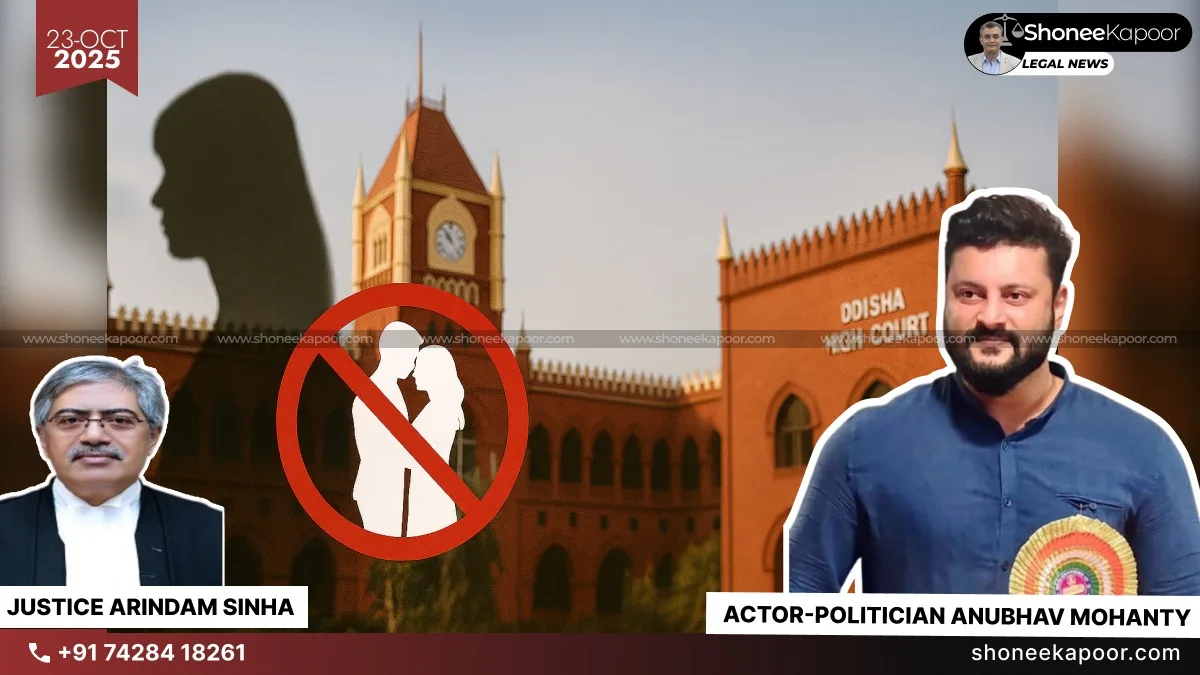
Wife’s Denial of Intimacy Is Mental Cruelty: Orissa High Court; Actor-Politician Anubhav Mohanty Wins Divorce Battle

Curated by NEWS DESK
Editorial DeskThe Orissa High Court has granted actor-politician Anubhav Mohanty a divorce holding that a wife’s unilateral refusal to consummate the marriage without any valid reason constitutes mental cruelty
CUTTACK: In Anubhav Mohanty v. Varsha Priyadarshini, the Orissa High Court dissolved the marriage of the famous couple, ruling that the wife’s repeated refusal of physical intimacy amounted to mental cruelty against the husband. This landmark decision strengthened the body of precedent regarding gender-neutral cruelty.
The Division Bench comprising Justice Arindam Sinha and Justice Sibo Sankar Mishra delivered its verdict on 21 December 2023, reversing the Family Court’s order that had dismissed both the husband’s divorce petition and the wife’s counterclaim for restitution of conjugal rights.
On February 8, 2014, actor-turned-politician Anubhav Mohanty married his fellow actor Varsha Priyadarshini. What started out as one of the most well-known celebrity unions in Odisha quickly turned into a drawn-out legal battle. Anubhav Mohanty claimed in his divorce petition before the Cuttack Family Court that his wife had repeatedly refused intimacy despite numerous attempts of reconciliation and that the marriage had never been consummated.
The High Court subsequently referred to this as a “contradiction on the face of the record” because the Family Court rejected both his plea for dissolution and the wife’s counterclaim for the restoration of conjugal rights. Aggrieved, Anubhav Mohanty appealed to the Orissa High Court, urging only the ground of mental cruelty arising from denial of physical relations, and relied on the Supreme Court’s ruling in Samar Ghosh v. Jaya Ghosh (2007) 4 SCC 511, para 101(xii); that unilateral refusal of sexual intercourse without valid reason amounts to mental cruelty.
The appeal, which was heard resulted in a ruling that would change the way Indian courts view emotional distress in men and marital neglect.
The Court observed:
The Court cited the wife’s cross-examination (11 April 2023) and noted that the wife herself admitted she had “never allowed” the husband physical relations — a statement that overrode all contrary claims.
“The answers leave no doubt that there was no physical intimacy between the parties.”
This finding of the court protected husbands who delay litigation out of faith in reconciliation the Court rejected the argument that he should have filed for annulment under Section 12 HMA within time.
“Appellant cannot be faulted for waiting in hope of consummation, causing expiry of the prescribed period for annulment.”
The bench reiterated Supreme Court’s Samar Ghosh v. Jaya Ghosh, (2007) 4 SCC 511 Principle of :
“Unilateral refusal of sexual intercourse for a considerable period without physical incapacity or valid reason amounts to mental cruelty.”
“Omission of respondent-wife to bring on record any physical incapacity or valid reason leads us to conclude that it was a unilateral decision on her part to deny her husband.”
When the wife argued that the husband had not pleaded “mental cruelty” the Court focused on vital procedural point relieving male litigants from hyper-technical pleading traps often used to dismiss their cases by stating that:
“Law need not be pleaded. Facts were pleaded; application of law is the Court’s task.”
The Bench also emphasized that dissatisfaction cannot imply consummation when the wife expressly admits withdrawal.
“The Family Court interpreted ‘unsatisfactory relations’ to mean there must have been some contact. This interpretation overlooked respondent’s clear admissions.”
The wife relied on Nirmal Singh Panesar v. Paramjit Kaur Panesar (2023 SC), where divorce was denied to an elderly husband. The Orissa HC clarified:
“That case turned on Article 142 equity. Here, cruelty under Section 13(1)(ia) stands proved.”
The appeal was allowed, the Family Court judgment reversed, and a decree of divorce directed to be drawn up immediately.
“Ground under clause (i-a) Section 13(1) is proved by appellant-husband. The marriage solemnized on 8 February 2014 is dissolved by decree of divorce.”
Legal Significance of the judgement
This ruling redefines what constitutes “mental cruelty” under Section 13(1)(ia) of the Hindu Marriage Act, making it much more than a celebrity hyped-up divorce case. The Orissa High Court has inserted long-overdue gender neutrality into the core of matrimonial law by ruling that a wife’s wilful and protracted denial of intimacy amounts to mental cruelty. For many years, women were the only ones who used the cruelty provisions; this ruling clearly shows that a husband’s psychological suffering, sexual deprivation, and emotional distress are all legally recognised injuries.

The Bench emphasised that compassion cannot be gender-selective and that marriage without companionship goes against the very spirit of partnership that the Hindu Marriage Act aims to establish, refusing to hide behind procedural formalities. It expanded its scope to shield men from silent suffering and upheld Samar Ghosh v. Jaya Ghosh, indicating that Indian family law is finally moving from protectionism to parity and from sympathy to justice.
Explanatory Table of Laws and Sections Referenced
| Law / Case | Section | Explanation / Relevance in this Case |
|---|---|---|
| Hindu Marriage Act, 1955 | Section 13(1)(ia) | Divorce on ground of cruelty; applied to husband’s suffering due to denial of intimacy. |
| Hindu Marriage Act, 1955 | Section 12 | Annulment for non-consummation; Court held delay does not defeat cruelty claim. |
| Family Courts Act, 1984 | Section 14 | Admissibility of informal evidence; WhatsApp messages considered but not decisive. |
| Indian Evidence Act, 1872 | Section 58 | Admissions as conclusive proof; wife’s admission pivotal. |
| Samar Ghosh v. Jaya Ghosh (2007) 4 SCC 511 | Para 101(xii) | Established that long-term denial of sex equals mental cruelty. |
| Janak Dulari Devi v. Kapildeo Rai (2011) 6 SCC 555 | _ | Cited by wife; rejected for lack of factual parity. |
| Nirmal Singh Panesar v. Paramjit Kaur Panesar (2023 SC) | _ | Distinguished; cruelty case not comparable to Art. 142 equitable relief. |
Case Summary
- Case Title: Nawang & Anr. v. Bahadur & Ors.
- Citation: MATA No. 353 of 2023
- Court: High Court of Orissa, Cuttack
- Jurisdiction: Matrimonial Appeal (Civil Jurisdiction)
- Date of Judgment: 21 December 2023
- Bench Composition: Justice Arindam Sinha and Justice Sibo Sankar Mishra
- Appellants’ Counsel: Mr. Lalitendu Mishra
- Respondents’ Counsel: Mrs. Sujata Jena
- Statutory Ground: Section 13(1)(ia), Hindu Marriage Act, 1955 – Mental Cruelty
- Main Issue: Whether refusal of marital intimacy constitutes mental cruelty warranting divorce?
- Judgment Outcome: Marriage dissolved; appeal allowed; decree directed.
- Result: Landmark recognition of husband’s emotional rights in marriage.
Why This Judgement Matters for Every Indian Husband?
Indian husbands have existed in legal silence for far too long; their rights are limited to financial responsibilities, their feelings are hidden, and their suffering is disregarded. That silence is broken by this judgement. The Orissa High Court has stated what millions of men have long believed but few have dared to say: it is cruelty, not empowerment, to deny a husband intimacy, affection, and companionship.
The court’s decision to grant Anubhav Mohanty a divorce on this basis not only ended one marriage but also changed the course of justice for men. It acknowledged that love denied is violence in silence, that emotional deprivation can leave a man just as scarred as physical abuse, and that gender equality entails compassion for all people, not just one.
This ruling serves as a mirror for India’s legal system, reminding all courts, attorneys, and citizens that men’s suffering should be treated with the same decency that the law has always accorded to women.
Disclaimer: The views and opinions expressed in this article are those of the Indian courts and do not necessarily reflect the official policy or position of “ShoneeKapoor.com” or its affiliates. This article is intended for informational and educational purposes only. The content provided is not legal advice, and viewers should not act upon this information without seeking professional counsel. Viewer discretion is advised.
Related Articles
Chef Kunal Kapur Divorce Case: Inside the Courtroom Battle, Allegations, and the Legal Victory That Redefined Matrimonial Cruelty
Celebrity chef Kunal Kapur fought a long and intense courtroom battle to prove mental cruelty.The Delhi High Court’s ...
The Law That Forgot Its Sons: How India’s Gender Laws Turn Protection into Persecution
India’s gender laws were designed to protect women — but today, countless innocent men are being destroyed by false c...
Share Your Thoughts
Comments are moderated before publication.