
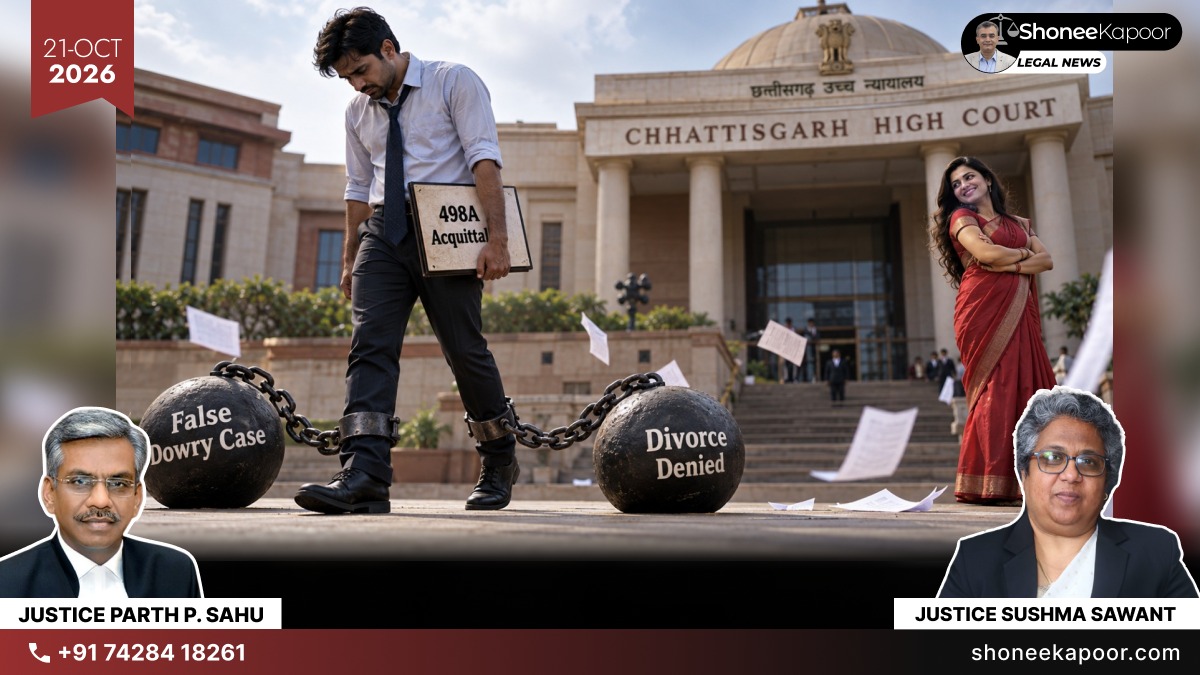
498A Acquittal Does Not Prove Wife Filed False Dowry Case: Chhattisgarh High Court Denies Husband Divorce

Written and analysed by Vaibhav Ojha
Head Of Legal CommunicationsBILASPUR: The Chhattisgarh High Court has ruled that a husband's acquittal in a criminal case under Section 498A IPC does not automatically prove that his wife's dowry harassment allegations were false. The Court clarified that mental cruelty must be established through evidence presented in matrimonial proceedings, even when the husband has been acquitted of criminal charges.
A Division Bench of Justice Parth Prateem Sahu and Justice Sushma Sawant was hearing an appeal filed by a husband against the Family Court's decision rejecting his divorce petition.
The husband alleged that his wife had subjected him to mental and physical harassment by filing dowry harassment complaints against him and his family members. These complaints resulted in a criminal case under Sections 498A and 34 of the Indian Penal Code.
Read Also:- Section 498A Ipc Judgements
He argued that his acquittal in the criminal case demonstrated that the allegations against him were false. According to him, the criminal proceedings and the allegations made by his wife amounted to mental cruelty and justified granting him divorce.
However, the High Court found that the witnesses produced by the husband had no direct personal knowledge of the alleged incidents. Their statements were largely based on information received from others rather than incidents they had personally witnessed.
The Court also found insufficient evidence to prove that the wife had deserted her husband without reasonable cause or was living in adultery.
While examining whether the criminal case amounted to matrimonial cruelty, the High Court observed:
“Mere acquittal in a criminal proceeding under Section 498A of the IPC does not, by itself, establish that the allegations constituting cruelty were false. For determining whether cruelty has in fact been established, the evidence available in the matrimonial proceedings has to be examined as a whole,”
The ruling highlights an important legal distinction: an acquittal protects a husband from criminal conviction but does not automatically establish that the complaint against him was knowingly false or malicious. Such allegations must be independently proved through relevant evidence when seeking divorce on grounds of cruelty.
The Court also examined a separate criminal case under Section 307 IPC involving the husband.
In that case, the parties had reached a compromise, following which the wife did not support the prosecution case against her husband, resulting in his acquittal.
Read Also:- How To File 498A Or Section 85 BNS Quashing Petition Under Section 528 BNSS?
However, despite the understanding reached during the compromise, the husband subsequently refused to resume living with his wife.
The High Court considered this conduct significant and observed:
“…the appellant/plaintiff husband did not adhere to his promise i.e. terms of the compromise and started refusing to keep the wife with him. Such conduct of the appellant/plaintiff husband lends support to the wife's case and indicates that he was, in fact, unwilling to keep her with him and was subjecting her to cruelty,”
The Court concluded that the husband had failed to produce convincing evidence establishing cruelty, desertion or adultery by his wife.
Accordingly, the High Court upheld the Family Court's decision and dismissed the husband's appeal seeking divorce.
The judgment reinforces that criminal acquittal and matrimonial cruelty are separate legal questions. A husband seeking divorce on the ground of false criminal allegations must establish cruelty through the evidence and circumstances of the matrimonial case. Acquittal alone is not sufficient.
Read Alos:- Section 498A Ipc Articles
EXPLANATORY TABLE OF LAWS AND SECTIONS
| LAW / SECTION | EXPLANATION | RELEVANCE TO CASE |
|---|---|---|
| Section 498A IPC | Cruelty against a married woman by her husband or his relatives. | Wife's dowry harassment complaint resulted in criminal proceedings. Husband was acquitted. |
| Section 34 IPC | Common intention: joint criminal liability for acts committed in furtherance of a common intention. | Invoked alongside Section 498A against the husband and family members. |
| Section 307 IPC | Attempt to murder. | Separate criminal case against the husband, ending in acquittal after the wife did not support the prosecution following a compromise. |
| Matrimonial Cruelty | A legal ground for divorce where cruelty is established through evidence. | Husband relied on the criminal allegations and acquittal to claim mental cruelty. |
| Desertion | Abandonment of a spouse without reasonable cause, subject to statutory requirements. | Husband failed to establish desertion by his wife. |
| Adultery | Voluntary sexual relations with someone other than one's spouse; a civil ground for divorce under applicable matrimonial law. | Husband's allegation was not proved. |
CASE DETAILS
| PARTICULARS | DETAILS |
|---|---|
| Case Title | Lokesh Sinha v. Smt. Kusumlata Sinha & Anr. |
| Case Number | FAM No. 133 of 2015 |
| Neutral Citation | 2026:CGHC:42403-DB |
| CNR Number | CGHC010163802015 |
| Court | High Court of Chhattisgarh, Bilaspur |
| Judgment Date | 29 September 2026 |
| Bench | Justice Parth Prateem Sahu and Justice Sushma Sawant |
| Judgment Authored By | Justice Sushma Sawant |
| Appellant | Lokesh Sinha (Husband) |
| Respondents | Smt. Kusumlata Sinha (Wife) and Devashish Nayak |
| Original Proceedings | Civil Suit No. 114-A/2012, Family Court, Rajnandgaon |
| Family Court Decision | 2 July 2015 |
| Final Outcome | Husband's divorce appeal dismissed; Family Court judgment upheld |
COUNSELS
| REPRESENTING | ADVOCATE |
|---|---|
| Appellant / Husband | Mr. T.K. Jha, Senior Advocate, with Mr. Parth Kumar Jha, Advocate |
| Respondent No. 1 / Wife | Mr. Praveen K. Dhurandhar, Advocate |
| Respondent No. 2 | None present, despite service |
KEY TAKEAWAYS
- 498A Acquittal Not Enough: Husband's acquittal does not automatically prove his wife's allegations were false.
- Divorce Denied: Despite his acquittal, the husband failed to establish matrimonial cruelty.
- Burden of Proof Remains: Men must independently prove cruelty, even after successfully defending criminal charges.
- False Allegations Need Proof: Acquittal alone cannot establish that a wife deliberately filed a false case.
- Criminal Victory, Matrimonial Defeat: A husband can win his criminal case yet lose his divorce battle.
Share Your Thoughts
Comments are moderated before publication.