
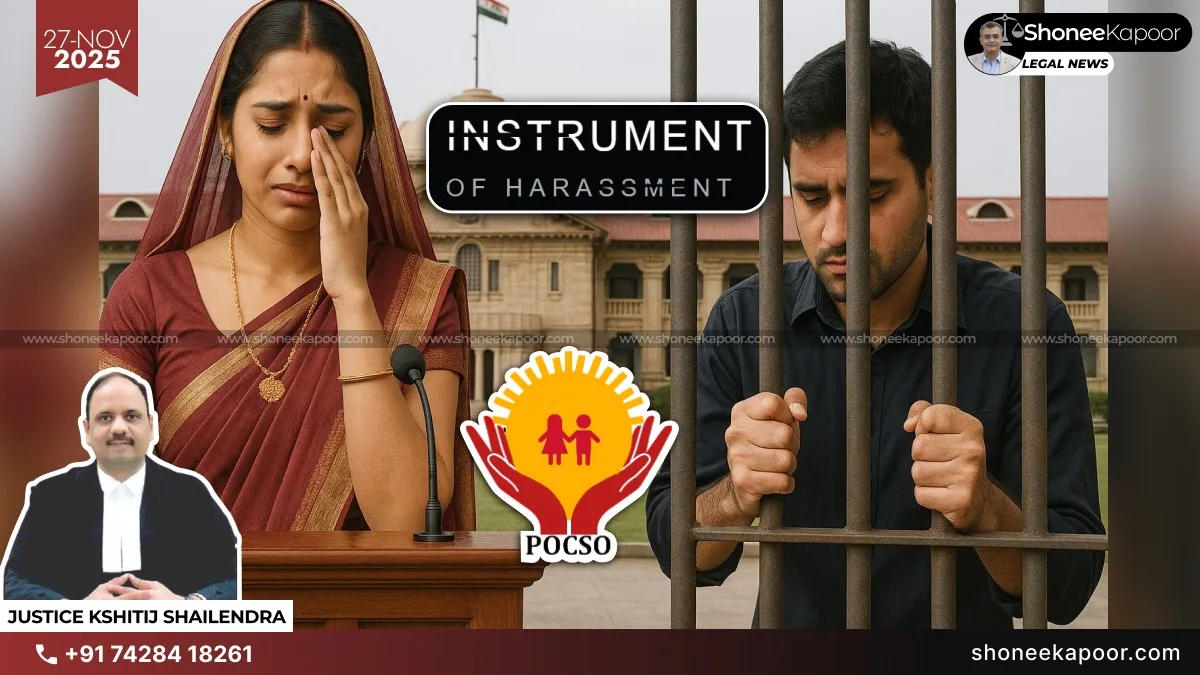
The Allahabad High Court has quashed kidnapping and POCSO charges against a Farrukhabad man after the alleged victim – now his wife – denied all allegations on oath. The Court said forcing a woman to repeatedly visit court to secure her husband’s acquittal would amount to harassment and defeat the ends of justice.
PRAYAGRAJ: The Allahabad High Court quashed the entire criminal case, including the charge sheet and cognizance order against Farrukhabad resident Ashwani Anand, who was accused of kidnapping and offences under the POCSO Act.
The Court held that continuing such a case would cause unnecessary harassment to the girl, who is now his legally wedded wife.
The judgment, delivered by Justice Kshitij Shailendra, said that compelling a woman to keep appearing in court for months or years only to help her husband get acquitted, especially when she has already denied all allegations on oath, would expose her to avoidable social stigma, financial burden, and indignity.
Quoting the court:
“Compelling a lady in such matters to visit court premises for months and years for the purposes of getting her own husband acquitted where he is facing threat of punishment for doing some wrong with his wife which she does not admit, would be an instrument of harass.”
What Led To The Case
The FIR was filed on 23 April 2024 by the girl’s father alleging that the applicant had kidnapped his daughter. Police investigated and filed a charge sheet on 30 September 2024. Cognizance was later taken on 8 April 2025 for offences under Sections 363, 366 IPC and Sections 11/12 of the POCSO Act.
However, the girl completely denied all allegations at every stage:
- In her Section 161 CrPC statement (16 August 2024), she said she had left home voluntarily, stayed at a girls’ PG in Ghaziabad, and had no physical relationship with the accused.
- In her Section 164 CrPC / Section 183 BNSS statement, she stated she was 20 years old, though her Aadhaar showed 17.
Her mother also told the police that she no longer wished to remain in any relationship with her daughter due to her intimacy with the applicant.
Later, the girl filed her own affidavit before the High Court, clearly supporting the quashing plea and stating the allegations were false.
Marriage Changed The Circumstances
The Court found it undisputed that:
- The couple married on 23 June 2025, after the girl attained the age of majority.
- The marriage was registered on 24 June 2025 under the UP Marriage Registration Rules, 2017.
- The marriage certificate was filed with the Court.
Since both were now living together as husband and wife, the applicant argued that continuing the prosecution served no purpose, especially when the so-called victim herself wanted the case closed.
State’s Objection: POCSO Is Non-Compoundable
The State strongly opposed quashing, arguing that:
- POCSO offences are serious and non-compoundable
- They are “offences against society”, not just against an individual
- Subsequent marriage cannot wipe out the offence
They relied on K. Kirubakaran v. State of Tamil Nadu (2025).
Why The High Court Rejected The State’s Argument
The Court clarified that the Kirubakaran case involved a conviction after trial, whereas in the present matter, the case was still at the pre-trial stage, with even the charges not framed yet.
It further noted that the Supreme Court itself had said the Kirubakaran judgment must not be treated as precedent, quoting:
“Needless to observe, this order is rendered in the unique circumstances that have unfolded before us and shall not be treated as precedent for any other case.”
The Court instead relied on Supreme Court judgments such as K. Dhandapani, Mafat Lal, Dasari Srikant, and Mahesh Mukund Patel, all of which recognized that continuing prosecution after the woman marries the accused and denies allegations on oath does not serve justice.
In Dasari Srikant, the Supreme Court held:
“The affirmation of the judgment … would have the disastrous consequence on the accused appellant being sent to jail which in turn could put his matrimonial relationship with the complainant in danger.”
Court’s Reasoning: Justice Over Procedure
Justice Shailendra emphasized that inherent powers under Section 528 BNSS must be used to ensure justice and prevent misuse of the judicial process. The Court reproduced the provision:
“Nothing in this Sanhita shall be deemed to limit or affect the inherent powers of the High Court … to prevent abuse of the process of any Court or otherwise to secure the ends of justice.”
He also stressed the role of constitutional courts:
“Judiciary … must become an active participant … ready to use law in the service of social justice through a proactive goal-oriented approach.”
Dragging the couple through a trial would be pointless
The Court noted that forcing the woman—who had already sworn that the allegations were false—to repeatedly attend trial only to be declared hostile would be:
“An irony of fate”
“A waste of precious judicial time”
It said it made no sense to force lower courts to acquit on the same facts when the High Court had the power to prevent such futile proceedings:
“As to why the High Court… cannot bury the lis by relying upon the similar statement of the alleged victim… is something which is not understandable.”
Final Decision
Taking into account:
- the marriage,
- the girl’s majority,
- her sworn denial of allegations, and
- her affidavit supporting the applicant,
the Court concluded this was a fit case to exercise inherent powers.
It held:
“Otherwise this Court would fail in its duty … to secure ends of justice.”
Outcome
The application was allowed, and the entire criminal proceedings were quashed.

Explanatory Table Of All Laws & Sections Used In This Case
| Law / Provision | Full Name / Meaning | How It Applies in This Case |
| Section 528 BNSS | Saving of Inherent Powers of High Court under Bharatiya Nagarik Suraksha Sanhita, 2023 | Applicant invoked this to quash the charge sheet, cognizance order, and full proceedings, arguing prosecution would be harass. Court used this section to close the case. |
| Section 482 CrPC (Old) | Inherent powers of High Court to prevent abuse of process | Court compared old CrPC 482 with new BNSS 528, explaining both allow High Court to stop misuse of law. |
| Section 161 CrPC | Police statement of victim/witness | Girl stated she left home voluntarily, had no physical relationship with accused. |
| Section 164 CrPC / Section 183 BNSS | Judicial Magistrate statement | Girl stated she was 20 years old and denied kidnapping/sexual allegations. |
| Section 363 IPC | Kidnapping | FIR accused applicant of kidnapping the girl. |
| Section 366 IPC | Abduction for marriage/illicit purpose | Police added this section alleging applicant intended to marry/compel her. |
| Sections 11/12 POCSO Act | Sexual harassment & punishment | Filed because Aadhaar showed her age as 17; later disproved by her statements & marriage at majority. |
| Article 142 Constitution | Supreme Court’s power to “do complete justice” | Court compared how SC used Article 142 in similar cases to quash proceedings after marriage. |
| UP Marriage Registration Rules, 2017 | Rules governing marriage registration in UP | Their marriage was registered under this rule on 24.06.2025. |
Case Summary
Case Title: Ashwani Anand vs. State of U.P. and 3 others
(Application U/s 528 BNSS No. 37031 of 2025)
Bench: Hon’ble Justice Kshitij Shailendra
Court: High Court of Judicature at Allahabad, Court No. 78
Petitioner / Applicantpetitioner / Applicant: Ashwani Anand
Respondents: State of U.P. and 3 Others
Counsel For Petitioner:
- Anjani Kumar Shukla
- Prakash Chand Srivastava
Counsel For Respondent / State:
- Learned A.G.A. (Government Advocate)
Date Of Order:
21 November 2025
| UP Marriage Registration Rules, 2017 | Rules governing marriage registration in UP | Their marriage was registered under this rule on 24.06.2025. |
Key Facts Of The Case
FIR Details
- Date of FIR: 23.04.2024
- Allegation: Applicant abducted the girl.
- Police Station: Rajepur, District Farrukhabad
Charge Sheet:
- Submitted: 30.09.2024
Cognizance Order:
- Date: 08.04.2025
Alleged Offences:
- Sections 363, 366 IPC
- Sections 11/12 POCSO Act
Statement Timeline:
- Section 161 CrPC (16.08.2024): Girl denies abduction; says she lived in PG in Ghaziabad.
- Section 164 CrPC / 183 BNSS: Says she is 20 years old, not 17.
Marriage Details:
- Marriage solemnized: 23.06.2025
- Marriage registered: 24.06.2025
- Rule: UP Marriage Registration Rules, 2017
Girl’s Affidavit: Supports quashing; denies FIR allegations.
Key Takeaways
- Allahabad High Court finally recognised that forcing a wife to appear against her own husband for false charges is nothing but harass.
- The girl consistently denied kidnapping and POCSO allegations, yet the system pushed the man into a criminal case until the High Court intervened.
- The Court admitted that prolonged trials in such cases waste judicial time and damage the dignity of both husband and wife.
- The judgment highlights how non-compoundable laws like POCSO are often misused in family and relationship matters, trapping men in serious criminal charges.
- High Courts can and must use inherent powers to stop such abuse of process instead of forcing men to suffer years of trial despite clear evidence of innocence.
This Could Change Your Case-Get FREE Legal Advice-Click Here!
Disclaimer: The views and opinions expressed in this article are those of the Indian courts and do not necessarily reflect the official policy or position of “ShoneeKapoor.com” or its affiliates. This article is intended for informational and educational purposes only. The content provided is not legal advice, and viewers should not act upon this information without seeking professional counsel. Viewer discretion is advised.
