
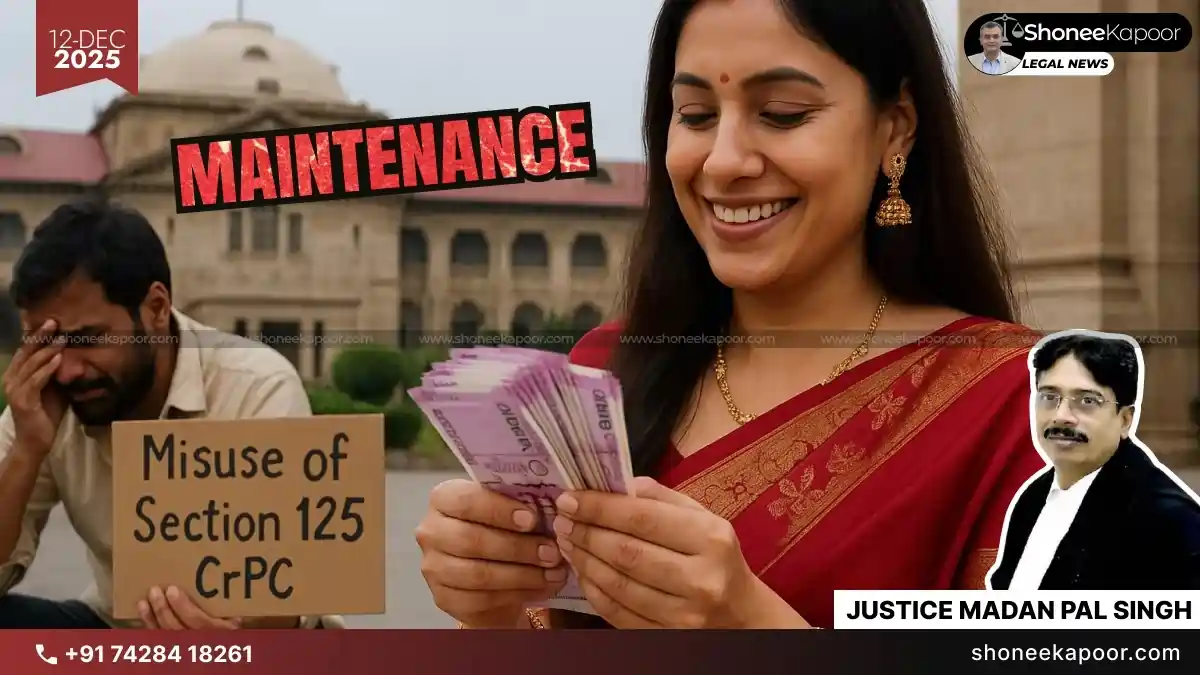
The Allahabad High Court ruled that a wife who is earning a sufficient monthly salary cannot entitled to maintenance under Section 125 CrPC. The Court also criticised the wife for hiding her employment details and approaching the court without clean hands.
PRAYAGRAJ: The Allahabad High Court clearly held that a Working Wife who is earning well and can maintain herself is not entitled to maintenance from her husband under Section 125 of the CrPC. The Court passed this order while hearing a criminal revision filed by the husband challenging the Family Court’s direction asking him to pay ₹5,000 per month to his wife.
Justice Madan Pal Singh examined the record and noted that the Family Court had ordered maintenance only to “balance the income” of the husband and wife, even though the wife herself was earning ₹36,000 per month. The High Court found this approach incorrect.
The husband argued that the wife had not been honest in her application. She initially claimed that she was unemployed and had no income, but the evidence showed that she was a Postgraduate, a Web Designer by qualification, and working as a Senior Sales Coordinator in a private company. The High Court recorded the same fact, noting that she had shown “nil” liabilities in her affidavit.
The Court observed from the trial court record that the wife had admitted in her affidavit and cross-examination that she earned between ₹34,000 and ₹36,000 monthly. The Court then held that for a wife who has no major financial responsibilities, such income is not small or insufficient. Meanwhile, the husband had the responsibility of taking care of his aged parents and fulfilling other social duties.
The Court stated:
“Thus, this Court is of the view that as per the provision of Section 125(1)(a), the opposite party no. 2 is not entitled to get any maintenance from her husband/revisionist as she is an earning lady and able to maintain herself.”
The High Court also took serious note of the fact that the wife had hidden important facts about her job and education from the Family Court. In her earlier application, she called herself “illiterate and unemployed”, but during cross-examination she accepted her income and employment when shown the documents.
The Court criticised this behaviour and reproduced the settled legal principle:
“It is settled law that when a person approaches a Court, he should approach the Court not only with clean hands but also with clean mind, clean heart and clean objective. It is a law of nature that one should not be enriched by the loss or injury to another.
Read Also: Scared of Marriage After Seeing Divorce? 25 Things Every Man Must Check Before Saying YesThe judicial process should never become an instrument of appreciation or abuse or a means in the process of the Court to subvert justice.
No litigant has a right to unlimited drought on the Court time and public money in order to get his affairs settled in the manner he wishes.
Read Also: How To Appeal A Divorce Judgment: Grounds, Time Limit, Procedure And Legal Remedies In IndiaEasy, access to justice should not be misused as a licence to file misconceived and frivolous petitions. If a petitioner is guilty of suppression of very important fact his case cannot be considered on merits. Thus, a litigant is bound to make full and true disclosure of facts.”
The Court then referred to the Supreme Court judgment in Rekha Sharad Ushir vs. Saptashrungi Mahila Nagari Sahkari Patsansta Ltd. and quoted paragraph 11:
“11. It is settled law that a litigant who, while filing proceedings in the court, suppresses material facts or makes a false statement, cannot seek justice from the court. The facts suppressed must be material and relevant to the controversy, which may have a bearing on the decision making. Cases of those litigants who have no regard for the truth and those who indulge in suppressing material facts need to be thrown out of the court.”
Based on these findings, the High Court declared that the wife did not deserve any sympathy because she was earning enough to maintain herself and had also hidden important facts.
The judgment concluded that she “does not deserve any sympathy” and set aside the Family Court’s order directing the husband to pay maintenance.
Thus, the criminal revision filed by the husband was allowed, and the earlier maintenance order was cancelled.
Explanatory Table of All Laws and Sections Mentioned
| Law / Section | Explained in Simple Terms | How It Applied in This Case |
| Section 125 CrPC | Provides quick relief of maintenance to a wife, child, or parents who cannot maintain themselves. | The Court held that the wife is not eligible because she earns ₹36,000 monthly and admitted she can maintain herself. |
| Section 125(1)(a) CrPC | Maintenance to wife only if she is “unable to maintain herself.” | The Court quoted: “the opposite party no. 2 is not entitled to get any maintenance… as she is an earning lady and able to maintain herself.” |
| Principle of Clean Hands Doctrine (general legal principle) | A litigant must disclose all material facts honestly; if they hide facts, they lose the right to relief. | The wife claimed she was unemployed, but documents showed she was highly qualified and earning. Court held she did not come with clean hands. |
| Supreme Court Judgment: Rekha Sharad Ushir v. Saptashrungi Mahila Nagari Sahkari Patsansta Ltd., 2025 SCC OnLine SC 641 | Supreme Court emphasised that litigants who suppress material facts cannot claim justice. | Quoted by High Court: “Cases of those litigants who have no regard for the truth… need to be thrown out of the court.” This supported cancellation of maintenance. |
Case Summary
- Case Title: Ankit Saha vs. State of U.P. and Another (Criminal Revision No. 2487 of 2024)
- Court: High Court of Judicature at Allahabad Court No. 89
- Bench: Hon’ble Justice Madan Pal Singh (Sole Judge)
- Date of Judgment: 3 December 2025
Counsel for Revisionist (Husband)
- Shreesh Srivastava
- Sujan Singh
Counsel for Opposite Party / State
- G.A. (Government Advocate)
- Nandini Mishra
Case Number Before Family Court
- Case No. 683 of 2019 (Neha Sahu vs. Ankit Saha)
Impugned Order Challenged
- Family Court, Gautam Budh Nagar
- Order dated 17.02.2024 directing husband to pay ₹5,000 per month.
Key Factual Findings
- Wife claimed she was unemployed and illiterate.
- Evidence showed she is:
- Post-Graduate
- Web Designer by qualification
- Senior Sales Coordinator at Keiath Telecom Pvt. Ltd.
- Earning ₹36,000 per month
- Her affidavit showed no liabilities.
- Husband had financial responsibility of maintaining aged parents.
- Trial court wrongly granted maintenance just to “equalise” status.
Key Takeaways
- Allahabad High Court clearly held that a working wife earning ₹36,000 per month cannot claim maintenance under Section 125 CrPC.
- Court exposed how the wife hid her qualifications and income, proving misuse of the maintenance system.
- Judgment reinforces that Section 125 CrPC is not a tool to equalise lifestyles or financially burden husbands unnecessarily.
- Court reminded that litigants must come with “clean hands, clean mind, clean heart and clean objective,” which the wife failed to do.
- Decision is a strong reminder that men should not be forced to pay maintenance to financially independent spouses, especially when they have their own family responsibilities.
This Could Change Your Case-Get FREE Legal Advice-Click Here!
Disclaimer: The views and opinions expressed in this article are those of the Indian courts and do not necessarily reflect the official policy or position of “ShoneeKapoor.com” or its affiliates. This article is intended for informational and educational purposes only. The content provided is not legal advice, and viewers should not act upon this information without seeking professional counsel. Viewer discretion is advised.
