
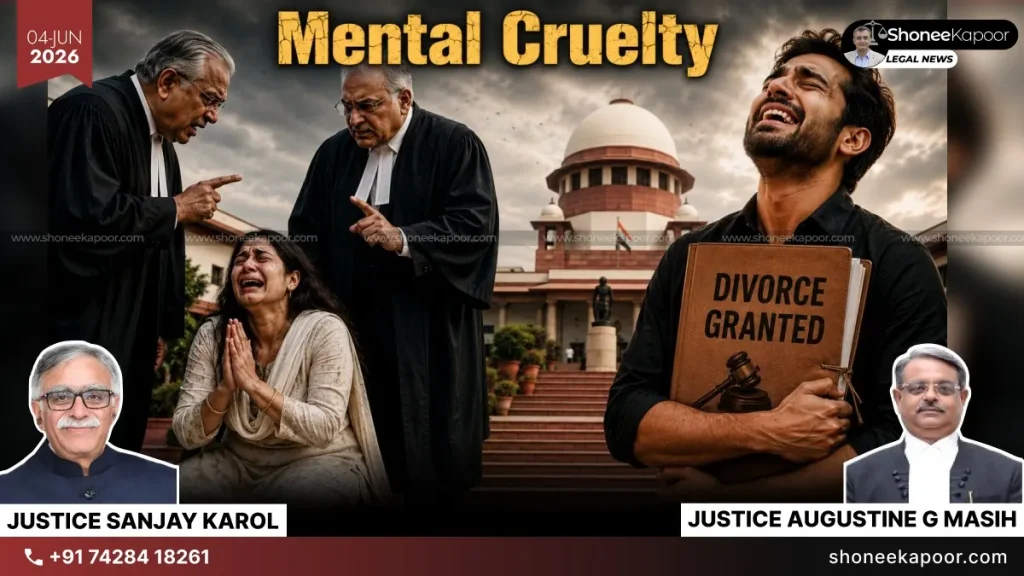
Stayed married on paper for 15 years but lived separate lives? Can a court force spouses to continue a relationship that has already ended in reality? The Supreme Court has ruled that prolonged separation, emotional alienation, and complete absence of marital life can amount to mental cruelty and justify divorce.
NEW DELHI: The Supreme Court has upheld a divorce granted to a husband whose wife had been living separately from him for around 15 years, holding that a marriage which has completely broken down in reality should not be forced to survive merely on paper. The judgment was delivered by a Bench of Justice Sanjay Karol and Justice Augustine George Masih.
The husband had filed a divorce petition under Section 13(1)(ia) of the Hindu Marriage Act in 2009 alleging cruelty. While the Family Court dismissed his plea, the Rajasthan High Court later granted divorce.
The wife challenged that decision before the Supreme Court. The Court noted that both parties were doctors, had no children from the marriage, and had been living separately for more than 15 years. Even mediation ordered by the Supreme Court failed to bring about any reconciliation. Throughout the proceedings, the wife continued to oppose divorce and expressed her desire to continue the marriage.
While discussing long-term separation, the Court made an important observation:
“In such circumstances, desertion ceases to be merely a matter of individual malice or unilateral fault rather it assumes the character of a shared, de facto abandonment of the matrimonial covenant. The parties have objectively deserted the matrimonial framework itself. The intentional maintenance of distinct lifestyles, separate domiciles, and the total cessation of marital interaction over fifteen years establishes a de facto abandonment of the marital covenant by both sides.”
The Bench clarified that matrimonial disputes cannot always be decided only on technical legal pleadings. Courts are entitled to examine the overall conduct of the parties and the reality of their relationship.
The Court observed:
“An Appellate Court, while carefully ensuring that a party does not profit from their own manifest wrong or unilateral desertion, may legitimately treat a prolonged period of separation as an indicator of mental cruelty within the meaning of Section 13(1)(ia) of the HMA. The Appellate Court is not precluded from examining whether continuous separation over a substantial period, coupled with absence of any genuine effort at reconciliation, complete cessation of cohabitation and emotional alienation has resulted in mental cruelty. Subsequent events occurring during pendency of proceedings may legitimately be taken into consideration while undertaking such assessment.”
The Court emphasized that marriage is not merely a legal contract but a relationship built on mutual respect, companionship, responsibility, and emotional support. It observed that conjugal rights cannot exist without corresponding marital duties. Persistent withdrawal from the fundamental aspects of marriage can have legal consequences while determining mental cruelty.
An important aspect of the judgment was the Court’s finding regarding denial of conjugal relations. Referring to the evidence on record, the Court noted that during the brief period when the parties lived together, the wife allegedly slept in a separate room, locked the door from inside, and the husband was compelled to sleep elsewhere. The wife did not deny that they slept in separate rooms.
Reaffirming settled law, the Court stated:
“As held in the case of Samar Ghosh (supra) and other catena of judgments by this Court, denial of conjugal rights including persistent refusal of sexual intercourse without a reasonable cause constitutes mental cruelty and is a valid ground for divorce under Section 13(1)(ia) of the HMA. The courts in India have repeatedly established that withholding sexual intimacy inflicts severe emotional distress and undermines the bedrock of marriage. Therefore, the conclusion of the High Court is sustained. The decree of divorce as granted by allowing the appeal of the Respondent-husband is upheld.”
The Court further observed that once spouses have lived apart for many years and there is no real effort to rebuild the relationship, forcing them to resume cohabitation may itself amount to cruelty.
On this aspect, the Court observed:
“This we say in the light of the fact that human relations are dynamic and once the initial mandate under the statute stands satisfied, continuation thereof during the litigation would aggravate the said agony which could be confirmational in substantiating the basis and pleaded ground for divorce. The same can be taken into consideration for formation of an opinion to accept the prayer by the Appellate Court.”
The Bench also found that the marriage had irretrievably broken down. It reiterated that under Article 142 of the Constitution, the Supreme Court has the power to dissolve a marriage that has become completely unworkable and beyond repair.
Highlighting the reality of prolonged matrimonial disputes, the Court observed:
“Prolongation of a matrimonial relationship would further lead not only to escalation of frustration in a dead relationship, which has already decayed and is decomposing day by day creating foul sociological, psychological and mental hollowness in life resulting in denial of a free and independent environment to flourish which each human strives in body and soul.”
Holding that the relationship had become emotionally dead, beyond repair, and incapable of revival, the Supreme Court dismissed the wife’s appeal and dissolved the marriage.
KEY CITATIONS RELIED UPON BY THE SUPREME COURT
| CASE | CITATION |
| Samar Ghosh v. Jaya Ghosh | (2007) 4 SCC 511 |
| Darshan Gupta v. Radhika Gupta | (2013) 9 SCC 1 |
| Vishnu Dutt Sharma v. Manju Sharma | (2009) 6 SCC 379 |
| Naveen Kohli v. Neelu Kohli | (2006) 4 SCC 558 |
| Vikas Kanaujia v. Sarita | (2025) 3 SCC 748 |
| Shilpa Sailesh v. Varun Sreenivasan | (2023) 14 SCC 231 |
| R. Srinivas Kumar v. R. Shametha | (2019) 9 SCC 409 |
| Nayan Bhowmick v. Aparna Chakraborty | 2025 INSC 1436 |
EXPLANATORY TABLE – ALL LAWS & SECTIONS MENTIONED
| LAW / SECTION | PURPOSE | HOW IT WAS APPLIED IN THIS CASE |
| Section 13(1)(ia), Hindu Marriage Act, 1955 | Divorce on ground of cruelty | Husband sought divorce alleging mental cruelty. Supreme Court upheld divorce on this ground. |
| Section 13(1)(ib), Hindu Marriage Act, 1955 | Divorce on ground of desertion | Though not specifically pleaded, the Court examined prolonged separation and de facto abandonment of marriage. |
| Article 142(1), Constitution of India | Supreme Court’s power to do complete justice | Court exercised power to dissolve the marriage after finding irretrievable breakdown. |
| Conjugal Rights (Judicial Principle) | Mutual marital obligations including companionship and intimacy | Court held that denial of conjugal rights and persistent refusal of sexual relations without reasonable cause can amount to mental cruelty. |
| Mental Cruelty (Judicial Interpretation under Section 13(1)(ia)) | Emotional suffering sufficient to justify divorce | Long separation, emotional alienation, refusal of intimacy, and absence of reconciliation were treated as mental cruelty. |
| Irretrievable Breakdown of Marriage (Article 142 Jurisprudence) | Marriage becomes completely unworkable and beyond repair | Court held marriage had effectively ended after 15 years of separation and dissolved it under Article 142. |
CASE DETAILS
| PARTICULARS | DETAILS |
| Case Title | Sonal Talpada v. Veerbhan Singh |
| Court | Supreme Court of India |
| Bench | Justice Sanjay Karol and Justice Augustine George Masih |
| Date of Judgment | 02 June 2026 |
| Neutral Citation | 2026 INSC 620 |
| Case Number | Civil Appeal No. ___ of 2026 (Arising out of SLP (C) No. 10422 of 2025) |
| Appellant | Sonal Talpada (Wife) |
| Respondent | Veerbhan Singh (Husband) |
| Result | Wife’s appeal dismissed; divorce upheld and marriage dissolved |
KEY TAKEAWAYS
- Mental cruelty is not gender-specific. Men can also suffer emotional and psychological trauma inside a marriage.
- A spouse cannot indefinitely force the continuation of a marriage that has effectively ended years ago.
- Persistent denial of conjugal relations without reasonable cause remains a valid ground for divorce.
- Courts are increasingly recognizing that keeping a man trapped in a dead marriage for years serves neither justice nor the institution of marriage.
- This judgment acknowledges a harsh reality: when spouses live separate lives for years with no effort to reconcile, forcing them to remain married becomes cruelty in itself.
This Could Change Your Case-Get FREE Legal Advice-Click Here!
Disclaimer: The views and opinions expressed in this article are those of the Indian courts and do not necessarily reflect the official policy or position of “ShoneeKapoor.com” or its affiliates. This article is intended for informational and educational purposes only. The content provided is not legal advice, and viewers should not act upon this information without seeking professional counsel. Viewer discretion is advised.