
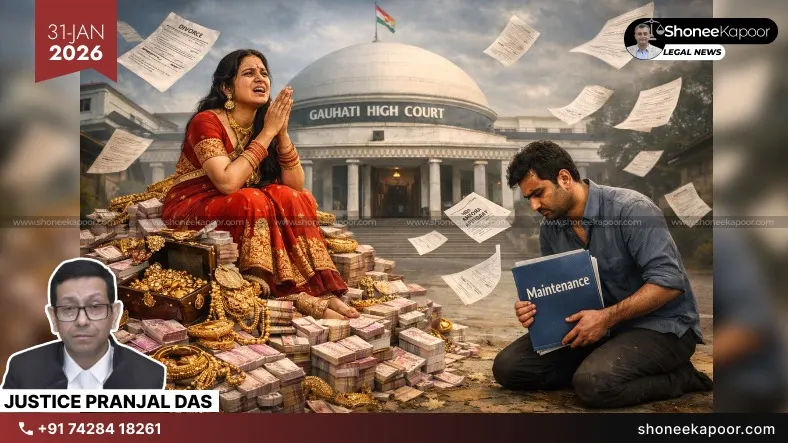
The Gauhati High Court ruled that a notarised affidavit is not a valid way to dissolve a marriage. Without legal proof of divorce, a man cannot be forced to pay maintenance as a husband.
Guwahati: The Gauhati High Court held that a marriage cannot be dissolved merely by signing an affidavit before a Notary. The Court made it clear that unless divorce is done strictly as per law, claims based on such informal documents cannot be accepted, especially when they are used to seek maintenance from a man.
The Court set aside a maintenance order passed by the Family Court, Barpeta, after finding that the woman’s earlier marriage was never shown to be legally dissolved. As a result, her claim of being the legally wedded wife of the petitioner could not stand.
Justice Pranjal Das, while deciding the criminal revision petition, clearly observed:
“Needless to say that a marriage cannot be dissolved by way of an affidavit made before the Notary. There is also no material to indicate that the respondent invoked the provisions of – Dissolution of Muslim Marriages Act, 1939 – for dissolving her marital tie with the said Manik Ali. Rather, she has mentioned about dissolving her marital tie with Manik Ali from her side and in support of the same, merely stated about submitting a copy of the affidavit, while retaining the original.”
The Court further noted:
“Thus, the earlier marriage of the respondent with Manik Ali is an admitted position. However, during the proceeding before the learned Court below, the respondent could not adduce sufficient evidence in support, to show that the said marriage with Manik Ali has been lawfully dissolved and that she is no longer his legally wedded wife.”
The case arose after the Principal Judge, Family Court, Barpeta, directed the husband to pay Rs. 3,000 per month as maintenance under Section 125 CrPC. The woman had claimed that she married the petitioner under Islamic law, lived with him, and was later driven out after alleged torture and monetary demands. The man disputed the marriage itself and pointed out that her earlier marriage was still legally subsisting.
During evidence, the woman admitted in cross-examination that she had married one Manik Ali in 2000 and had three children from that marriage. She also stated that he did not divorce her, but that she had given divorce to him in 2017. Both sides referred to a photocopy of an affidavit claiming divorce, but the document was never properly exhibited before the Family Court.
Clarifying the legal position, the High Court held:
“Reference to the affidavit in her cross-examination and about submitting a copy of the affidavit in the maintenance proceeding – would not constitute sufficient proof of dissolution of her earlier marriage – so as to confer any status of wife of the present petitioner, even if it is accepted that she had married the present petitioner. In any case, as already stated, any such affidavit sworn by the respondent before Notary Public would not constitute legally acceptable dissolution of the marriage.”
The Court then concluded:
“Perhaps the learned Family Court erred in overlooking this aspect of the matter and in accepting the marital status of the respondent, as wife of the petitioner.”
On this basis, the High Court held that the woman could not claim maintenance as a legally wedded wife. The maintenance order was set aside and quashed, and the criminal revision petition was allowed.
This judgment quietly reinforces a crucial principle often ignored in practice: a man’s legal liability cannot be created merely on assertions or informal documents. Maintenance law is meant for genuine cases, not for situations where basic legal requirements like lawful divorce are missing.
Explanatory Table: Laws & Sections Involved
| Law / Section | What It Deals With | How It Was Applied in This Case |
| Section 125 CrPC | Maintenance to wife, children, and parents | The woman claimed maintenance as a wife, but the Court examined whether she legally qualified as one |
| Explanation (b) to Section 125(1) CrPC | Divorced woman included as “wife” if not remarried | Court held this applies only when divorce itself is lawful and provable |
| Dissolution of Muslim Marriages Act, 1939 | Legal procedure for dissolving a Muslim marriage | No material showed this Act was ever invoked, making the alleged divorce invalid |
| Section 125(4) CrPC | Bars maintenance in specific situations | Reinforces that entitlement depends on lawful marital status |
| Revisional Jurisdiction (Criminal Revision) | Power of High Court to correct legal errors | Used to set aside the Family Court’s maintenance order |
Case Details
- Case Title: Tufazzul Hussain vs Fulmala Khatun
- Case Number: Crl. Rev. P. No. 212 of 2025
- Court: Gauhati High Court (High Court of Assam, Nagaland, Mizoram and Arunachal Pradesh)
- Bench: Hon’ble Mr. Justice Pranjal Das
- Date of Judgment: 20 January 2026
- Neutral Citation: 2026:GAU-AS:617
- Originating Court & Order Challenged: Order dated 17.03.2025 passed by the Principal Judge, Family Court, Barpeta, in F.C. (Crl.) Case No. 356/2020
Counsels
- For the Petitioner (Husband): Mr. S. C. Biswas, Mr. N. Uddin Mollah, Mr. B. Kalita, Ms. S. Chanda, Mr. F. A. Hassan
- For the Respondent (Wife): Mr. A. Roshid, Ms. T. Begum
Key Takeaways
- Marriage and divorce are legal acts, not paperwork formalities; affidavits before a notary have zero legal value.
- A man cannot be made to pay maintenance unless the woman first proves a lawful and subsisting marriage.
- Courts will not presume divorce; the burden lies on the claimant to show legal dissolution of any earlier marriage.
- Family Courts cannot ignore gaps in marital status and mechanically grant maintenance orders.
- This judgment reinforces that maintenance law is not a tool to penalise men through incomplete or misleading claims.
This Could Change Your Case-Get FREE Legal Advice-Click Here!
Disclaimer: The views and opinions expressed in this article are those of the Indian courts and do not necessarily reflect the official policy or position of “ShoneeKapoor.com” or its affiliates. This article is intended for informational and educational purposes only. The content provided is not legal advice, and viewers should not act upon this information without seeking professional counsel. Viewer discretion is advised.
