
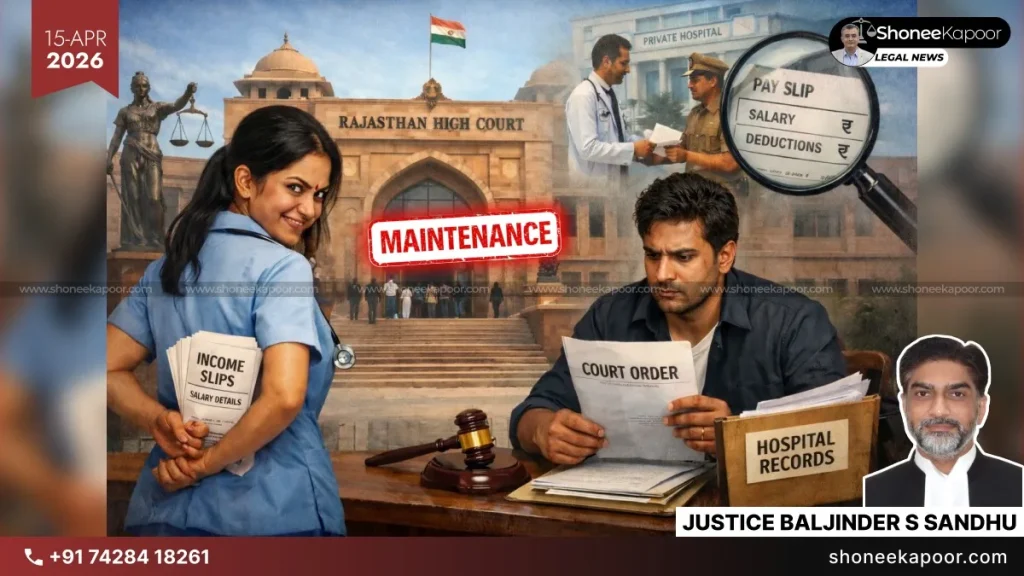
Can a wife hide her income and still expect the court to decide the maintenance case without verifying her true financial status?
The Rajasthan High Court held that both parties must disclose income, and under Section 94 BNSS, courts can summon employment records to prevent concealment and ensure a fair decision.
JODHPUR: The Rajasthan High Court at Jodhpur, in a recent judgment delivered by Justice Baljinder Singh Sandhu, has clarified an important legal position in maintenance cases, especially where there is a possibility that the wife has not disclosed her true income.
The case arose when a husband informed the court that his wife, who had filed for maintenance, was working as a nurse in a private hospital and earning around ₹80,000 per month. Despite this, she did not disclose her employment details before the trial court. When the husband tried to verify this information, the hospital refused to provide details due to privacy concerns, leaving him with no option but to seek help from the court.
However, the trial court rejected his request, stating that he had not submitted supporting documents. The husband challenged this decision, arguing that if he already had proof, there would be no need to file such an application.
The High Court examined the issue and clarified the legal position under Section 94 BNSS, stating that courts have the authority to direct production of documents if they are necessary for a fair decision. It emphasized that in maintenance matters, income details of both parties are crucial.
The Court made an important observation:
“The documents sought by the petitioner are relevant and have a direct bearing on the fair adjudication and are certainly necessary and desirable for the purpose of trial. The rejection of the application by the learned trial Court on the ground that the burden is upon the petitioner to file the documents is unsustainable. If the petitioner had access to such documents, there would have been no need to invoke Section 94 BNSS.”
The High Court further noted that the wife did not clearly deny her employment, which raised serious concerns about concealment of income. It also acknowledged that the husband had made genuine efforts to obtain the information, but was blocked due to the private nature of the employer.
Relying on established legal principles, the Court reiterated that both parties must make full and honest disclosure of their income in maintenance proceedings, as financial transparency is essential for justice.
In the end, the High Court set aside the trial court’s order and allowed the husband’s application. It directed the trial court to obtain complete employment and salary records of the wife from the hospital for proper adjudication of the case.
Explanatory Table: Laws & Provisions Involved
| Law / Provision | Purpose | How Applied in This Case |
| Section 94 BNSS | Empowers court to summon documents necessary for inquiry or trial | Husband invoked this to seek wife’s employment and salary records from private hospital |
| Section 91 CrPC (principle) | Earlier provision governing summoning of documents; forms interpretative basis of Section 94 BNSS | Court relied on its principles to assess necessity and stage of document production |
| Section 528 BNSS | Allows filing of criminal miscellaneous petitions before High Court | Husband approached High Court to challenge rejection of his application |
| Section 125 CrPC (Maintenance Law) | Provides right to claim maintenance based on financial capacity of parties | Underlying dispute involved maintenance, making wife’s actual income a crucial factor |
| Rajnesh v. Neha (2020) Supreme Court | Mandates full and frank disclosure of income, assets, and liabilities by both parties | Court emphasized that concealment of income violates this principle |
| Evidence Act, 1872 (General Principle – Burden of Proof) | Requires parties to prove facts they assert, but allows court assistance where evidence is inaccessible | Court held husband cannot be denied relief merely because documents are not in his possession |
| Right to Fair Trial (Constitutional Principle under Article 21) | Ensures fair procedure and equal opportunity to present case | Court recognized husband’s right to access relevant financial records for fair adjudication |
Case Details
- Case Title: Arvind Kumar vs. Smt. Namita
- Court: Rajasthan High Court, Jodhpur Bench
- Case Number: S.B. Criminal Misc. Petition No. 1527/2026
- Bench: Justice Baljinder Singh Sandhu
- Neutral Citation: 2026:RJ-JD:15612
- Date of Order: 06/04/2026
- Counsels:
- For Petitioner (Husband): Mr. Parvej Moyal
- For Respondent (Wife): Mr. Chirag Keshwal
Key Takeaways
- Courts cannot blindly grant maintenance without verifying the wife’s actual income; concealment must be tested.
- Husband has a clear legal right to seek wife’s salary and employment records through court when access is denied.
- Trial courts cannot reject such applications just because the husband does not already have documents.
- Full financial disclosure by both parties is mandatory; hiding income directly impacts fairness of maintenance orders.
- This judgment reinforces that maintenance law cannot become a one-sided burden and must operate on verified financial truth.
This Could Change Your Case-Get FREE Legal Advice-Click Here!
Disclaimer: The views and opinions expressed in this article are those of the Indian courts and do not necessarily reflect the official policy or position of “ShoneeKapoor.com” or its affiliates. This article is intended for informational and educational purposes only. The content provided is not legal advice, and viewers should not act upon this information without seeking professional counsel. Viewer discretion is advised.