
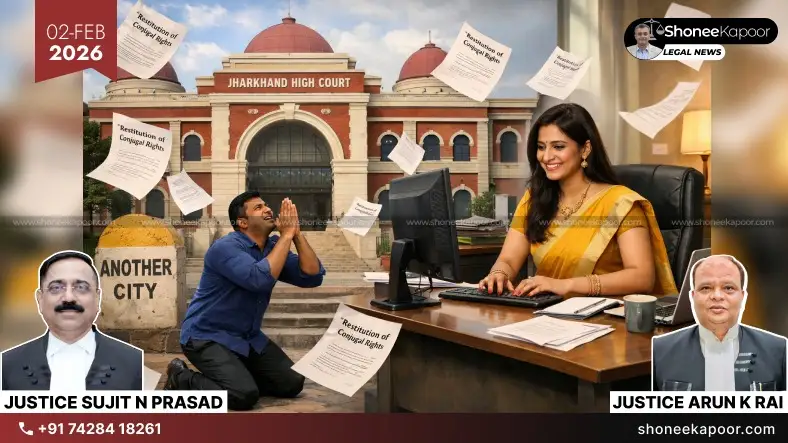
The Jharkhand High Court has ruled that a wife living separately to continue her job cannot be forced to return under restitution of conjugal rights. The Court said marriage today requires mutual adjustment, not one-sided sacrifice.
RANCHI: The Jharkhand High Court has made it clear that the old belief that a wife must always follow her husband and give up her career no longer fits today’s reality. The Court said that a married woman has the right to stand on her own feet financially, continue her job, and contribute to society, and this by itself cannot be treated as desertion.
A Division Bench of Justice Sujit Narayan Prasad and Justice Arun Kumar Rai gave this ruling while dismissing a husband’s appeal filed under Section 19 of the Family Courts Act. The husband had challenged the Family Court’s order which rejected his petition for restitution of conjugal rights under Section 9 of the Hindu Marriage Act, 1955.
The marriage between the parties took place on 12 March 2018 according to Hindu rites. At the time of marriage, the wife was working as a teacher, while the husband was working as medical staff on daily wages in a government hospital. After marriage, the couple lived together only for two to three days. Since both were working in different cities, they continued living separately for work reasons.
Over time, disputes arose between the husband and wife. The husband claimed that the wife left the matrimonial home without informing him, took her ornaments and belongings, pressured him to live as a “ghar jamai”, and even asked him to prepare divorce papers. On these allegations, he approached the Family Court seeking restitution of conjugal rights.
The wife, however, told the Court that she was willing to continue the marriage but did not want to leave her job. She alleged that her husband and his family demanded Rs. 10 lakhs to buy a Scorpio vehicle for a side business, and when she refused, the relationship worsened. Evidence also showed that the husband earned about Rs. 10,000 per month, while the wife earned around Rs. 60,000 per month as a government teacher.
While examining the case, the High Court explained that restitution of conjugal rights can be granted only when certain conditions are met. These include proof that one spouse has withdrawn from the society of the other without any reasonable excuse, that there is no legal bar to granting relief, and that the Court is satisfied about the truth of the allegations made.
Applying these principles, the Court found that the main reason for the couple living apart was their employment in different cities. The Court recognised that modern marriages often involve two working spouses and such situations require balance and adjustment from both sides.
The High Court observed that the traditional thinking about a wife’s role has changed significantly with education, equality under the Constitution, and social progress. In this context, the Court made a detailed observation:
“It is true that the orthodox concept of the Hindu wife is that she is expected to be Dharmpatni, Ardhangini, Bharya or Anugamini. The literal meaning is that she has to follow the husband and be in his company always as a part of his own body. This orthodox concept of wife and expectations from her to subject herself to husband’s wishes has undergone a revolutionary change with education and high literacy in women and with recognition of equal rights to women in the constitution and abolition of sex distinction in all walks of life. She is a partner in marriage with equal status and equal rights with the husband”.
The Court further explained that marriage does not give one spouse a superior right over the other. While living together is an important part of married life, the nature of that living must consider the realities of both partners’ employment and careers.
The Bench directly addressed a crucial question that often arises in such disputes:
“Whether a husband has an absolute right to insist that the wife should leave her service and live with him as his dependent only to discharge her marital obligations towards him…?”
Answering this, the Court clearly said no, and added:
“Such problems between the modern couples are on increase naturally because there are large number of married partners who are educated and have a career of their own in service or profession and they want to continue with them during the whole period of their married life.”
The High Court stressed that the correct legal test in restitution cases is “reasonableness”. The Court must see which party is being unreasonable in insisting on conditions that make joint living impossible. In this case, both the husband and wife were working in different cities, and neither could easily leave their job.
The Court held that the wife’s decision to continue her service while trying to adjust her married life could not be called unreasonable. It also noted the evidence regarding the demand for money and a vehicle, and found that the wife had not left the matrimonial home by choice but due to compelling circumstances.
Importantly, the Court clarified that restitution of conjugal rights does not mean that only the wife must adjust or sacrifice. It said that marriage is a shared responsibility, and both spouses must make genuine efforts to find a workable solution instead of forcing one-sided obedience.
Based on all these factors, the High Court concluded that the wife had valid and sufficient reasons to live separately. It agreed with the Family Court’s findings and refused to grant restitution of conjugal rights to the husband.
Accordingly, the appeal was dismissed.
Explanatory Table of Laws and Sections Mentioned in the Case
| Law / Statute | Section | Simple Explanation |
| Hindu Marriage Act, 1955 | Section 9 | This section deals with restitution of conjugal rights. It allows a husband or wife to approach the court if the other spouse has withdrawn from marital companionship without reasonable excuse. The court must first check if the reason for living separately is justified. |
| Family Courts Act, 1984 | Section 19(1) | This section provides the right to file an appeal before the High Court against judgments passed by the Family Court. The husband used this provision to challenge the Family Court’s decision. |
| Indian Penal Code, 1860 | Section 498A | This section relates to cruelty by husband or his relatives against a married woman. In this case, it was mentioned during evidence to explain background disputes, though the present case was not directly about conviction under this section. |
| Constitution of India | Articles on Equality (implicit reference) | The Court referred to constitutional values like equality and abolition of sex-based discrimination to explain why a wife cannot be treated as subordinate to the husband in marriage. |
| Hindu Marriage Act, 1955 | Explanation to Section 9 | This places the burden on the person who has withdrawn from marital society to prove that there was a reasonable excuse for doing so. The wife successfully showed reasonable grounds in this case. |
Case Details
- Case Title: Jitendra Azad v. Meena Gupta
- Case Number: F.A. No. 274 of 2023
- Neutral Citation: 2026:JHHC:2356-DB
- Court: High Court of Jharkhand at Ranchi
- Bench (Coram): Hon’ble Mr. Justice Sujit Narayan Prasad & Hon’ble Mr. Justice Arun Kumar Rai
- Date of Judgment Reserved: 19/01/2026
- Date of Judgment Pronounced: 28/01/2026
- Counsel for Appellant (Husband): Mr. Pankaj Srivastava, Advocate
- Counsel for Respondent (Wife): Mr. Manoj Kumar Choubey, Advocate
- Originating Court: Court of Principal Judge, Family Court, Pakur
- Original Case Number: Original Suit No. 79 of 2022
Key Takeaways
- Section 9 HMA is not automatic relief for husbands – Courts will closely test “reasonableness”, not emotions or assumptions of male entitlement.
- Economic imbalance weakens the husband’s case – When a husband earns far less and seeks control instead of adjustment, courts see it as pressure, not partnership.
- Restitution is not a tool to force obedience – Law does not support compelling a spouse to quit employment or live on dictated terms.
- Allegations matter even without conviction – Mere background references to dowry or 498A-related issues can tilt judicial sympathy, a risk men must legally anticipate.
- Modern courts expect negotiation, not dominance – Husbands approaching courts without proof of genuine reconciliation efforts risk outright dismissal.
This Could Change Your Case-Get FREE Legal Advice-Click Here!
Disclaimer: The views and opinions expressed in this article are those of the Indian courts and do not necessarily reflect the official policy or position of “ShoneeKapoor.com” or its affiliates. This article is intended for informational and educational purposes only. The content provided is not legal advice, and viewers should not act upon this information without seeking professional counsel. Viewer discretion is advised.
