
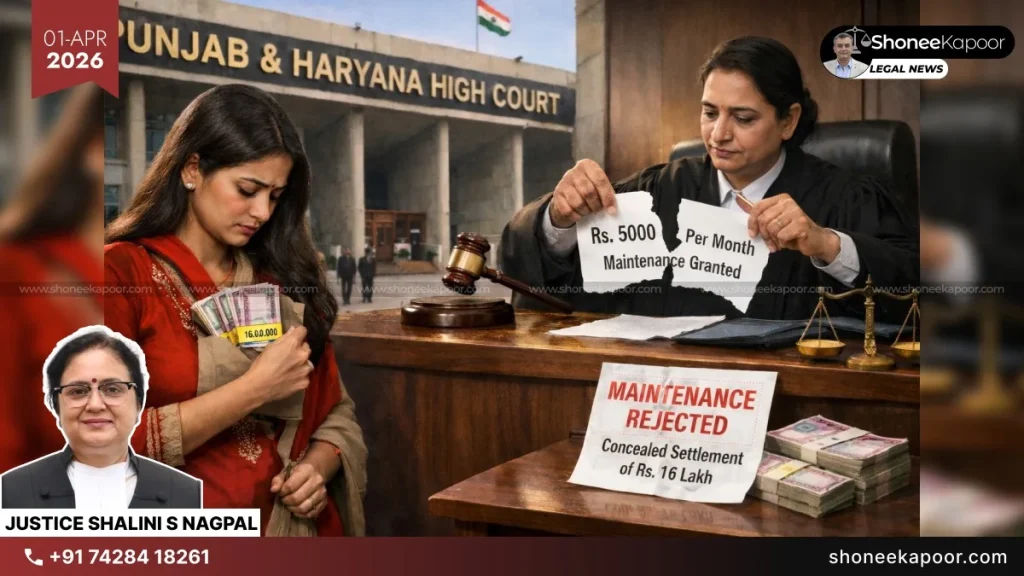
She took ₹16 lakh as full settlement—but never told the Court while demanding more. The Punjab & Haryana High Court stepped in—raising a critical question: how far can concealment go before justice is compromised?
CHANDIGARH: The Punjab & Haryana High Court, in a judgment by Justice Shalini Singh Nagpal, set aside a maintenance order after finding that the wife had concealed key facts from the court.
The dispute was about a maintenance claim where the wife had already received a lump sum amount earlier, but did not disclose it while asking for monthly maintenance.
The wife claimed she had no income and could not maintain herself, and the family court had granted her ₹5,000 per month along with litigation expenses. However, the husband challenged this order and showed that she had already received ₹16 lakh as a full and final settlement in an earlier case, meant for her and the child.
The High Court noted that this important fact was completely hidden by the wife. At the same time, the court clarified that even if a woman has taken a settlement earlier, she can still legally claim maintenance. It stated:
“There can be no quarrel with the well settled legal proposition that statutory rights conferred by Section 125 Cr.P.C. cannot be waived away by a mutual agreement.”
But the court made it clear that honesty is essential. Referring to Supreme Court law, it observed:
“If maintenance is awarded to the wife in a previously instituted proceeding, she is under a legal obligation to disclose the same in a subsequent proceeding for maintenance, which may be filed under another enactment. While deciding the quantum of maintenance in the subsequent proceeding, the civil court/family court shall take into account the maintenance awarded in any previously instituted proceeding, and determining the maintenance payable to the claimant.”
The court found that the wife not only hid the ₹16 lakh settlement in her petition but also failed to mention it during her evidence. This was treated as an attempt to mislead the court.
Reinforcing the principle of clean conduct, the court stated:
“A litigant, who approaches the Court of law seeking redressal of any grievance and claims relief, is obliged to disclose complete and true facts.”
It further added:
“A litigant who attempts to mislead the Court by furnishing false facts or by concealing material facts is not entitled to any relief.”
Citing Supreme Court precedent, the court also said:
“Suppression of material fact by a litigant disqualifies such litigant from obtaining any relief.”
Based on these findings, the High Court held that the earlier maintenance order was legally incorrect. The ₹5,000 per month maintenance was cancelled, and the wife’s petition was dismissed, making it clear that hiding facts can cost a litigant the entire case.
Explanatory Table: Laws And Provisions Involved
| Law / Provision | Provision | How Applied In This Case |
| Section 125 Cr.P.C. | Provides maintenance to wife, children, parents if they cannot maintain themselves | Court said this right is statutory and cannot be waived by agreement |
| Hindu Marriage Act (Section 13-B) | Divorce by mutual consent | Mentioned to establish that parties were already divorced |
| Guardians and Wards Act | Governs custody of children | Referred in background regarding child custody disputes |
| Principle of “Clean Hands” | A person must come to court with full honesty | Court used this to deny relief due to concealment |
| Public Policy Doctrine | Agreements against law/public interest are invalid | Used to say maintenance rights cannot be permanently waived |
| Supreme Court Precedents (Rajnesh v. Neha, etc.) | Require disclosure of previous maintenance | Court relied heavily on this to stress disclosure obligation |
Case Details
- Case Title: ABC Vs. XYZ
- Court: High Court of Punjab and Haryana at Chandigarh
- Case Numbers: CRR(F)-138 of 2014 (O&M) and CRR(F)-175 of 2014 (O&M)
- Bench: Hon’ble Ms. Justice Shalini Singh Nagpal
- Date Of Order: 30.03.2026
- Neutral Citation: 2026:PHHC:048808
- Counsels:
- For Petitioner: Mr. Nilesh Kumar Goyal, Advocate, and Mr. Amarjit Singh Virk, Advocate
- For Respondent: Mr. Sudhanshu Sharma, Advocate, and Mr. Himanshu Sharma, Advocate
Key Takeaways
- Even after taking a large settlement, fresh maintenance claims are still filed—men must document every payment and settlement properly.
- Men are often made to pay again and again, but this case shows courts will step in when the system is misused.
- Legal rights exist for protection, not for double recovery or unfair advantage.
- If men start challenging cases properly with evidence, misuse of maintenance laws can be exposed.
- Justice is not about gender, it is about honesty—whoever hides facts loses the case.
This Could Change Your Case-Get FREE Legal Advice-Click Here!
Disclaimer: The views and opinions expressed in this article are those of the Indian courts and do not necessarily reflect the official policy or position of “ShoneeKapoor.com” or its affiliates. This article is intended for informational and educational purposes only. The content provided is not legal advice, and viewers should not act upon this information without seeking professional counsel. Viewer discretion is advised.