
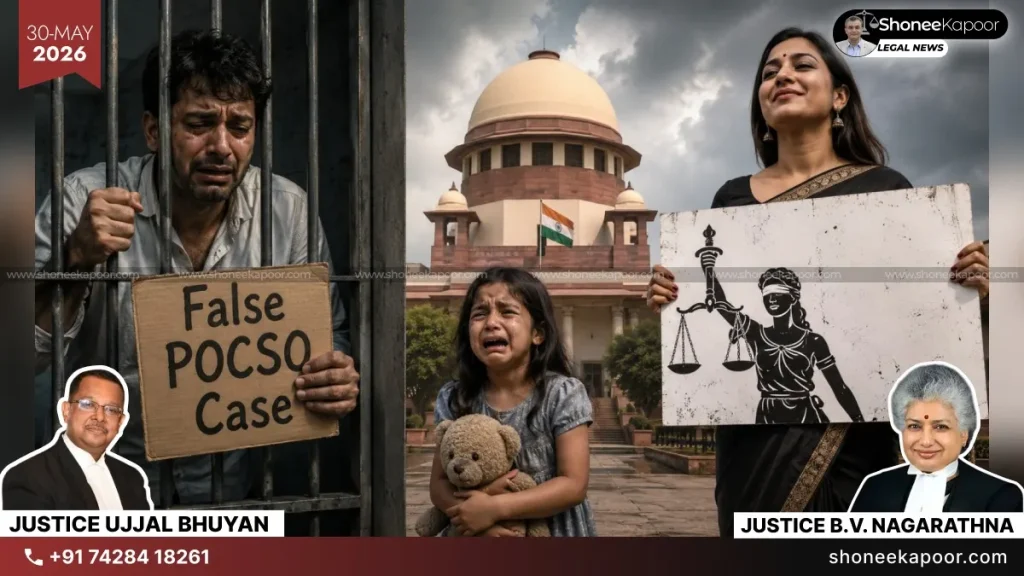
Can a child be used as a weapon in a matrimonial battle? The Supreme Court has raised serious concerns. Why did the Court quash multiple rape, POCSO and criminal cases against an entire family? Read what the judges found.
NEW DELHI: The Supreme Court has expressed serious concern over the increasing misuse of criminal laws, especially the Protection of Children from Sexual Offences (POCSO) Act, in matrimonial and personal disputes. The Court observed that false and frivolous cases not only cause immense hardship to innocent persons but also place an unnecessary burden on the justice delivery system.
A Bench of Justice B.V. Nagarathna and Justice Ujjal Bhuyan made these observations while quashing more than ten criminal cases filed against a husband and his family members. The allegations included offences under the POCSO Act and rape provisions of the Bharatiya Nyaya Sanhita (BNS). One of the complaints alleged that the husband and his brother had sexually assaulted the couple’s 14-year-old daughter, while other family members had physically assaulted her.
After examining the record, the Supreme Court found the allegations to be frivolous, concocted and vexatious. The Court noted that when matrimonial relationships become bitter, criminal law is often used as a tool of personal revenge, pressure and harassment.
The Bench observed that many matrimonial disputes follow a familiar pattern where allegations of dowry harassment, cruelty under Section 498A IPC, domestic violence and harassment by in-laws are levelled against multiple family members. The Court noted that many such complaints contain vague, sweeping and omnibus allegations without specific details or supporting evidence.
The Court stated that “A tell-tale sign” of vexatious litigation is the tendency to implicate several members of the spouse’s family, including elderly and sick relatives, through broad allegations that do not identify any specific role played by each accused person.
The Supreme Court also highlighted what it described as an emerging and deeply troubling trend involving false POCSO allegations in matrimonial disputes. According to the Court, there are instances where wives accuse their husbands, who are also fathers of minor daughters, of committing sexual offences against their own children in order to gain an advantage in ongoing matrimonial litigation.
Justice Nagarathna, writing the judgment, observed:
“In this regard, we would be remiss to not highlight the recent upswing in the false and frivolous matrimonial cases which have unfortunately brought to the fore the uglier side of litigation. A recent trend in this regard is when the wife resorts to filing false complaints and cases under POCSO Act alleging that the husband, who is also the father of the minor child, has committed wanton acts which are sexual in nature especially against the minor daughter. At the centre of this sort of litigation is a child who is often used by her mother against her father, against her will and wishes, so as to make false and vexatious complaints against her father and other male members of her paternal family in order to exact revenge or as an arm-twisting tactic to obtain a higher monetary settlement or to simply harass.”
The Court further noted that misuse of the POCSO Act is not limited to matrimonial disputes. It observed that false complaints are sometimes filed in family feuds, neighbourhood disputes, business rivalries and financial disagreements.
The Bench stated:
“There are also instances where in cases of enmity between the members of a family, between neighbours or business partners or associates, or even between borrowers and lenders of financial assistance, a weapon of harassment being resorted to is a complaint under the POCSO Act at the instance of a parent of a child (in most cases being the daughter) so as to wreak vengeance or to get over civil disputes between the parties by a subdued accused under the said Act yielding to the demands of the complainant. Also, the threat of a false complaint under the POCSO Act is used as a means to escape legal consequences arising out of a commercial transaction, a matrimonial dispute or such other disputes.”
At the same time, the Supreme Court made it clear that genuine cases of child sexual abuse must receive the highest degree of attention, sensitivity and judicial scrutiny. The Court emphasised that serious allegations supported by credible evidence must be thoroughly investigated and prosecuted.
However, the Bench warned that criminal trials cannot be permitted to continue merely on the basis of vague and general allegations without supporting material. Subjecting a person to prosecution without credible evidence would amount to an abuse of the legal process.
The Court also called upon lawyers to act responsibly and discourage litigants from filing false complaints solely to pressurise the opposite side into a settlement. It noted that such cases often result in anticipatory bail proceedings, quashing petitions and multiple rounds of litigation, causing severe emotional, financial and social hardship to those accused while consuming valuable judicial time.
Emphasising the responsibility of courts, the Bench observed that judges must carefully scrutinise allegations at the initial stage, especially when criminal proceedings arise out of matrimonial discord.
The Court noted:
“The Courts have to be extremely careful before taking cognizance of complaints made while invoking the provisions of rape, especially in cases where parties have already been heavily embroiled in matrimonial litigation, since the scope of manipulation, fabrication and vexatious litigation is exponentially high due to pre-existing bad blood between the parties who are often emotionally charged against one another and allegations of rape becomes an aid towards arm twisting tactics”
Setting aside the Allahabad High Court’s decision, the Supreme Court found that the allegations were vague, unsupported by medical evidence and formed part of a larger pattern of retaliatory litigation.
The Bench also noted that the statements of the complainant and the prosecutrix were almost identical.
The Court observed:
“There has been no alteration, addition or subtraction from either of the three statements making each of them virtually identical to one another. This is not a case of there being consistency in all the statements but a case of verbatim reproduction of statements almost parrot-like, as a result of tutoring by the complainant and possibly her family,”
The Supreme Court held that permitting prosecution to continue on the basis of such sweeping allegations would amount to abuse of the process of law and therefore quashed the complaint, cognizance order and summoning order against all accused family members.
At the same time, the Court clarified that its observations were limited to the facts of the present case and should not be interpreted as undermining genuine complaints of matrimonial cruelty or sexual abuse.
The Bench observed:
“We are conscious of the fact that there are many instances where women are gravely affected by matrimonial disputes and violence that they have to endure at the hands of the spouse and in-laws… Such cases deserve our utmost attention and judicial scrutiny.”
The appeal was accordingly allowed and all criminal proceedings against the husband and his family members were quashed.
Explanatory Table Of All Laws And Sections Involved
| LAW / SECTION | PURPOSE | RELEVANCE IN THIS CASE |
| Section 65 BNS | Punishment for rape of minor girls | Alleged against husband and brother-in-law |
| Section 74 BNS | Outraging modesty of a woman | Alleged sexual misconduct |
| Section 115 BNS | Voluntarily causing hurt | Alleged assault by female relatives |
| Section 351 BNS | Criminal intimidation | Alleged threats to prosecutrix |
| Section 352 BNS | Intentional insult provoking breach of peace | Alleged verbal abuse |
| Section 3 POCSO Act | Defines penetrative sexual assault | Core allegation against husband and brother-in-law |
| Section 4 POCSO Act | Punishment for penetrative sexual assault | Invoked with Section 3 POCSO |
| Section 498A IPC | Cruelty by husband or relatives | Earlier matrimonial litigation between parties |
| Sections 3 & 4 Dowry Prohibition Act | Dowry demand and acceptance offences | Part of earlier litigation |
| Protection of Women from Domestic Violence Act, 2005 (Sections 12,17,18,19,20,21,22) | Protection and remedies for domestic violence victims | Earlier proceedings filed by wife |
| Section 13(1) Hindu Marriage Act, 1955 | Divorce provision | Husband’s divorce petition |
| Section 307 IPC | Attempt to murder | Earlier cross litigation |
| Section 302 IPC | Murder | Earlier cross litigation |
| Section 528 BNSS | High Court quashing jurisdiction | Used before Allahabad High Court |
| Sections 223 & 225 BNSS | Recording statements before Court | Statements of complainant and prosecutrix examined by Court |
Case Details
| PARTICULARS | DETAILS |
| Case Title | Ishwar Chand Sharma & Others vs State of Uttar Pradesh & Another |
| Court | Supreme Court of India |
| Bench | Justice B.V. Nagarathna and Justice Ujjal Bhuyan |
| Judgment Date | 29 May 2026 |
| Case Number | Criminal Appeal No. ___ of 2026 (Arising out of SLP (Criminal) No.18035 of 2025) |
| Impugned Order | Allahabad High Court Order dated 15.09.2025 |
| Trial Court | Special Judge (POCSO Act)/Additional Sessions Judge, Meerut |
| Bench | Justice B.V. Nagarathna & Justice Ujjal Bhuyan |
| Neutral Citation | 2026 INSC 587 |
Key Takeaways
- The Supreme Court has openly acknowledged a growing trend of false and frivolous POCSO allegations being used in matrimonial disputes as a pressure tactic against husbands and their families.
- The Court warned that children should never be used as weapons in family disputes to settle scores, seek revenge, or extract higher settlements.
- Mere allegations, without specific facts, evidence, medical support, or credible material, cannot justify putting a person through a criminal trial.
- The judgment reinforces that vague and omnibus accusations against multiple family members are a classic sign of vexatious litigation and abuse of criminal law.
- The Court recognised the devastating impact false criminal allegations can have on a man’s reputation, mental health, family life, and social standing long before any verdict is delivered.
This Could Change Your Case-Get FREE Legal Advice-Click Here!
Disclaimer: The views and opinions expressed in this article are those of the Indian courts and do not necessarily reflect the official policy or position of “ShoneeKapoor.com” or its affiliates. This article is intended for informational and educational purposes only. The content provided is not legal advice, and viewers should not act upon this information without seeking professional counsel. Viewer discretion is advised.