
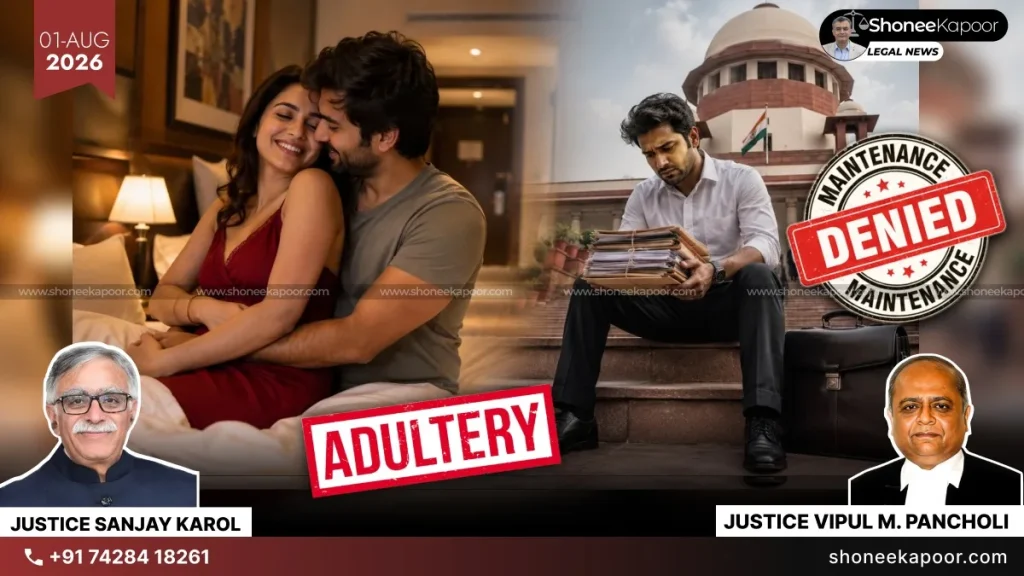
Can a wife continue receiving interim maintenance even when the husband places clear evidence of an adulterous relationship before the court? The Supreme Court has explained when such maintenance can be stopped—and why a husband’s evidence cannot simply be ignored until the final hearing.
NEW DELHI: The Supreme Court, on July 31, 2026, held that interim maintenance under Section 125 of the Code of Criminal Procedure may be denied to a wife when the husband is able to show clear and convincing evidence of her adulterous relationship at the initial stage itself.
The judgment was delivered by a Bench of Justice Sanjay Karol and Justice Vipul M. Pancholi. The Court was hearing an appeal filed by a husband whose application under Section 125(4) Cr.P.C. had been rejected without examining its merits.
The Supreme Court observed:
“…we are of the view that if a husband files an application under Section 125(4) and is, at the first instance, able to establish the charge through evidence ex facie, then only, there can be said to be a bar to interim maintenance.”
The husband and wife were married on July 7, 2014. According to the case record, disputes developed between them after a few years of marriage. The wife left the matrimonial home on May 13, 2020, along with their child and her valuables.
On November 5, 2020, she filed a petition under Section 125 Cr.P.C. and also sought interim maintenance before the court in Udaipur.
The husband filed a separate application under Section 125(4) Cr.P.C. He argued that the wife was not entitled to maintenance because she was allegedly living in an adulterous relationship.
To support his objection, the husband placed photographs, electronic material and other evidence before the Trial Court. His case was that this evidence was sufficient to require an immediate decision on the wife’s eligibility for interim maintenance.
However, the Trial Court dismissed his application. It held that the authenticity and originality of the photographs and electronic documents could be examined only after the evidence was formally exhibited during the main maintenance proceedings.
The Rajasthan High Court agreed with the Trial Court. It held that there was no specific provision requiring the allegation of adultery to be decided as a preliminary issue before considering interim maintenance.
The husband then approached the Supreme Court.
The Supreme Court examined the purpose of Section 125 Cr.P.C. and the legal restriction contained in Section 125(4). The Court noted that maintenance law is intended to prevent neglect and destitution. At the same time, the conditions and disqualifications expressly written in the law cannot be made meaningless.
Section 125(4) states that a wife is not entitled to maintenance or interim maintenance from her husband if she is living in adultery, refuses to live with him without sufficient reason, or if both parties are living separately by mutual consent.
The Supreme Court clarified that merely filing an application under Section 125(4) will not automatically stop interim maintenance. A husband must place clear and cogent material before the court.
When the allegation is supported by evidence that establishes adultery on the face of the record, the court may deny or stop interim maintenance. However, where the evidence requires detailed examination, verification or formal proof, interim maintenance may continue until the application under Section 125(4) is properly decided.
The Court stated that if the material clearly establishes one of the disqualifications under Section 125(4), interim maintenance can be stopped and the maintenance petition may be dismissed. But where the evidence remains disputed and needs to be proved according to law, the court must examine it before reaching a conclusion.
The Supreme Court found that the lower courts were wrong in refusing to decide the husband’s application merely because the main maintenance case was still pending.
It observed:
“The courts below clearly fell into error to hold that it was only at the stage of final adjudication that such a question could be decided. This view would render otiose what has been provided in the statute.”
The Court explained that when a husband raises a statutory objection supported by evidence, he cannot be forced to keep paying maintenance indefinitely while the objection is postponed until the final disposal of the case.
Such an approach may cause serious financial prejudice to a husband even before the court examines whether the wife is legally entitled to receive the amount. A statutory defence available to a man cannot be treated as irrelevant merely because the proceedings are at an interim stage.
At the same time, the Supreme Court did not itself declare that the wife had committed adultery. It also did not finally reject her maintenance claim. The Court directed the Trial Court to examine the husband’s evidence and decide his Section 125(4) application on its merits.
The Court observed:
“…the matter stands remanded to the Trial Court to make a decision on the merits since they had in this instance dismissed the application on the threshold.”
The judgment further explained that electronic evidence, including photographs and videos, may be questioned by the opposite party. The Trial Court must consider their correctness, legality, authenticity and admissibility before recording a final finding.
The Supreme Court also raised concerns regarding the use of private investigators for collecting photographs and videos in matrimonial cases. The record referred to approximately 92 videos and 237 photographs placed before the lower court.
The Court questioned who had taken the photographs, whether the person had authority to collect them, whether the material was genuine or technologically altered, and how such collection affected privacy and personal-data rights.
Considering the absence of a proper regulatory framework for private detective agencies, the Supreme Court directed that a copy of the judgment be sent to the Secretary, Ministry of Law and Justice, and the Chairman of the Law Commission of India for appropriate consideration.
The Supreme Court set aside the Rajasthan High Court’s order dated February 4, 2025, remanded the matter to the Trial Court and allowed the husband’s appeal.
EXPLANATORY TABLE OF ALL MAJOR LAWS AND SECTIONS MENTIONED
| LAW OR PROVISION | WHAT IT DEALS WITH | RELEVANCE IN THIS CASE |
| Section 125 Cr.P.C. | Summary remedy for maintenance of wives, children and parents who are unable to maintain themselves | The wife filed the main maintenance petition under this provision |
| Section 125(1) Cr.P.C. | Permits a Magistrate to direct a person having sufficient means to maintain his wife, child or parents when they are unable to maintain themselves | It formed the legal basis of the wife’s maintenance claim |
| Second proviso to Section 125(1) Cr.P.C. | Allows the Magistrate to grant interim maintenance and litigation expenses during the case | The dispute concerned whether the wife should continue receiving interim maintenance |
| Third proviso to Section 125(1) Cr.P.C. | States that an interim-maintenance application should, as far as possible, be decided within 60 days from service of notice | The Supreme Court referred to the statutory aim of providing quick interim relief |
| Section 125(3) Cr.P.C. | Provides enforcement measures where a person fails to comply with a maintenance order without sufficient cause | Reproduced as part of the complete statutory scheme considered by the Court |
| Section 125(4) Cr.P.C. | Disqualifies a wife from maintenance or interim maintenance if she is living in adultery, refuses to live with her husband without sufficient reason, or the spouses live separately by mutual consent | This was the central provision relied upon by the husband |
| Section 125(5) Cr.P.C. | Requires cancellation of an existing maintenance order when one of the Section 125(4) disqualifications is proved | Used by the Court to explain the consequence of subsequently proving adultery or another statutory disqualification |
| Section 91 Cr.P.C. | Allows a court or police officer to require production of a document or thing necessary for an investigation, inquiry, trial or other proceeding | The husband sought records relating to bank accounts, call details, locations, social-media accounts, property and tax returns; the Trial Court dismissed this application |
| Guardians and Wards Act, 1890 | Governs appointment of guardians and custody-related proceedings concerning minors | The husband had filed proceedings under this Act, but the Supreme Court clarified that those proceedings were not the subject of this appeal |
| Section 354C IPC | Punishes voyeurism, including watching or capturing the image of a woman engaged in a private act in specified circumstances | Mentioned while discussing possible legal risks faced by private investigators collecting photographs or videos |
| Sections 65A and 65B, Indian Evidence Act, 1872 | Provide the special legal framework governing proof and admissibility of electronic records | Relevant because the husband relied on photographs, CDs, videos and other electronic material |
| Section 65B(1), Evidence Act | Treats electronic records as documents subject to compliance with the statutory conditions | Discussed through precedent concerning admissibility of electronic evidence |
| Section 65B(4), Evidence Act | Requires the prescribed certificate for admissibility of specified secondary electronic evidence | The judgment referred to the certificate as a condition precedent for admitting electronic records |
| Section 7, Indian Evidence Act, 1872 | Makes facts that are the occasion, cause or effect of facts in issue relevant | Mentioned in the quoted precedent dealing with the admissibility of recorded conversations |
| Section 8, Indian Evidence Act, 1872 | Makes motive, preparation and conduct relevant in specified circumstances | Mentioned in the precedent explaining how a contemporaneous recorded conversation may become relevant |
| Bharatiya Sakshya Adhiniyam, 2023 | The current evidence law replacing the Indian Evidence Act, subject to its commencement and applicable transitional rules | The Court referred to the BSA provision equivalent to Section 65B while discussing verification of electronic material |
| Private Detective Agencies (Regulation) Bill, 2007 | Proposed licensing, supervision and regulation of private detective agencies through Central and State Boards | The Court referred to the Bill while highlighting the absence of an effective regulatory system for private investigators |
| Code of Criminal Procedure, 1973 | Procedural criminal law under which Section 125 maintenance proceedings were instituted | The proceedings began under the Cr.P.C.; the judgment uses the applicable provision under which the original case was filed |
| Bharatiya Nagarik Suraksha Sanhita, 2023 | Current procedural criminal law replacing the Cr.P.C. | The judgment mainly decides the dispute under Section 125 Cr.P.C.; it does not undertake a detailed section-by-section analysis of the corresponding BNSS provision |
CASE DETAILS
| PARTICULAR | DETAILS |
| Case title | Himanshu Chordia v. State of Rajasthan & Another |
| Court | Supreme Court of India |
| Jurisdiction | Criminal Appellate Jurisdiction |
| Case number | Criminal Appeal arising out of SLP (Criminal) No. 3171 of 2025 |
| Neutral citation | 2026 INSC 778 |
| Reportability | Reportable judgment |
| Bench | Justice Sanjay Karol and Justice Vipul M. Pancholi |
| Date of judgment | July 31, 2026 |
| Impugned judgment | Rajasthan High Court order dated February 4, 2025 |
| Trial Court | Special Additional Chief Judicial Magistrate, PCPNDT Cases, Udaipur |
| Trial Court judicial officer named in record | Ambika Solanki, Special ACJM |
| Main maintenance case | Main Case No. 570 of 2021 |
| Interim-maintenance application | Application No. 1328 of 2021 |
| Other proceeding mentioned | Criminal Miscellaneous Petition No. 522 of 2023 |
| Marriage date | July 7, 2014 |
| Date wife left matrimonial home | May 13, 2020 |
| Date maintenance case filed | November 5, 2020 |
| Trial Court order on husband’s applications | June 27, 2024 |
| Interim-maintenance order | July 30, 2024 |
KEY TAKEAWAYS
- Interim maintenance is not automatic. A wife can be denied it when the husband produces clear and convincing evidence of adultery.
- A husband’s defence cannot be postponed indefinitely. Courts cannot continue making him pay and examine his Section 125(4) objection only at the end of the case.
- Mere allegations are not enough. The husband must present clear, cogent and ex facie evidence—not suspicion, anger or unsupported claims.
- If evidence needs detailed verification, maintenance may continue temporarily. But the court must decide the husband’s application instead of throwing it out at the threshold.
- The Supreme Court corrected a serious procedural wrong against the husband. It set aside the High Court order and sent the case back because his statutory defence was rejected without being decided on merits.
This Could Change Your Case-Get FREE Legal Advice-Click Here!
Disclaimer: The views and opinions expressed in this article are those of the Indian courts and do not necessarily reflect the official policy or position of “ShoneeKapoor.com” or its affiliates. This article is intended for informational and educational purposes only. The content provided is not legal advice, and viewers should not act upon this information without seeking professional counsel. Viewer discretion is advised.