
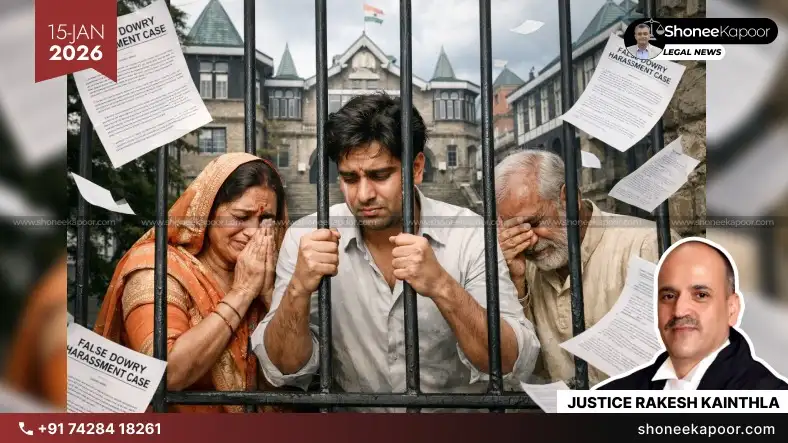
Vague Dowry Harassment Claims Can’t Sustain 498A & Abetment Of Suicide Conviction: HP High Court Exposes Abuse of Law

Written and analysed by Shonee Kapoor
Legal Consultant, Author & Men's Rights ActivistThe Himachal Pradesh High Court has ruled that general and non-specific allegations of dowry harassment are not enough to prove cruelty or abetment of suicide under Sections 498A and 306 IPC. Setting aside the conviction, the Court held that criminal trials in matrimonial disputes require clear acts, particulars, and proof of mens rea, else they become an abuse of law.
Vague Dowry Claims: The Himachal Pradesh High Court at Shimla, in a Criminal Appeal set aside the conviction of three accused who were earlier sentenced under Sections 498A and 306 read with Section 34 of the IPC. The trial court had convicted them for cruelty and abetment of suicide based on allegations that the deceased wife was harassed for dowry and money and later consumed insecticide. Based on this reasoning, the accused were sentenced to imprisonment and fine.
Shimla: The Himachal Pradesh High Court at Shimla, in a Criminal Appeal set aside the conviction of three accused who were earlier sentenced under Sections 498A and 306 read with Section 34 of the IPC. The trial court had convicted them for cruelty and abetment of suicide based on allegations that the deceased wife was harassed for dowry and money and later consumed insecticide. Based on this reasoning, the accused were sentenced to imprisonment and fine.
According to the prosecution, after about one month of marriage, deceased victim was allegedly beaten and harassed for dowry and money by her husband and in-laws. It was claimed that family members and local persons had tried to counsel the accused several times and that the accused had apologised. In July 2008, deceased consumed insecticide and later died. The police registered a case and filed a charge sheet for cruelty and abetment of suicide.
The accused challenged the conviction before the High Court. They argued that the allegations were general in nature and that no witness gave clear details such as date, time, place, exact acts of cruelty, or any specific dowry demand. It was also argued that no complaint was ever made to the police or any authority during the lifetime of the deceased, and that most witnesses were interested relatives whose statements were not independently supported.
The High Court carefully examined the entire evidence. The Court noted that the initial statement of the informant did not mention any specific act of cruelty or any clear demand of dowry or money. No amount, no mode of demand and no incident was properly described. The witnesses repeatedly made broad statements that the deceased was harassed, beaten or taunted, but none of them could give concrete particulars.
The Court observed that the brother of the deceased claimed he saw taunting and misbehaviour, yet he did not immediately take any action, did not inform others, and did not make any complaint. This conduct weakened the credibility of his version. Similarly, other relatives admitted that no complaint was ever made to any authority despite allegedly continuous harassment. The Court also noted that the husband was working in Delhi for long periods, which raised serious doubts about continuous physical harassment at the matrimonial home.
The testimony of independent witnesses did not support the prosecution strongly. One witness stated that the deceased was living cordially and that he had not seen or heard any quarrel. It also came on record that the accused themselves took the deceased to the hospital, which the Court considered as conduct consistent with innocence.
While deciding the case, the High Court relied upon settled principles laid down by the Supreme Court in Neelu Chopra v. Bharti, Abhishek v. State of M.P., Kahkashan Kausar v. State of Bihar, Preeti Gupta v. State of Jharkhand, Achin Gupta v. State of Haryana, Mamidi Anil Kumar Reddy v. State of A.P., and Kailashben Mahendrabhai Patel v. State of Maharashtra. These judgments consistently hold that criminal cases under Section 498A cannot survive on vague, omnibus and unsupported allegations, and that courts must be cautious before dragging entire families into criminal trials.
Applying these legal principles to the present facts, the High Court held that the prosecution failed to prove cruelty or abetment beyond reasonable doubt. The evidence did not show any continuous, specific or proximate act that forced the deceased to commit suicide. The alleged apologies by the accused were also not properly proved because independent witnesses were not examined. The Court observed that the Trial Court relied more on assumptions than on strong and reliable proof.
On the charge of abetment of suicide under Section 306 IPC, the Court explained that mere harassment is not enough. There must be clear proof that the accused intentionally created such circumstances that the deceased had no option except to commit suicide. There must be a direct or proximate act showing instigation, encouragement or intentional aid. In this case, no such direct act or clear mental intention was proved.
The Court further held that criminal law cannot be applied mechanically in matrimonial disputes. Everyday marital quarrels, misunderstandings or emotional conflicts cannot automatically become criminal cruelty unless supported by strong and specific evidence. Dragging multiple family members into criminal cases on the basis of vague allegations leads to misuse of the legal process.
The High Court also rejected the Trial Court’s reasoning that mere apology by the accused proved guilt. The persons who allegedly witnessed the apology were not examined, and the entire claim was based only on related witnesses.
After analysing all material on record, the High Court concluded that the prosecution failed to prove cruelty and abetment beyond reasonable doubt. The evidence was inconsistent, general, uncorroborated and legally insufficient. Therefore, the convictions under Sections 498A and 306 IPC were set aside. All accused were acquitted, and any fine deposited was directed to be refunded as per law.
The judgment reinforces that criminal cases must be based on solid, specific and credible evidence, especially in sensitive matrimonial disputes where exaggeration and false implication remain serious risks. The Court reiterated that prosecution must establish a direct link between alleged conduct and the act of suicide, and courts must protect citizens from mechanical prosecution while ensuring justice in genuine cases.
Explanatory table – laws & sections involved
| Law / Section | Purpose | How It Applied In This Case |
| Section 498A IPC | Punishes cruelty by husband or relatives against a married woman. | Court held that vague, omnibus and unsupported allegations without specific acts, dates or roles cannot sustain conviction. |
| Section 306 IPC | Punishment for abetment of suicide. | Court ruled that mere harassment is not enough; there must be clear instigation, mens rea and a proximate act leading to suicide. |
| Section 34 IPC | Criminal act done by several persons with common intention. | Trial Court applied common intention; High Court found no specific role or shared criminal intent proved. |
| Section 107 IPC | Defines abetment – instigation, conspiracy or intentional aid. | Used to assess whether accused actively instigated or aided suicide; Court found no such proof. |
| Section 114 IPC | Abettor present at offence treated as principal offender. | Referred only for legal understanding of abetment principles. |
| Section 309 IPC | Punishment for attempt to commit suicide. | Discussed while explaining legal framework of suicide and abetment. |
| Section 313 CrPC | Statement of accused without oath during trial. | Accused denied all allegations during their statements. |
| Section 437-A CrPC | Bail bond after acquittal to ensure appearance in higher court. | Compliance direction after acquittal. |
Case Details
- Case Titles:
- Meenki Devi vs State of Himachal Pradesh
- Ram Pal & Anr. vs State of Himachal Prades
- Case No. Criminal Appeal Nos. 526 & 528 of 2012
- Court: High Court of Himachal Pradesh, Shimla
- Bench: Hon’ble Mr Justice Rakesh Kainthla
- Dates:
- Judgment Reserved on: 09 December 2025
- Date of Decision: 01 January 2026
- Neutral Citation: 2026:HHC:6
- Counsels for Appellants: Mr. Rajesh Mandhotra, Advocate (vice Ms. Kanta Thakur, Advocate)
- Counsel for Respondent (State): Mr. Jitender Kumar Sharma, Additional Advocate General
Key Takeaways
- Vague and emotional allegations under Section 498A are not law; without dates, amounts and specific acts, families cannot be jailed.
- Mere marital disputes, taunts or routine conflicts do not amount to cruelty or abetment of suicide unless there is a direct, intentional and legally provable act.
- Abetment under Section 306 requires strong proof of mens rea and a proximate act forcing suicide, not assumptions, sympathy-based reasoning or afterthought narratives.
- Dragging parents and relatives into criminal cases without defined roles is legal abuse and must be strictly filtered by courts at the very first stage.
- This judgment strengthens due process and sends a strong message that matrimonial laws cannot be weaponised for pressure, revenge or settlement leverage.
This Could Change Your Case-Get FREE Legal Advice-Click Here!
Disclaimer: The views and opinions expressed in this article are those of the Indian courts and do not necessarily reflect the official policy or position of “ShoneeKapoor.com” or its affiliates. This article is intended for informational and educational purposes only. The content provided is not legal advice, and viewers should not act upon this information without seeking professional counsel. Viewer discretion is advised.
Related Articles
Can a ‘girlfriend’ of the husband be implicated under Section 498A?
From landmark Supreme Court rulings to ground-level misuse, this article unpacks how Section 498A defines ‘husband’ a...
False 498A – 85 BNS Fear And Need Legal Help? The Law Changed, The Risk Remains, The Defence Must Change Too
If arrest is “not automatic” now, why are families still rushing for bail and protection? Is Section 85 BNS just a ne...
Karisma Kapoor – Sunjay Kapur Case Explained: Marriage, Divorce, 498A, Death & the Delhi High Court Property War
From a celebrity wedding to IPC 498A allegations, a Supreme Court-linked divorce settlement, and now a Delhi High Cou...
Share Your Thoughts
Comments are moderated before publication.