
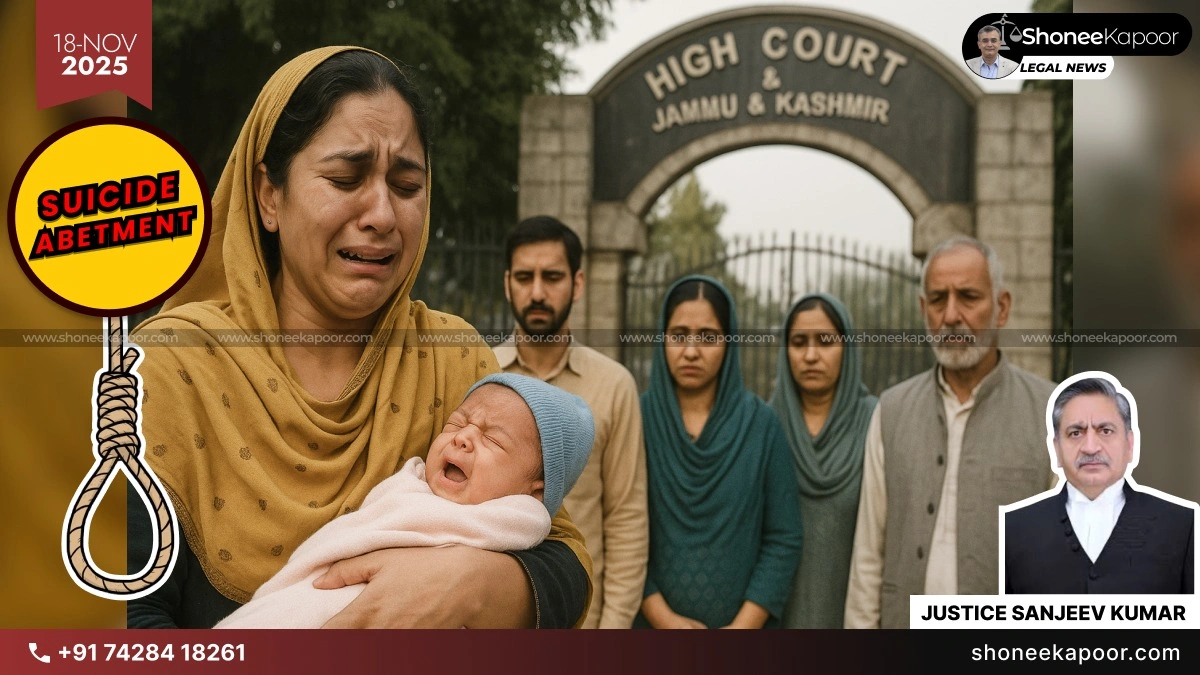
The Jammu & Kashmir High Court has ruled that occasional taunts about infertility cannot by themselves amount to abetment of suicide under Section 306 RPC. The Court upholds acquittal of a husband and in-laws in a 2011 suicide case, holding that no reliable evidence of cruelty existed.
Upholds Acquittal Of Husband And In-Laws: The Jammu and Kashmir High Court has given an important ruling on what amounts to abetment of suicide under Section 306 of the Ranbir Penal Code (RPC).
The Court said that occasional taunts about a woman not being able to conceive a child may be hurtful, but such comments alone cannot be treated as “abetment to suicide” unless there is clear proof of persistent cruelty or intentional provocation to force a person to end their life.
This observation was made by a Division Bench of Justice Sanjeev Kumar and Justice Sanjay Parihar, while dismissing the State’s appeal and upholding the acquittal of a husband and his parents.
The prosecution’s case was that the woman was taunted for not conceiving and that her husband’s drinking habit created constant fights, which allegedly pushed her to take her life. However, the High Court noted that no reliable or consistent evidence supported these allegations.
The Court said:
“Even assuming, for the sake of argument, that the deceased was unable to bear a child and that she was occasionally taunted for it, such an accusation, though distressing, cannot by itself attract the ingredients of Section 306 RPC. Undoubtedly, a woman expects dignity and respect in her matrimonial home, yet, what Section 306 contemplates is intentional instigation or persistent cruelty of such nature as to drive a person to end her life.”
The Bench added that domestic issues are common in marriages and cannot automatically be treated as criminal abetment. It observed that differences between spouses, misunderstandings, and emotional stress do occur, but these alone do not lead a reasonable person to commit suicide.
The judgment stated:
“However, an ordinary prudent person is expected not to take an extreme step merely on that account. In contemporary times, women are more aware, independent, and resilient in addressing such domestic issues.”
The case involved a woman who died by suicide in 2011. Her father filed a complaint alleging that the husband and in-laws tortured her regularly and harassed her for being childless. Based on this, the police registered an FIR under Section 306 RPC. A trial court later acquitted the accused in 2016 due to lack of evidence.
When the State challenged this acquittal, the High Court re-examined all witness statements and evidence. It found that none of the prosecution witnesses could provide specific incidents of cruelty or prove consistent harassment.
The Court also addressed the allegation that the husband drank alcohol. It noted that even if he consumed liquor, that alone is not enough to presume abetment:
“His being a drunkard by itself cannot lead to the presumption that such a habit rendered the life of the deceased miserable or drove her to take the extreme step. While consumption of liquor is undoubtedly an undesirable habit, its implications vary from person to person, depending upon the domestic atmosphere and social context, and therefore cannot, by itself, be treated as evidence of abetment to suicide.”
The prosecution further claimed that the accused initially tried to show the case as a heart attack. However, the Court found no trustworthy evidence to support this version.
Importantly, the Bench highlighted the absence of any proof of cruelty for childlessness, stating:
“There is not an iota of evidence to prove that the husband and in-laws had harassed the deceased woman about her being childless, as claimed by the prosecution.”
The judgment explained that to convict someone for abetment to suicide, the law requires strong and clear proof of conduct capable of provoking a person to take such an extreme step:
“Section 306 RPC requires the presence facts or conduct that are sufficiently grave to incite or provoke a person to commit suicide. In the present case, the prosecution’s evidence is shaky and unreliable. Neither has it been proved that the deceased was a habitual drinker, not have the allegations of taunting for childlessness been consistently supported by the witnesses. The alleged attempt by the respondents to portray the suicide as a case of heart attack has also not been substantiated by credible evidence.”
After reviewing all records, the High Court concluded that the Trial Court was right in acquitting the accused. There was no perversity, mistake, or incorrect reasoning in the earlier judgment.
The Bench therefore upheld the acquittal and dismissed the State’s appeal.
Explanatory Table Of All Laws / Sections Mentioned
| Law / Section | Statute | Meaning in Simple Indian English | Relevance in This Case |
| Section 306 RPC | Ranbir Penal Code (J&K) | Punishes a person who abets (helps, encourages, provokes) someone to die by suicide. | Accused were charged under this section for allegedly driving the woman to suicide. HC held no evidence of abetment. |
| Section 107 RPC | Ranbir Penal Code | Defines “abetment”. Requires intentional instigation, aid, or active involvement. | Court relied on this definition to say there was no intentional provocation or cruelty. |
| Section 342 Cr.P.C. | J&K Criminal Procedure Code | Accused are questioned by the Court about the evidence against them. | Accused were examined under this section but gave no defence evidence. |
| FIR No. 119/2011 | Criminal Procedure | Police complaint registered for the incident. | Basis of the entire criminal case. |
| Charge Sheet | Cr.P.C. | Final police report after investigation. | Police filed charge sheet for Section 306 RPC against husband & in-laws. |
| Appeal Against Acquittal | Cr.P.C. | State can challenge an acquittal in Higher Court. | State filed this appeal (CrlA (AD) No. 7/2020). |
| Double Presumption of Innocence | Criminal Jurisprudence | Once acquitted, accused get stronger presumption of innocence. | Court relied on this principle to uphold acquittal. |
| Post-Mortem Report | Medical Jurisprudence | Legal medical examination of the dead body. | Doctor confirmed death due to hanging; no external injuries. |
| Abetment to Suicide – Legal Ingredients | Judicial Precedents | Requires: (1) Intention (2) Provocation (3) Continuous cruelty. | Court held none were proved. |
| Domestic Cruelty (General Principle) | Not specifically under 498-A (not charged) | Cruelty must be severe, repetitive, and intentional. | General allegations were found unsubstantiated. |
Case Summary
- Case Title: State of J&K through SHO, Police Station Jhajjar Kotli, Jammu vs.Sanjay Singh & Others
- Case Number: CrlA (AD) No. 7/2020
- Reserved On: 13 October 2025
- Pronounced On: 03 November 2025
- Uploaded On: 04 November 2025
- Nature of Case: Criminal Appeal against acquittal under Section 306 RPC.
- Origin of Appeal: Against judgment dated 16.11.2016 passed by the Additional Sessions Judge, Jammu, acquitting all accused.
Trial Case Information
- FIR No.: 119/2011
- Police Station: Jhajjar Kotli, Jammu
- Offence Alleged: Section 306 RPC (Abetment to Suicide)
- Accused Persons:
- Sanjay Singh (Husband)
- Lakshman Singh (Father-in-law)
- Smt. Satya Devi (Mother-in-law)
- Deceased: Arti Devi
- Trial Court Finding: Acquittal due to lack of reliable evidence
Bench (Judges)
- Justice Sanjeev Kumar
- Justice Sanjay Parihar (Author of the judgment)
Counsel for the Appellant (State)
- Mr. Ravinder Gupta, AAG
Counsel for the Respondents (Accused)
- Mr. G. S. Thakur, Advocate
Key Legal Provisions Involved
- Section 306 RPC – Abetment of Suicide
- Section 107 RPC – Definition of Abetment
- Section 342 Cr.P.C. – Examination of Accused
- General criminal appellate principles – Double presumption of innocence
Basic Case Background
The deceased, Arti Devi, died by suicide in 2011. Her father alleged that she was harassed and taunted for not conceiving a child and that her husband’s drinking habit caused regular quarrels. Based on this, FIR No. 119/2011 was registered. The Trial Court acquitted all accused in 2016, holding that no clear evidence existed to prove abetment to suicide. The State appealed to the J&K High Court.
High Court’s Conclusion
The High Court upheld the acquittal, observing that:
- Occasional taunts about infertility do not constitute abetment.
- No specific evidence of persistent cruelty or provocation existed.
- Allegations of dowry demand or severe harassment were unproven.
- Husband’s drinking habit alone cannot be considered abetment.
- Prosecution witnesses gave inconsistent and unreliable statements.
Disclaimer: The views and opinions expressed in this article are those of the Indian courts and do not necessarily reflect the official policy or position of “ShoneeKapoor.com” or its affiliates. This article is intended for informational and educational purposes only. The content provided is not legal advice, and viewers should not act upon this information without seeking professional counsel. Viewer discretion is advised.
