
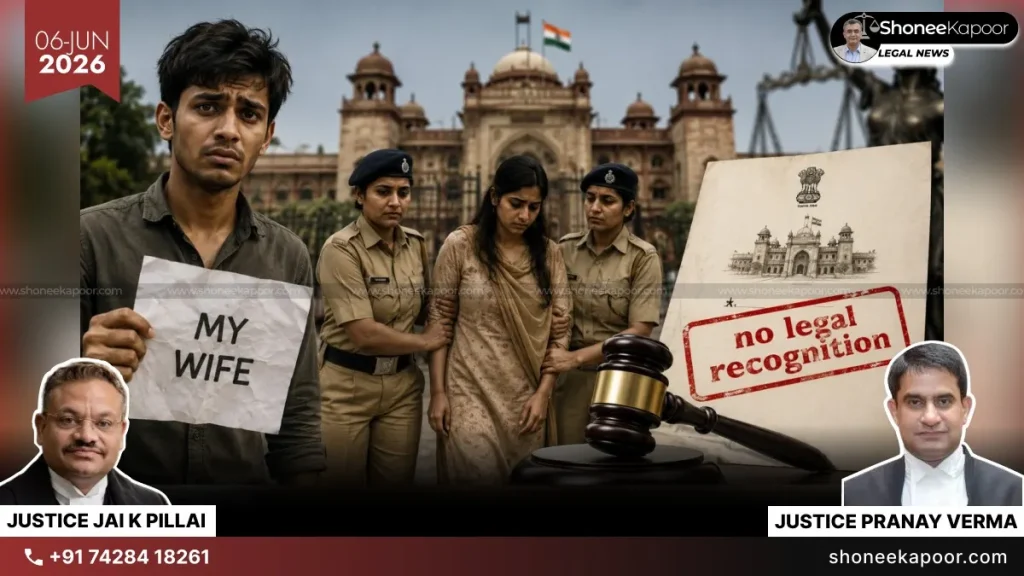
Can a man’s marriage fail in court even when the woman says, “I want to go with him”? The MP High Court held that personal choice cannot cure the legal defect arising from the man’s age, and therefore the marriage could not be recognized.
MADHYA PRADESH: In a judgment dated June 5, 2026, the Madhya Pradesh High Court at Indore, comprising Justice Pranay Verma and Justice Jai Kumar Pillai, dealt with a habeas corpus petition filed by a young man who claimed that his wife was being illegally detained by the police authorities.
A habeas corpus petition was filed before the Madhya Pradesh High Court by a young man who claimed that the woman he had married was being illegally detained by the police. He requested the Court to direct the authorities to produce her before the Court and allow her to accompany him.
While examining the matter, the Court noted that the petitioner himself was only 20 years old. Since the law prescribes a minimum marriageable age for men, the Court observed that the alleged marriage could not be granted legal recognition.
Pursuant to an earlier direction, the woman was produced before the Court by police officials. The judges personally interacted with her to ascertain her wishes and to determine whether she was being unlawfully restrained.
During the interaction, the woman clearly stated that she wished to accompany the petitioner. The Court recorded her statement as follows:
“She wants to go with the petitioner.”
However, the Court held that the woman’s desire to accompany the petitioner could not by itself validate the alleged marriage. Since the petitioner had not attained the legally prescribed marriageable age, the Court observed that she could not be permitted to go with him as his wife.
At the same time, the Court emphasized that the woman was a major and therefore entitled to make her own choices regarding her place of residence and future course of life. The judges observed that an adult woman cannot be illegally detained by the police or by any other person against her wishes.
Balancing these considerations, the Court held that the woman was free to live wherever she wished. However, it clarified that such liberty would not amount to recognition of the alleged marriage or permit her to reside with the petitioner in the legal capacity of his wife.
The Bench specifically observed:
“The corpus is major she certainly has a right to live as per her wishes and cannot be illegally detained by the Police authorities.”
To ensure that her wishes were respected, the Court directed the police officials who had produced her before the Court to escort her safely to the place where she desired to go.
With these observations, the Madhya Pradesh High Court disposed of the petition. The judgment reiterates that while every adult woman has the fundamental right to choose where and with whom she wishes to live, a marriage involving a man who has not attained the legally prescribed marriageable age cannot be granted legal recognition merely because the parties claim to be married.
EXPLANATORY TABLE: LAWS AND PROVISIONS INVOLVED
| Law / Provision | Purpose | Relevance In This Case |
| Article 226, Constitution of India | Empowers High Courts to issue writs for enforcement of legal and fundamental rights. | The habeas corpus petition was filed under Article 226 alleging illegal detention of the woman. |
| Writ of Habeas Corpus | Protects personal liberty by requiring production of a person allegedly under unlawful detention. | The Court directed the production of the woman and personally verified her wishes. |
| Article 21, Constitution of India | Guarantees the right to life and personal liberty. | The Court protected the major woman’s right to choose where and with whom she wishes to live. |
| Section 5(iii), Hindu Marriage Act, 1955 | Prescribes the minimum marriageable age for a Hindu marriage. | The Court noted that the petitioner was only 20 years old and therefore had not attained the legally prescribed marriageable age. |
| Prohibition of Child Marriage Act, 2006 | Prevents child marriages and provides remedies regarding such marriages. | The Court considered the issue of marriageable age while refusing to grant legal recognition to the alleged marriage. |
| Section 2(a), Prohibition of Child Marriage Act, 2006 | Defines a “child” as a male below 21 years and a female below 18 years. | Relevant because the petitioner was below 21 years of age. |
CASE DETAILS
- Case Title: Ritesh Katara v. State of Madhya Pradesh and Others
- Case Number: Writ Petition No. 19587 of 2026
- Court: High Court of Madhya Pradesh, Indore Bench
- Date of Decision: 05 June 2026
- Neutral Citation: 2026:MPHC-IND:15213
- Bench: Justice Pranay Verma | Justice Jai Kumar Pillai
- Counsels:
- For Petitioner: Shri Harshwardhan Singh Rathore, Advocate
- For State: Shri Aditya Garg, Government Advocate
KEY TAKEAWAYS
- Personal liberty belongs to every adult, regardless of whether families, society, or authorities approve of their choices.
- Love or consent cannot override statutory requirements when the law prescribes minimum conditions for a valid marriage.
- Police cannot restrict the freedom of a major woman merely because her relationship is disputed or unpopular.
- Legal recognition of a marriage depends on compliance with law, not merely on the wishes of the parties.
- Individual choice must be protected, but rights and relationships must still operate within the framework of the law.
This Could Change Your Case-Get FREE Legal Advice-Click Here!
Disclaimer: The views and opinions expressed in this article are those of the Indian courts and do not necessarily reflect the official policy or position of “ShoneeKapoor.com” or its affiliates. This article is intended for informational and educational purposes only. The content provided is not legal advice, and viewers should not act upon this information without seeking professional counsel. Viewer discretion is advised.