
Wife Left Husband For 30 Years. Yet She Gets Alimony: Supreme Court Finally Frees Man Trapped in a Dead Marriage | Divorce Granted Under Article 142

Written and analysed by Shonee Kapoor
Legal Consultant, Author & Men's Rights ActivistThe Supreme Court dissolved a marriage from 1980 after the couple lived apart for nearly 30 years. The Court used Article 142, noting the wife’s absence from all proceedings and allowing her six months to seek alimony.
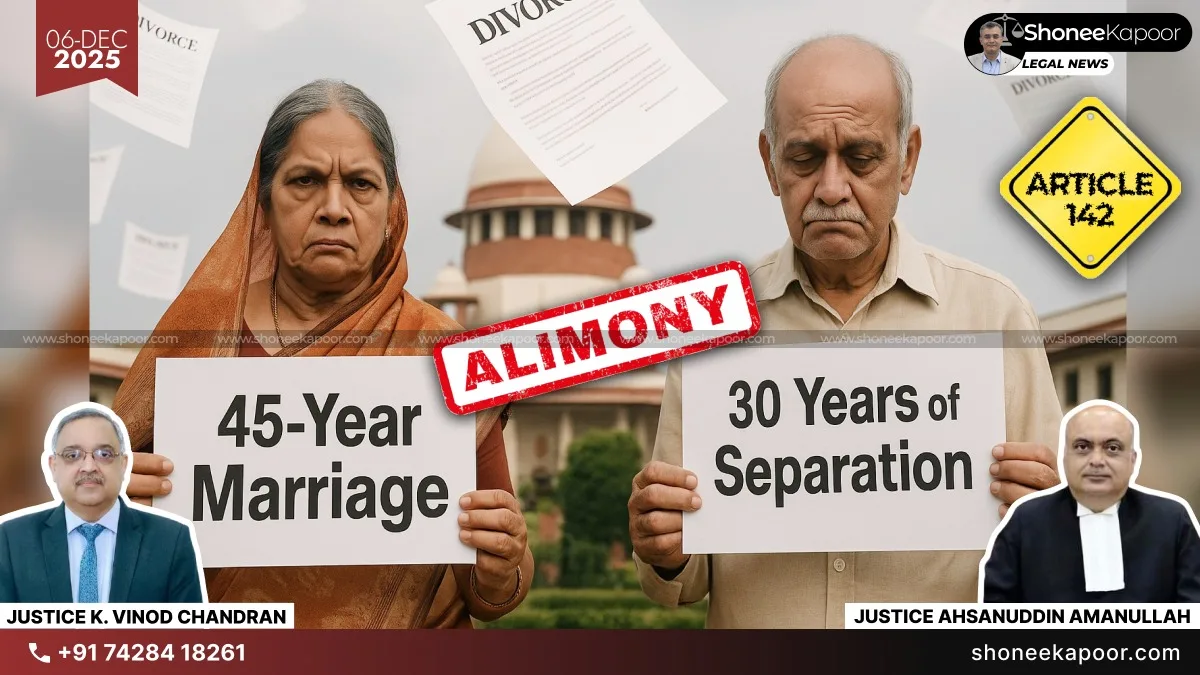
Supreme Court Finally Frees Man Trapped in a Dead Marriage: The Supreme Court of India finally ended a matrimonial relationship that had been broken for almost three decades. The couple married in 1980 but had been living separately since 1995. Seeing that there was no chance of reunion and that the marriage had completely collapsed, the Court dissolved the marriage by using its power under Article 142 of the Constitution.
The husband had appealed before the Supreme Court after the Allahabad High Court upheld the trial court’s refusal to grant divorce. Both the Additional District Judge/Special Judge, Budaun, and the High Court had earlier dismissed the husband’s divorce plea because cruelty and desertion were not proved.
The husband argued that although the wife visited the matrimonial home briefly in earlier years, she had completely stopped coming after 1995. From that year onward, the couple did not live together even for a single day.
The High Court agreed with the trial court mainly because the wife had withdrawn the criminal cases she had filed, and therefore, cruelty was not proved. But before the Supreme Court, the situation was different. The wife did not appear before the High Court or the Supreme Court, even after notices were issued.
The Court recorded that despite dasti service attempts, she refused to accept the notice. It also noted that she had not filed any new cases, which showed she was not interested in contesting the divorce.
The Supreme Court reviewed the facts and concluded that the lower courts’ findings needed interference. The Court observed:
“It is true that facts speak for themselves. In the present case, at least, it is not in dispute that since 1995 i.e., almost for the last 30 years, the parties are not living together. It is also true that the respondent-wife has not appeared before the High Court and even before this Court.”
It further quoted its earlier order dated 22.07.2025, which said:
“Learned Senior Counsel for the petitioner submits that although notice has been served, the respondent-wife has not entered appearance.
2. However, having regard to the nature of the relief sought, we deem it appropriate that the respondent-wife be given an opportunity to appear before this Court before we take a final view in the matter.
3. Accordingly, learned Senior Counsel for the petitioner is permitted to serve dasti notice on the respondent-wife, enclosing a copy of this order, requesting the respondent-wife to make necessary arrangements to appear before this Court.
4. It is clarified that in the event the respondent-wife expresses her inability to appear due to financial and/or other constraints, she shall be informed that she is entitled to avail legal aid services through the concerned District Legal Services Authority, which shall co-ordinate with the Supreme Court Legal Services Committee for providing a counsel to represent her before this Court.
5. List on 09.09.2025.”
Even after such directions, the wife did not come forward. The Court noted that the respondent had withdrawn earlier criminal cases and had filed no fresh case, showing no intention to continue the relationship or contest the divorce.
The bench explained:
“Under the aforesaid circumstances, when the respondent-wife after having resisted the challenge before the Trial Court, has thereafter, not chosen to contest is a sufficient proof that she is not interested in pursuing the issue of divorce which leads to the next presumption that she is no more interested for restoration of relationship also.”
The Court also highlighted that she did not even use the legal aid assistance offered earlier.
To bring closure to a dispute that had dragged on for decades, the Supreme Court held that this was a fit case to use its special power. It said a decree of divorce must be granted based on irretrievable breakdown of marriage.
The Court stated that a clear case had been made for invoking Article 142 to finally end the dead marriage. It therefore granted the divorce to the husband and directed the Registry to prepare the decree.
Before concluding the order, the Court made an important clarification regarding financial rights. It said:
“If the respondent-wife feels that she is in need of some financial support by way of permanent alimony or otherwise, it will be open for her to approach this Court for the same. However, the same has to be done latest, within a period of six months from today. We once again reiterate that even for such proceedings, the respondent would be entitled for assistance from the Legal Services Committee of this Court.”
The Court further directed that the District Legal Services Committee at Badaun should coordinate with the Supreme Court Legal Services Committee if the wife decides to approach the Court. It also ordered that the judgment be communicated to her immediately.
With these directions, the Supreme Court allowed the husband’s appeal and formally ended a marriage that had effectively been over for 30 years.
Explanatory Table Of All Laws & Sections Referenced
| Law / Provision | Where It Applies in This Case | Meaning in Simple Indian English | Why the SC Mentioned It |
| Article 142 of the Constitution of India | Used by Supreme Court to grant divorce | Allows SC to pass any order necessary to do complete justice | Marriage was dead for 30 years; normal divorce grounds were not proved; SC used Article 142 to end the marriage |
| Irretrievable Breakdown of Marriage (Judicial Doctrine) | Ground on which SC dissolved the marriage | Marriage is considered beyond repair; no chance of reunion | Couple lived separately for nearly 30 years; wife not appearing showed complete breakdown |
| Matrimonial Case No. 208/1995 | Trial court record | Husband sought divorce, trial court rejected | SC had to override this because cruelty/desertion could not be proven but marriage had collapsed |
| First Appeal No. 715/2004 – Allahabad HC | Appeal by husband | High Court upheld trial court’s refusal | SC reversed this |
| Criminal cases withdrawn by wife | Cited by High Court to deny divorce | Wife withdrawing the cases was interpreted as no cruelty | SC said this was irrelevant because the real fact was 30 years of separation |
| Legal Services Authority Act (implied through legal aid directions) | SC instructed District Legal Services Authority & SCLSC | Provides free legal help to those unable to afford representation | SC ensured wife had every chance to appear before giving final order |
| Dasti Notice Service | Method used to serve notice to the wife | A party personally serves court notice | Wife refused to accept notice → showed disinterest |
| Permanent Alimony (not a section but relief) | SC allowed wife to seek it within 6 months | Financial support after divorce | Protects wife’s rights despite her absence |
Case Summary
- Case Title: Shri Sarvesh Kumar Sharma vs. Smt. Sarvesh Kumari Sharma (Civil Appeal arising out of SLP (C) No. 10130 of 2025)
- Bench (Judges)
- Hon’ble Mr. Justice Ahsanuddin Amanullah
- Hon’ble Mr. Justice K. Vinod Chandran
Counsel Appearing
- For Appellant (Husband):
- Mr. Ranjan Mukherjee, AOR
- Ms. Aayushi, Advocate
- For Respondent (Wife):
- No appearance
Procedural Details
- Marriage Year: 1980
- Separation Since: 1995 (30 years apart)
- Trial Court: Additional District Judge / Special Judge, Budaun (Matrimonial Case No. 208/1995)
- High Court: Allahabad High Court, First Appeal No. 715/2004
- SC Order Date: 09 September 2025
- Relief Granted: Divorce under Article 142 – Irretrievable Breakdown of Marriage
Key Timeline Summary
- 1980: Marriage solemnised
- 1995: Wife stops living with husband
- 2004: HC upholds rejection of divorce
- 2025: SC dissolves marriage under Article 142
Result: Marriage dissolved. Wife allowed to seek alimony within 6 months. Order to be communicated immediately.
Key Takeaways
- The Supreme Court had to step in and end a 45-year marriage because the system kept a husband trapped despite 30 years of separation.
- Lower courts refused divorce only because cruelty wasn’t “proved”, showing how men remain stuck in dead marriages due to rigid standards of proof.
- The wife didn’t appear before any court for decades, yet the husband still had to fight all the way to the Supreme Court for basic closure.
- The Court finally used Article 142 because the marriage had completely collapsed, proving the urgent need for irretrievable breakdown to be a statutory divorce ground.
- Once again, a man spent most of his life in litigation simply to end a marriage that ended long ago, highlighting how biased matrimonial processes burden men disproportionately.
This Could Change Your Case-Get FREE Legal Advice-Click Here!
Disclaimer: The views and opinions expressed in this article are those of the Indian courts and do not necessarily reflect the official policy or position of “ShoneeKapoor.com” or its affiliates. This article is intended for informational and educational purposes only. The content provided is not legal advice, and viewers should not act upon this information without seeking professional counsel. Viewer discretion is advised.
Related Articles
Real Court Cases Where False Allegations Backfired On Wife
Real Indian court cases where false 498A, dowry, cruelty and defamatory allegations against husbands backfired, leadi...
Can a Section 498A IPC Case Be Filed If the Husband Lives in Canada? The Real Indian Legal Position for NRIs
Can a Section 498A IPC case be filed if the husband lives in Canada? Updated 2026 legal guide for NRI husbands on Ind...
Share Your Thoughts
Comments are moderated before publication.