
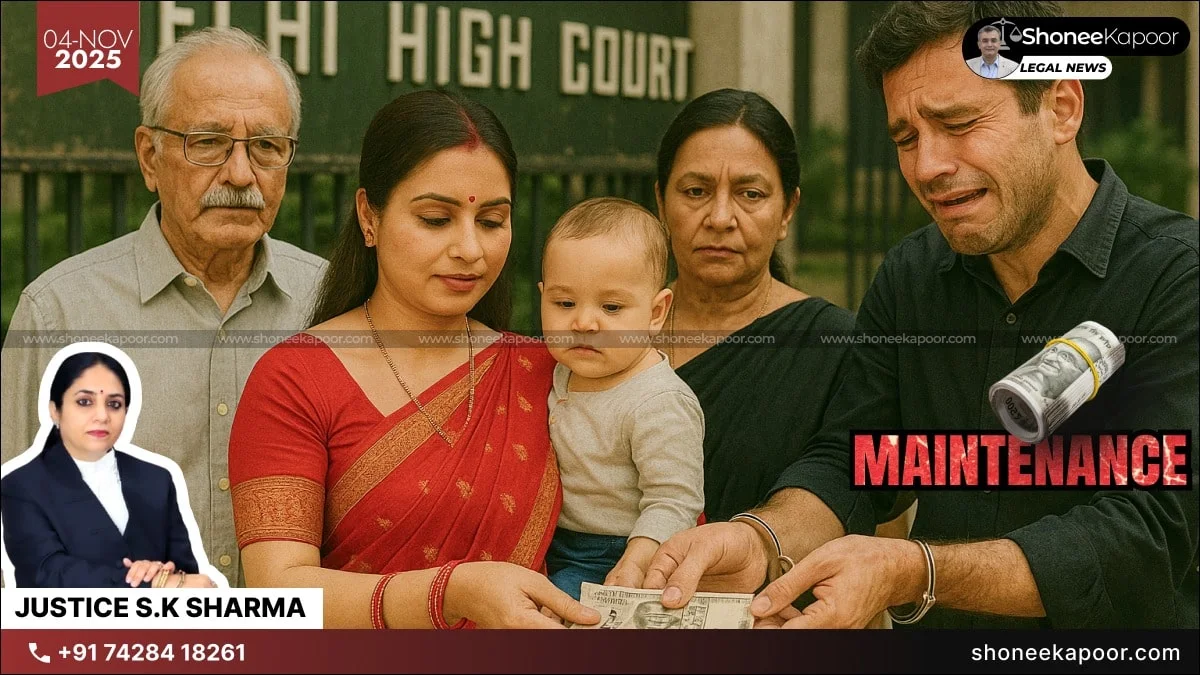
Delhi High Court Lays Strict Guidelines for Maintenance, Demands Reasoned Family Court Orders: “Guesswork Isn’t Justice”

Written and analysed by Vaibhav Ojha
Head Of Legal CommunicationsThe Delhi High Court ruled that maintenance orders must be based on clear reasoning, not assumptions. It set aside a ₹20,000 interim maintenance order, stressing that Family Courts must record detailed justifications.
NEW DELHI | In a scathing reminder that justice cannot survive on assumption, the Delhi High Court has drawn a red line for Family Courts that routinely decide maintenance by “guesswork.” In Tasmeer Qureshi v. Asfia Muzaffar, Justice Swarana Kanta Sharma held that courts must show how they reach a figure, not merely what figure they award. The long judgment tears into the growing trend of “mechanical or cryptic” interim orders that fix monthly sums without disclosing any income basis.
“Guesswork is not justice,” the Bench observed. “An order that does not reveal the reasoning behind its numbers is an order that hides its fairness.”
Justice Sharma stressed that maintenance relief is meant to preserve dignity, not distribute sympathy, and that even at the interim stage, judges are duty-bound to record the evidence or inference that supports their assessment of income.
The ruling setting aside a ₹20,000 per-month maintenance order passed without income analysis marks a crucial step toward judicial accountability in maintenance jurisprudence and a push for transparency over presumption.
Facts of the Case
The parties, Tasmeer Qureshi (husband) and Asfia Muzaffar (wife), were married on 3 October 2019 in accordance with Muslim rites. The marriage itself was not in dispute. However, soon after the wife began residing at her matrimonial home in Gwalior, Madhya Pradesh, she alleged that the petitioner and his family’s behavior “changed drastically.”
According to her petition under Section 125 CrPC, the wife accused the husband and his family of verbal and physical abuse, harassment over trivial issues, and demands for dowry. She further claimed that upon disclosing her pregnancy, the husband became enraged and pressured her to either terminate the pregnancy or bring ₹10 lakh from her parental home to support his business and “the future needs of the unborn child.”
The judgment records that in September 2020, Tasmeer allegedly brought his wife to Delhi, left her at her parental home, and never returned to take her back. Despite repeated attempts, the wife claimed the husband cut all communication. Left to fend for herself, she filed a maintenance petition in January 2021, seeking ₹30,000 per month for herself and ₹3 lakh for pregnancy-related medical expenses.
During the pendency of the proceedings, she gave birth to a son while residing with her parents. The husband filed a written reply denying all allegations and asserted that it was a second marriage for both parties, solemnized through a matrimonial website “without dowry.”
He contended that the wife was previously employed as a teacher till 2019 and had the capacity to earn. Both sides submitted affidavits of income, assets, and expenditure before the Family Court.
On 30 March 2024, the Family Court at Saket directed the husband to pay ₹15,000 per month to the wife and ₹5,000 per month to their son as interim maintenance, effective from the date of filing.
This forms the factual foundation for the Delhi High Court’s later analysis where Justice Swarana Kanta Sharma questioned how the Family Court could fix a maintenance amount without first recording how it estimated the husband’s income or which material it relied upon, warning that “maintenance cannot be determined in vacuum.”
Court’s Findings
Justice Sharma’s judgment went beyond this single case it reads like a judicial training manual for Family Courts across India. The Court systematically codified eight guiding principles for maintenance proceedings, turning the case into a roadmap for procedural fairness.
(i) Follow the Rajnesh v. Neha Guidelines:
“The Supreme Court in Rajnesh v. Neha (2021) 2 SCC 324 has already provided a uniform template for maintenance cases. Compliance with this judgment is not optional it is mandatory.”
Both spouses must file detailed affidavits of income, assets, and liabilities. The Court must ensure these affidavits are verified, complete, and cross-checked. Adverse inference can be drawn if a party deliberately conceals or delays disclosure.
(ii) Income Assessment Must Be the Starting Point:
“The process of determining maintenance cannot begin or end with assumptions. It must rest on an assessment of earning capacity.”
Courts must identify the actual or notional income of both spouses. If no salary slips or tax documents exist, reasonable inference may be drawn from lifestyle, qualifications, and spending patterns. Interim findings must indicate how income was calculated not just what amount was fixed.
(iii) Record Reasons, Even for Interim Orders
“An interim order is not a casual note it is a judicial act affecting the sustenance of lives. It must, therefore, reveal the reasoning process behind it.”
Each order must reflect what documents were considered and what logic was followed. A simple statement of why a figure was chosen is essential for transparency.
(iv) Avoid Both Extremes; Lengthy Narratives and Cryptic Notes
“Some orders reproduce pages of pleadings without reasoning; others are so brief that reasoning disappears altogether. Both defeat the very purpose of judicial clarity.”
Justice Sharma advised a balanced approach: record key facts and relevant material briefly but clearly.
(v) Minimum Wages Are Not a Default Benchmark
“Mechanical application of Delhi’s minimum wage to outstation respondents, without context, leads to unfairness. The court must consider the actual economic environment of the litigant.”
(vi) Wife’s Employability Must Be Judged Realistically
“Employability is not the same as employment. Motherhood, relocation, and childcare duties alter practical realities.”
The Court emphasized that the ability to work must be assessed in real-life context, not merely by educational qualifications.
(vii) Living with Parents Is Not a Ground to Deny Maintenance
“The law of maintenance prevents a woman from being dependent on charity. Parents’ support cannot replace a husband’s duty.”
However, the Court clarified that this should not be used to indefinitely shift the husband’s financial burden, especially when the wife has independent capacity.
(viii) Understand Maintenance as Human Stories, Not Legal Disputes
“No two maintenance cases are identical. Each represents a lived human story of struggle, survival, and dignity.”
Justice Sharma reminded Family Courts that behind every affidavit lies a real life urging them to judge with both reason and empathy.
THE FINAL ORDER:
Having found that the Family Court’s order lacked reasoning, Justice Sharma set it aside and remanded the case back for fresh adjudication:
“The learned Family Court shall reassess the income of the parties, record clear reasons, and pass a fresh order on interim maintenance within one month from receipt of this judgment.”
She ended with a reflective observation that transcends this case:
“Maintenance proceedings are not financial calculations they are human stories. Each order must strive to balance law and life, compassion and practicality.”
Legal Significance
Swarana Kanta Sharma’s concluding remarks in Tasmeer Qureshi v. Asfia Muzaffar stand out as one of the strongest judicial reflections on how maintenance law must be practiced with both empathy and evidence. She acknowledged the real burdens faced by Family Courts “heavy dockets, limited time, and emotionally charged cases” but made it clear that these pressures cannot justify mechanical or vague orders.
“Even amidst these constraints, the Court must endeavor to strike a balance between expedition and fairness. While it may not be possible to undertake a detailed examination of every financial detail at the interim stage, the orders passed should not suffer from lack of reasoning or absence of clarity as to how the quantum of maintenance has been arrived at.”
She underscored that maintenance orders are not financial calculations but judicial responsibilities that directly affect “the dignity, sustenance, and stability of lives.” To that end, she directed all Family Courts and Mahila Courts to ensure that each order reflects the judicial mind at work connecting facts to conclusions.

The High Court also ordered that a copy of this judgment be circulated to all Principal District and Sessions Judges in Delhi, and included in the Delhi Judicial Academy’s training modules, so that the principles of fairness, uniformity, and reasoning are taught as judicial discipline, not discretion
In short, Justice Sharma transformed a maintenance revision into a judicial charter reminding every magistrate that justice begins not with sympathy, but with clarity, reasoning, and accountability.
Explanatory table of sections/case laws rereferred in the judgement
| Law / Judgment | Section / Citation | Explanation / Relevance as Stated by the Court |
| Code of Criminal Procedure, 1973 | Section 125 CrPC | The foundation of the wife’s maintenance claim. Justice Sharma reiterated that the objective of this provision is not charity but sustenance—to ensure that a dependent spouse or child is not reduced to destitution. |
| Rajnesh v. Neha & Anr. | (2021) 2 SCC 324 | Reaffirmed as the central framework for maintenance proceedings. The Court directed that this Supreme Court judgment must be “scrupulously followed in letter and spirit” to ensure fairness, uniformity, and consistency in all maintenance orders. |
| Bharat Hegde v. Saroj Hegde | 2007 SCC OnLine Del 622 | Quoted to clarify that even in the absence of complete financial documents, courts may make a reasonable, evidence-based assessment of income, but must record the logic behind that inference. |
| Annurita Vohra v. Sandeep Vohra | 2004 SCC OnLine Del 192 | Relied upon for the principle that income should be divided among all dependents equitably, and that the husband’s financial obligation must be proportionate to his actual or notional income. |
| Shamima Farooqui v. Shahid Khan | (2015) 5 SCC 705 | Cited to stress that an able-bodied husband cannot evade maintenance duties by citing low income. However, Justice Sharma nuanced this by requiring that even “ability” must be determined through reasoned assessment, not presumption. |
| Manish Jain v. Akanksha Jain | (2017) 15 SCC 801 | Reinforced that a wife’s parental support does not relieve the husband of his legal obligation to maintain her. Yet, the Court clarified that such support also cannot become a perpetual justification for inflated claims. |
| Guideline (i): Compliance with Rajnesh v. Neha | — | Family Courts must ensure affidavits of income, assets, and liabilities are filed by both spouses and properly scrutinized. Non-disclosure warrants adverse inference. |
| Guideline (ii): Assessment of Income | — | Determination of maintenance “cannot begin or end with assumptions.” The Court outlined that Family Courts must either compute actual income from documents or deduce notional income based on qualifications, past employment, and lifestyle indicators. |
| Guideline (iii): Recording Reasons for Interim Maintenance | Even interim orders must reflect “how” and “why” a figure was fixed. Justice Sharma observed that brevity is acceptable; silence is not. | |
| Guideline (iv): Avoiding Extremes of Lengthy or Cryptic Orders | — | Judges were cautioned to avoid two common errors—writing pages of pleadings without findings, or issuing one-line orders without logic. |
| Guideline (v): Caution in Applying Minimum Wages Criteria | — | Warned that applying Delhi’s minimum wage to outstation husbands without considering their local economic realities can cause “unintended injustice.” |
| Guideline (vi): Wife’s Employability Post-Marriage | — | The Court stated that employability must be assessed in context—childcare, relocation, and social circumstances affect a woman’s ability to work. |
| Guideline (vii): Living with Parents After Separation | — | Clarified that a wife’s residence with her parents cannot be used to deny maintenance, though courts must ensure it doesn’t become a long-term substitute for the husband’s legal duty. |
| Guideline (viii): Humanizing Maintenance Proceedings | — | Maintenance cases are “human stories, not mere legal disputes.” Courts must apply law with empathy but also demand evidence, ensuring that justice remains reasoned, not emotional. |
| Direction to Delhi Judicial Academy | — | Judgment ordered to be circulated to all Principal District Judges and included in judicial training modules to strengthen reasoned adjudication practices across Family Courts. |
Case Details
| Case Title: | Tasmeer Qureshi v. Asfia Muzaffar |
| Court: | High Court of Delhi at New Delhi |
| Bench: | Hon’ble Dr. Justice Swarana Kanta Sharma |
| Case Number: | CRL.REV.P.(MAT.) 123/2024 with CRL.M.A. 36001/2024 & CRL.M.A. 3589/2025 |
| Date of Judgment: | 29 October 2025 |
| Petitioner (Husband): | Tasmeer Qureshi |
| Respondent (Wife): | Asfia Muzaffar |
| Counsel for Petitioner: | Ms. Jahanvi Worah (DHCLSC) and Mr. Rajat Oswal |
| Counsel for Respondent: | Mr. Mahtab Ali |
| Provision Invoked: | Section 125 of the Code of Criminal Procedure, 1973 |
| Impugned Order: | Family Court (Saket), Order dated 30 March 2024 directing ₹20,000/month as interim maintenance (₹15,000 for wife + ₹5,000 for minor son) |
| Grounds of Challenge: | Husband alleged lack of reasoning in the order; claimed unemployment and financial incapacity; argued that maintenance was fixed without income assessment. |
| Key Legal Issue: | Whether Family Courts can fix interim maintenance amounts without clearly recording the basis or assessment of income. |
| High Court’s Findings: | – Family Court was correct to note concealment of income but erred by not recording the basis of its estimation. – Interim maintenance must always reflect reasoning, even in brief form. – Brevity is permissible; absence of reasoning is not. |
| Judicial Directions: | Judgment to be circulated to all Principal District & Sessions Judges in Delhi and included in Delhi Judicial Academy training modules for uniform compliance. |
| Core Principle Evolved: | Maintenance cannot be based on guesswork. Every order—interim or final—must record how income was determined and why a particular amount was fixed. |
Question In Issue: Can a Family Court fix interim maintenance without recording any clear finding or reasoning on the actual or notional income of the husband?
Final Order / Result: Family Court’s order set aside. Case remanded for fresh assessment of income and reasoned determination of interim maintenance within one month.
Disclaimer: The views and opinions expressed in this article are those of the Indian courts and do not necessarily reflect the official policy or position of “ShoneeKapoor.com” or its affiliates. This article is intended for informational and educational purposes only. The content provided is not legal advice, and viewers should not act upon this information without seeking professional counsel. Viewer discretion is advised
Related Articles

Family Courts Refuse My RTI To Reveal Divorce Data: Is Transparency Selective When It Comes to Men?
Family Courts have refused to provide year-wise divorce and alimony statistics under the RTI Act, citing technical gr...

The Silent Crisis: Men Destroyed by False Allegations in India – How Laws Meant for Protection Are Destroying Innocent Men
Laws Meant for Protection Are Destroying Innocent Men. An FIR is filed and a man’s life collapses before any evidence...
Relevant Judgements

Can an NRI Husband Be Forced to Pay Maintenance in India? Supreme Court Rules Explained for Overseas Indian Men
Living abroad does not automatically protect an NRI husband from maintenance claims in India.But can Indian courts pa...
Share Your Thoughts
Comments are moderated before publication.