
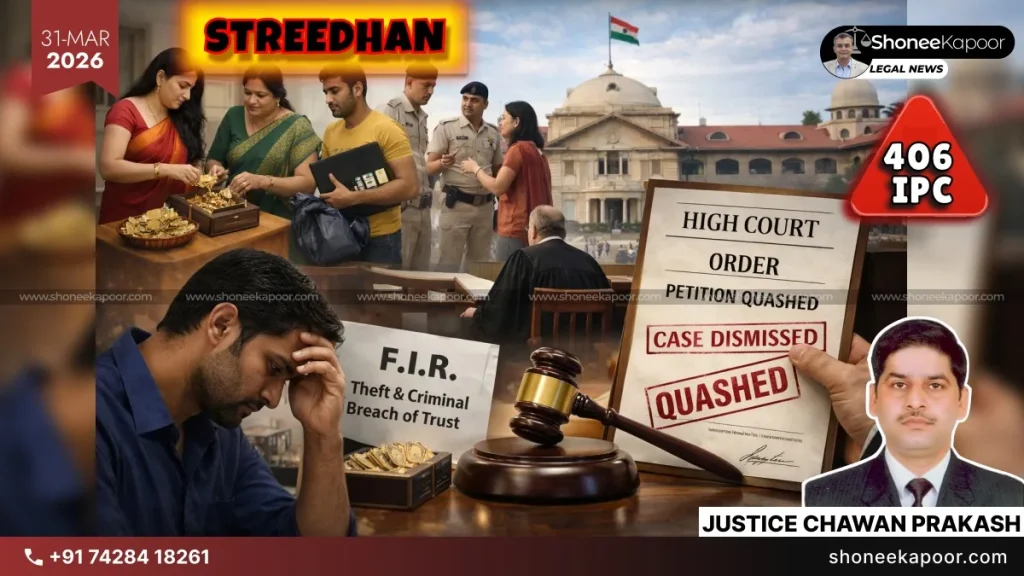
The Allahabad High Court, while clarifying that streedhan is the wife’s absolute property, has raised a deeper concern in matrimonial disputes—
Does the concept of streedhan override a husband’s right to seek protection for property taken from his house?
In a judgment dated 16 March 2026, Justice Chawan Prakash of the Allahabad High Court quashed criminal proceedings against a wife and her family, bringing attention to how counter-cases are often used in matrimonial disputes to create legal pressure on the husband’s side.
The case arose from a marriage in 2012 that later turned into multiple litigations. The wife had already initiated dowry harassment proceedings and secured maintenance orders. Soon after this, the husband filed a complaint alleging that the wife and her family entered his house and took away cash, jewellery, and household items. The Magistrate proceeded to summon them under Sections 323, 504, and 406 IPC.
The High Court carefully examined whether these allegations actually constituted a criminal offence. Referring to the legal position, the Court stated:
“Section 405. Criminal breach of Trust.-Whoever, being in any manner entrusted with property, or with any dominion over property, dishonestly misappropriates or converts to his own use that property…”
And clarified that criminal breach of trust requires clear proof of entrustment and dishonest intention.
While dealing with the issue of property, the Court observed:
“It is well settled principle of law that the properties given to a woman before marriage, at the time of marriage or thereafter are her ‘streedhan’ property. It is her absolute property with all rights to dispose at her own pleasure.”
It further held:
“The husband or other in-laws has no control over her ‘streedhan’ property… Therefore, ‘streedhan’ property does not become a joint property of wife and husband.”
Despite this legal position, the Court found that the husband’s complaint had been taken at face value without proper scrutiny. It held that no offence under Section 406 IPC was made out and that the allegations were largely general and unsupported by specific legal ingredients.
Significantly, the Court criticised the Magistrate’s approach, noting that the summoning order was passed in a mechanical manner without proper application of mind. This reflects a larger issue where husbands often face multiple proceedings simultaneously, and even weak or retaliatory complaints can proceed without initial judicial filtering.
In the end, the Court quashed the entire case, holding that the proceedings were not sustainable in law and appeared to be a reaction following maintenance orders.
This ruling highlights that even when a husband is already entangled in multiple legal proceedings, courts often allow successive complaints to proceed, thereby increasing pressure regardless of their legal strength. However, when the husband approaches the system for relief or challenges such actions, the doors are frequently narrowed, making it harder for him to get timely protection.
This imbalance highlights the urgent need for stricter scrutiny at the very initial stage, so that criminal law is not selectively used as a tool of pressure against men in matrimonial disputes.
Explanatory Table: Laws & Sections Involved
| Section / Law | Purpose | How Applied In This Case |
| Section 482 Cr.P.C. | Power of High Court to quash criminal cases to prevent misuse of law | Used by applicants to challenge and quash proceedings |
| Section 323 IPC | Punishment for causing hurt | Alleged against wife & family, but found general and weak |
| Section 504 IPC | Intentional insult to provoke breach of peace | Allegations vague, no strong evidence |
| Section 406 IPC | Criminal breach of trust (misusing entrusted property) | Main allegation, but court held not applicable |
| Section 405 IPC | Defines criminal breach of trust | Court explained its ingredients were not satisfied |
| Section 498A IPC | Cruelty by husband or relatives for dowry | Earlier case filed by wife against husband |
| Section 3/4 Dowry Prohibition Act | Punishment for dowry demand | Part of earlier FIR by wife |
| Section 125 Cr.P.C. | Maintenance to wife and child | Wife was granted maintenance before this complaint |
| Section 200 Cr.P.C. | Examination of complainant by Magistrate | Husband examined himself under this |
| Section 202 Cr.P.C. | Inquiry before issuing summons | Witnesses examined before summoning |
Case Details
- Case Title: Anamika Tiwari and 4 Others vs State of U.P. and Another
- Court: High Court of Judicature at Allahabad
- Case Number: Application U/S 482 No. 37453 of 2024
- Bench: Hon’ble Justice Chawan Prakash
- Date of Judgment: 16 March 2026
- Neutral Citation: 2026 LiveLaw (AB) 155
- Counsels:
- For Applicants (Wife Side): Sri Manish Tripathi, Advocate (through Sri Avinash Kumar)
- For Opposite Party (Husband): Sri Upendra Kumar Tiwari, Advocate
- For State: Learned A.G.A.
Key Takeaways
- Courts often allow multiple cases against husbands to proceed simultaneously, increasing legal pressure even when allegations are weak or repetitive.
- When the husband alleges that the wife and her family entered his house and took away cash, jewellery, and valuables, such claims often fail to get serious legal consideration or immediate relief.
- The system tends to presume allegations from one side more readily, while the husband’s complaints are subjected to higher scrutiny or dismissed as counter-blast actions.
- Relief for husbands often comes only after prolonged litigation, meaning the process itself becomes the punishment.
- There is a clear need for balanced scrutiny at the initial stage so that criminal law is not disproportionately used as a pressure tactic against men in matrimonial disputes.
This Could Change Your Case-Get FREE Legal Advice-Click Here!
Disclaimer: The views and opinions expressed in this article are those of the Indian courts and do not necessarily reflect the official policy or position of “ShoneeKapoor.com” or its affiliates. This article is intended for informational and educational purposes only. The content provided is not legal advice, and viewers should not act upon this information without seeking professional counsel. Viewer discretion is advised.