
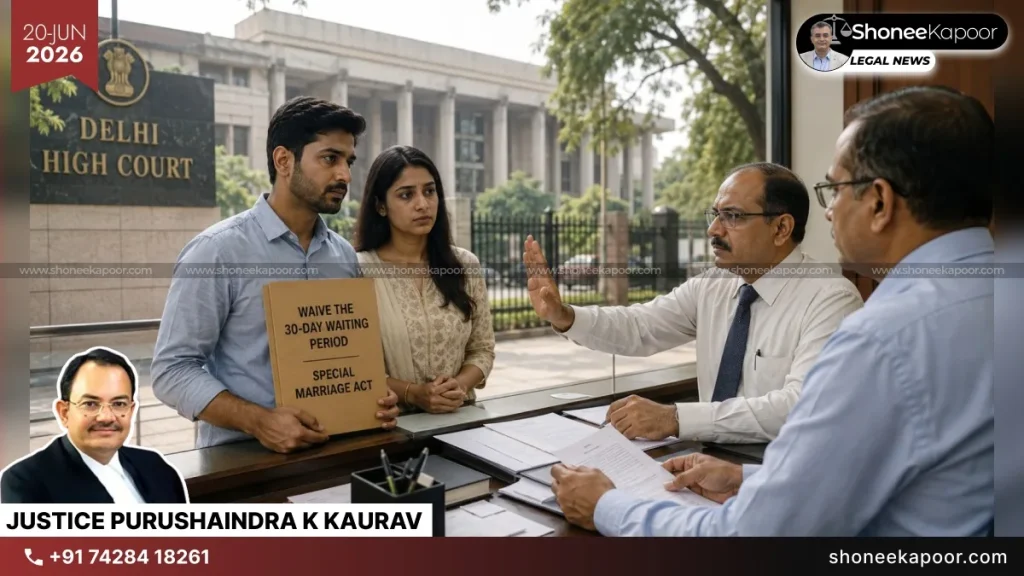
Can courts create an exception where the law gives no waiver? Delhi High Court said No. Courts cannot rewrite the Special Marriage Act or add a waiver power that Parliament never provided.
NEW DELHI: TheDelhi High Court, through Justice Purushaindra Kumar Kaurav, has refused to waive or shorten the 30-day statutory waiting period under the Special Marriage Act, 1954, holding that courts cannot direct authorities to act against the clear mandate of law.
The petition was filed by a couple against the Delhi Government and the concerned authority. They wanted the Marriage Officer to relax the 30-day notice period and solemnize or register their marriage before 10 June 2026.
The petitioners had submitted their notice of intended marriage before the Marriage Officer, Kalkaji, on 11 May 2026 under Section 5 of the Special Marriage Act, which the Court referred to as “the Act of 1954”.
Since the statutory period had not expired, the marriage was scheduled for 19 June 2026. The petitioners told the Court that petitioner no.1 had secured employment abroad and had to join before 10 June 2026. They argued that waiting till 19 June would cause grave hardship because of foreign relocation.
The couple relied on earlier judgments including Pranav Kumar Mishra and Safiya Sultana, but the Delhi High Court said those cases were different. Pranav Kumar Mishra dealt with sending notices to residential addresses and through the Station House Officer, called “SHO”, for address verification. Safiya Sultana dealt with liberty, privacy, choice of partner and social interference.
The Delhi High Court held that the law, as it stands today, allows solemnization of marriage only after expiry of the prescribed 30-day period. The Court made it clear that writ courts under Article 226 cannot compel statutory authorities to violate the statute.
The Court relied on the settled rule that when law requires something to be done in a particular manner, it must be done in that manner only. It observed that courts cannot create an exception where Parliament has not provided one.
The Court also referred to the Supreme Court’s warning that no court can issue directions which force authorities to act against law, because such directions “may result in destruction of rule of law.”
The High Court further held that the 30-day period is not just a technical formality. It is part of the legislative scheme of the Special Marriage Act. Therefore, the Marriage Officer cannot be directed to solemnize the marriage before the statutory period ends.
The Court said personal hardship or inconvenience, even if genuine, cannot be a ground to bypass mandatory legal compliance. It referred to the legal maxim dura lex sed lex, meaning:
“The law is hard, but it is the law”.
The Court also relied on another legal maxim, “A verbis legis non est recedendum”, meaning:
“From the words of law, there must be no departure”.
In simple words, the Court said it cannot rewrite the Special Marriage Act. It cannot add a power of waiver when the statute itself does not provide such power.
Finally, the Delhi High Court held that there was no justifiable ground to waive or curtail the 30-day statutory period. It said granting such relief would mean directing the authorities to act against the express mandate of law.
The writ petition was dismissed as devoid of merit.
EXPLANATORY TABLE: LAWS AND SECTIONS INVOLVED
| Law / Section | Purpose | How It Applied In This Case |
| Special Marriage Act, 1954 | Law for civil marriage irrespective of religion | Marriage was sought under this Act. |
| Section 5, Special Marriage Act | Notice of intended marriage to Marriage Officer | Notice was filed on 11 May 2026. |
| Section 6, Special Marriage Act | Publication of marriage notice | Court noted the statutory notice process. |
| Section 7, Special Marriage Act | Objections to intended marriage | Linked with the 30-day waiting period. |
| Section 15, Special Marriage Act | Conditions for marriage registration | Referred through Section 16. |
| Section 16, Special Marriage Act | Registration after notice and 30 days for objections | Court relied on this to refuse waiver. |
| Article 226, Constitution of India | High Court’s writ power | Court said writ cannot override statute. |
| Writ of Mandamus | Court direction to public authority | Relief was refused as contrary to law. |
| Dura Lex Sed Lex | “The law is hard, but it is the law” | Hardship could not bypass the statute. |
| A Verbis Legis Non Est Recedendum | “From the words of law, there must be no departure” | Court refused to rewrite the Act. |
CASE DETAILS
- Case Title: Syed Fayazuddin and Anr v. Government of NCT of Delhi and Anr
- Court: High Court of Delhi at New Delhi
- Case Number: W.P.(C) 7103/2026
- Bench: Hon’ble Mr. Justice Purushaindra Kumar Kaurav
- Neutral Citation: 2026:DHC:4935
- Date of Decision: 21.05.2026
- Counsels:
- For Respondents: Mr. Mohit Aggarwal and Mr. Prerak Khurana, Advocates
KEY TAKEAWAYS
- Marriage under Special Marriage Act is not an emotional shortcut; the 30-day legal waiting period has to be respected.
- Personal urgency, foreign job or relocation cannot override a mandatory statutory procedure.
- Courts cannot force Marriage Officers to break the law, even when hardship appears genuine.
- Men must understand legal timelines before planning marriage, travel, job joining or foreign settlement.
- Rule of law protects everyone; once courts start bending statutes for convenience, legal certainty collapses.
This Could Change Your Case-Get FREE Legal Advice-Click Here!
Disclaimer: The views and opinions expressed in this article are those of the Indian courts and do not necessarily reflect the official policy or position of “ShoneeKapoor.com” or its affiliates. This article is intended for informational and educational purposes only. The content provided is not legal advice, and viewers should not act upon this information without seeking professional counsel. Viewer discretion is advised.