
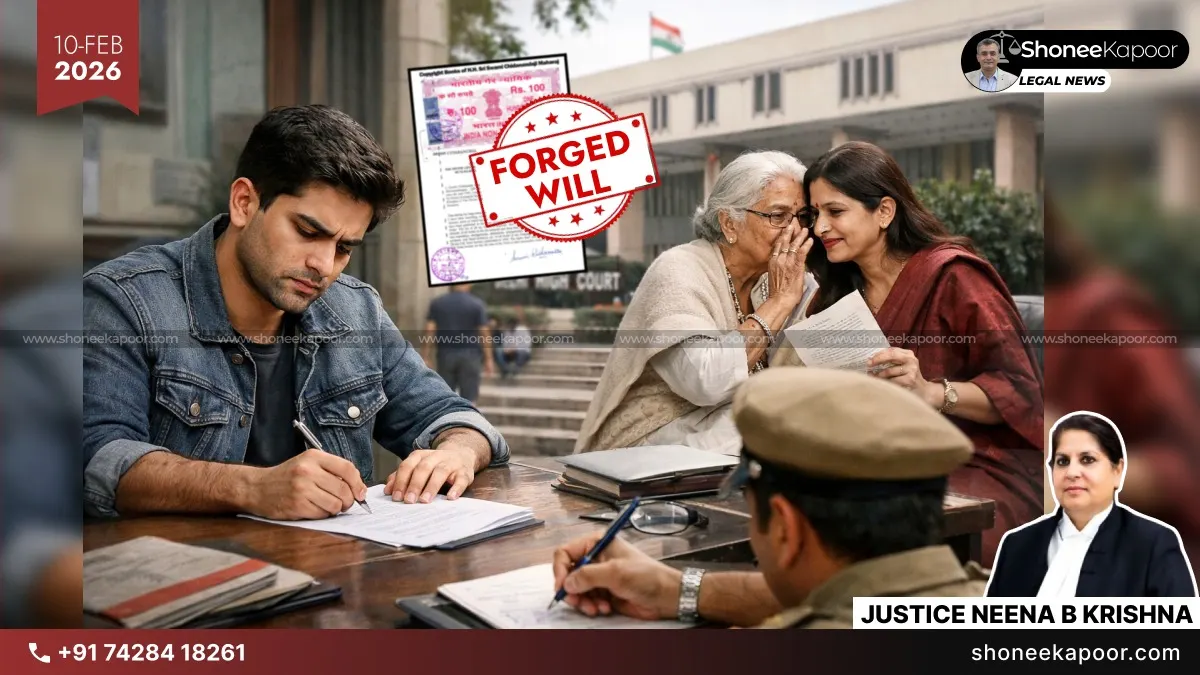
The Delhi High Court refused to stop an FIR alleging forgery of a father’s Will that excluded his son. The Court held that criminal investigation can continue even while probate proceedings are pending.
NEW DELHI: The Delhi High Court, through Justice Neena Bansal Krishna, has delivered a significant judgment explaining a common misconception faced by families involved in Will disputes. The Court made it clear that when allegations of forgery are raised, criminal law cannot be blocked merely by pointing out that a probate or civil case is already pending.
The case revolved around a registered Will executed in 2011 by the late Narender Kishore Khanna. After his death, his sister and mother initiated probate proceedings to obtain legal recognition of the Will. The deceased’s son opposed the Will from the very beginning and claimed it was forged. This challenge continued for years in the probate court.
During the pendency of the probate case, the son relied on a private handwriting expert’s report and approached the Magistrate, alleging that the Will was forged and had been used to deprive him of his legal rights. The Magistrate found that the allegations disclosed cognizable offences and directed registration of an FIR under Sections 467 and 471 of the IPC, which deal with forgery and use of forged documents.
The petitioner then approached the High Court seeking quashing of the FIR. The main argument was simple: since the probate case was already pending and the Will’s validity was under examination, no criminal case should be allowed to continue. It was argued that the dispute was purely civil in nature.
The High Court rejected this argument and explained the legal position in very clear terms. The Court observed that civil proceedings and criminal proceedings operate in different fields. A probate court examines whether a Will is legally valid based on civil standards of proof. A criminal court, on the other hand, examines whether a document was forged with dishonest intention, which is a serious offence against society.
While explaining this distinction, the Court referred to settled principles laid down by the Supreme Court, including the view expressed in Sardool Singh vs. Nasib Kaur, Kamaladevi Agarwal vs. State of West Bengal, and Syed Askari Haid Ali Augustine Iman vs. State (Delhi Administration), which collectively clarify that there is no absolute bar on criminal proceedings merely because a civil dispute is pending.
The Court emphasised the broader message reiterated by the Supreme Court that criminal prosecution should not be stalled simply because civil proceedings are ongoing. In this context, reliance was placed on the principle articulated in M.S. Sheriff vs. State of Madras, where the Supreme Court observed:
“As between the civil and the criminal proceedings, we are of the opinion that the criminal matters should be given precedence”, and further explained that “a civil suit often drags on for years, and it is undesirable that a criminal prosecution should wait till everybody concerned has forgotten all about the crime. The public interests demand that criminal justice should be swift and sure; that the guilty should be punished while the events are still fresh in the public mind and that the innocent should be absolved as early as is consistent with a fair and impartial trial.”
The Delhi High Court further reiterated that at the stage of quashing an FIR, the High Court is not expected to weigh evidence or decide the truth or falsity of allegations. That task squarely belongs to the investigating agency and the trial court.
The Court cautioned that quashing an FIR at an early stage would amount to premature determination of disputed questions of fact.
The judgment also underlined another crucial legal principle drawn from decisions such as Neeharika Infrastructure Pvt. Ltd. vs. State of Maharashtra and State of Haryana vs. Bhajan Lal. Even if a document is ultimately held invalid in civil proceedings, that alone does not determine criminal liability.
Allegations of forgery, cheating, impersonation, and use of forged documents are independent criminal offences and carry penal consequences irrespective of the outcome of civil litigation.
The Court reiterated the Supreme Court’s clear warning that High Courts must not conduct mini-trials while exercising powers to quash FIRs. It reaffirmed the settled position that courts should not assess the reliability or correctness of allegations at the investigation stage and must allow the police to perform their statutory duty of investigation.
The Court noted that the FIR in this case was not based on vague allegations. It was based on specific claims of forgery, conspiracy, impersonation, and use of forged documents.
The Magistrate had found that a police investigation was necessary to uncover the truth, including examination of signatures, thumb impressions, registration records, and other material.
The High Court made it clear that merely calling a dispute “civil” cannot shield an accused from criminal investigation. If such an argument is accepted, it would allow accused persons to defeat criminal law simply by filing or continuing civil proceedings.
The Court also referred to the principle that quashing should be an exception and not the rule. Investigation should be stopped only when an FIR does not disclose any offence at all. In the present case, the allegations clearly disclosed cognizable offences.
In its concluding remarks, the Court held that there was no legal ground to interfere with the FIR at this stage. It was observed that the investigation must proceed and the truth must come out through a proper legal process.
The High Court refused to express any opinion on whether the Will was genuine or forged, stating that such findings can only be made after investigation and trial.
With these observations, the Delhi High Court dismissed the petition and allowed the criminal investigation to continue, sending a strong message that allegations of forgery cannot be brushed aside merely because a civil case is pending.
Explanatory Table: Laws And Sections Involved
| Law / Section | Purpose | How Applied In This Case |
| Article 226 of the Constitution of India | Gives High Courts power to issue directions, orders, or writs to protect legal rights | The petitioner used this to seek quashing of the FIR |
| Section 482 CrPC | Inherent powers of High Court to prevent abuse of process of law | Invoked to request quashing of FIR |
| Section 156(3) CrPC | Power of Magistrate to order police to register FIR and investigate | Magistrate used this provision to direct registration of FIR |
| Section 200 CrPC | Procedure for filing private complaint before Magistrate | Complaint was filed under this provision |
| Section 202 CrPC | Magistrate’s power to postpone issue of process and inquire further | Argument was made that inquiry under this was sufficient instead of FIR |
| Section 91 CrPC | Power to summon documents or records during investigation | Used to call for certified copy of Will from Sub-Registrar |
| Section 173 CrPC | Filing of final police report after investigation | Referenced in discussion on investigation stage |
| Section 467 IPC | Punishment for forgery of valuable security, Will, etc. | FIR registered alleging forged Will |
| Section 471 IPC | Using forged document as genuine | Allegation that forged Will was used in probate proceedings |
| Section 448 IPC | House trespass | Referred in precedent case involving similar legal principles |
| Section 68 of Evidence Act | Requirement of proving execution of Will through attesting witnesses | Important in probate proceedings |
| Section 45 of Evidence Act | Opinion of handwriting expert as evidence | Handwriting expert report formed basis of complaint |
| Indian Succession Act | Governs Wills and probate | Probate case regarding validity of Will pending |
| Bhajan Lal Principles (State of Haryana vs. Bhajan Lal) | Guidelines for quashing FIR | Court applied these principles to refuse quashing |
| Neeharika Infrastructure Pvt. Ltd. Vs. State of Maharashtra | Supreme Court guidelines on quashing FIR and stopping investigation | Court relied on this to allow investigation to proceed |
| M.S. Sheriff vs. State of Madras | Criminal cases should generally take precedence over civil cases | Court quoted this to justify continuation of FIR |
Case Details
- Case Title: Babita Chopra vs. The State (GNCT of Delhi) & Anr.
- Case Number: W.P. (CRL.) 2202/2024
- Court: High Court Of Delhi
- Bench: Hon’ble Ms. Justice Neena Bansal Krishna
- Neutral Citation: 2026:DHC:341
- FIR Details:
- FIR No.: 197/2024
- Police Station: Laxmi Nagar, Delhi
- Sections Invoked: 467/471 IPC
- Dates:
- Judgment Reserved On: 27th November, 2025
- Judgment Pronounced On: 15th January, 2026
- Counsels:
- For Petitioner: Mr. Vineet Mehta, Advocate, and Mr. Prakhar Sharma, Advocate
- For State: Mr. Amol Sinha, ASC (CRL), Mr. Kshitiz Garg, Advocate, Mr. Ashvini Kumar, Advocate, and Mr. Nitish Dhawan, Advocate
Key Takeaways
- Civil disputes are often used as a shield to delay or manipulate outcomes, but criminal law works on a separate track and cannot be blocked just by keeping a matter pending in civil court.
- Allegations alone should not become a tool for harassment; investigation must be objective, evidence-based, and free from emotional or familial pressure.
- Private expert opinions are not final truth and must always be tested through proper legal process, cross-examination, and independent scrutiny.
- Courts must avoid turning preliminary stages into punishment and should ensure that legal processes are not misused to settle personal or property disputes.
- Men involved in family and inheritance disputes must stay legally prepared, document everything carefully, and avoid being cornered by narrative-driven allegations rather than proven facts.
This Could Change Your Case-Get FREE Legal Advice-Click Here!
Disclaimer: The views and opinions expressed in this article are those of the Indian courts and do not necessarily reflect the official policy or position of “ShoneeKapoor.com” or its affiliates. This article is intended for informational and educational purposes only. The content provided is not legal advice, and viewers should not act upon this information without seeking professional counsel. Viewer discretion is advised.
