
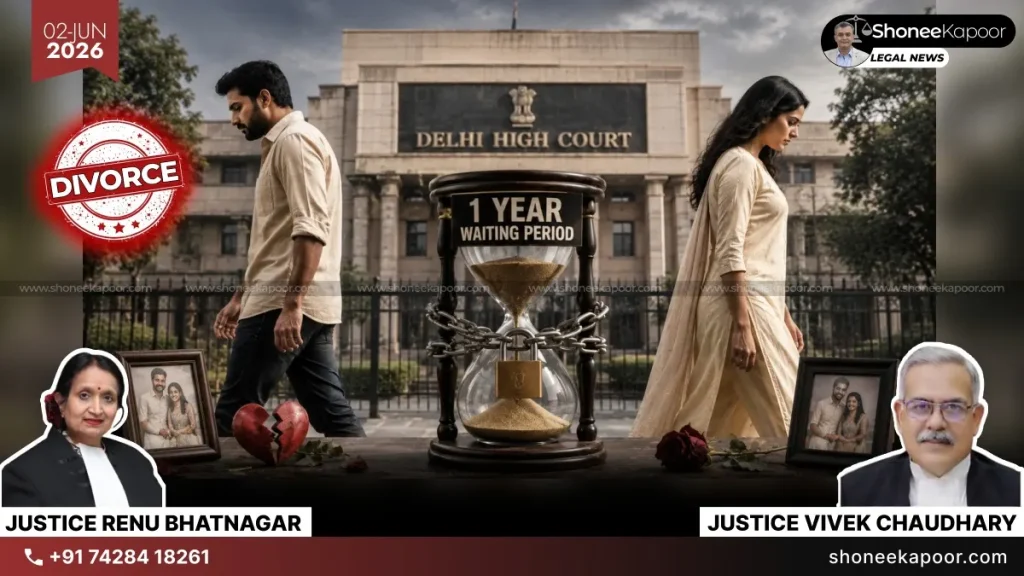
Can a couple be forced to wait one year for divorce when there is no chance of reconciliation?
The Delhi High Court observed that legal procedures should not prolong hardship and allowed waiver of the waiting period in a case involving exceptional circumstances.
NEW DELHI: In an important judgment delivered on May 29, 2026, Justice Vivek Chaudhary and Justice Renu Bhatnagar of the Delhi High Court held that courts can waive the statutory one-year waiting period under the Special Marriage Act in exceptional circumstances where continuing the marriage serves no meaningful purpose.
The case involved a couple from different faiths who had solemnized their marriage under the Special Marriage Act. However, the marriage never progressed beyond the legal formalities. The parties never lived together, never consummated the marriage, and never received acceptance from their families. The relationship effectively ended before it could begin as a real marital partnership.
The Family Court had refused to waive the statutory waiting period and dismissed the mutual consent divorce petition, observing that the circumstances did not amount to exceptional hardship and that sufficient efforts had not been made to save the marriage.
The Delhi High Court disagreed with that approach. While examining the purpose of the law, the Court explained that waiting periods are intended to protect marriage as an institution and provide an opportunity for reconciliation. At the same time, the law also recognizes that certain cases are so unusual that insisting on rigid timelines would only increase the suffering of the parties.
Referring to an earlier Full Bench decision, the Court reiterated that:
“The statutory period of 01-year prescribed under section 13B(1) of the HMA as a pre-requisite for presenting the first motion, can be waived”
and that such relief can be granted where circumstances of “exceptional hardship to the petitioner” exist.
After considering the facts, the Court found that the marriage was merely notional and existed only on paper. There was no cohabitation, no marital relationship, no child from the wedlock, and no realistic possibility of reconciliation. Both parties had already reached a mutual decision to separate.
The High Court observed that forcing such parties to wait for the statutory period would not revive the marriage or serve the objective of the law. Instead, it would only prolong emotional, social and personal hardship. The Court emphasized that judicial discretion exists precisely to deal with such extraordinary situations.
Significantly, the Court held that the severe family consequences faced by the parties constituted “exceptional hardship” within the meaning of the Special Marriage Act. It further observed that insisting upon the statutory period in such circumstances-
“Would serve no meaningful purpose” and “would only result in prolongation of hardship.”
Setting aside the Family Court’s order, the Delhi High Court allowed waiver of the one-year waiting period and directed that the mutual consent divorce proceedings be taken up without insisting on the statutory separation requirement.
Explanatory Table: Laws And Sections Involved
| Law / Section | Purpose of the Provision | How It Applied In This Case |
| Section 19(1), Family Courts Act, 1984 | Provides right to appeal against Family Court judgments before the High Court | The husband filed the appeal under this provision challenging the Family Court’s order |
| Section 29, Special Marriage Act, 1954 | Restricts filing of divorce petitions within one year of marriage, but permits waiver in exceptional hardship cases | Central issue before the Court; waiver was ultimately granted |
| Section 28, Special Marriage Act, 1954 | Governs divorce by mutual consent under the Special Marriage Act | Parties sought divorce through mutual consent |
| Section 28(2), Special Marriage Act, 1954 | Contains the second motion stage and cooling-off requirement in mutual consent divorce | Court directed Family Court to consider the second motion expeditiously |
| Section 28(1), Special Marriage Act, 1954 | Governs presentation of the first motion petition for mutual consent divorce | Family Court directed to entertain the petition despite the one-year restriction |
| Section 14, Hindu Marriage Act, 1955 | Restricts divorce petitions within one year of marriage, subject to exceptional hardship | Court held that Section 29 SMA is pari materia to Section 14 HMA |
| Section 13B(1), Hindu Marriage Act, 1955 | Prescribes conditions and waiting requirements for mutual consent divorce | Referred to through Full Bench precedent for interpreting SMA provisions |
| Section 13B(2), Hindu Marriage Act, 1955 | Provides six-month cooling-off period before final divorce decree | Court referred to precedents permitting waiver in suitable cases |
Case Details
- Case Title: Shahbaz Khan v. Komal Shresth
- Case Number: MAT.APP.(F.C.) 60/2026 & CM APPL. 11752/2026
- Court: Delhi High Court
- Bench: Justice Vivek Chaudhary | Justice Renu Bhatnagar
- Neutral Citation: 2026:DHC:4767-DB
- Date Of Judgment: 29 May 2026
- Counsels:
- For Appellant: Ms. Khalida Akhtar, Mr. Abdullah Akhtar and Mr. Maaz Akhtar, Advocates
- For Respondent: Mr. Shadaan, Advocate
Key Takeaways
- Legal procedures should facilitate justice and not prolong hardship where there is no realistic possibility of reconciliation.
- Courts have the discretion to waive statutory waiting periods in genuinely exceptional circumstances.
- Family disputes must be decided based on practical realities rather than a purely technical interpretation of the law.
- Waiting periods are intended to preserve viable marriages, not relationships that have effectively broken down from the outset.
- Judicial discretion plays an important role in ensuring that legal safeguards do not become obstacles to fair and timely relief.
This Could Change Your Case-Get FREE Legal Advice-Click Here!
Disclaimer: The views and opinions expressed in this article are those of the Indian courts and do not necessarily reflect the official policy or position of “ShoneeKapoor.com” or its affiliates. This article is intended for informational and educational purposes only. The content provided is not legal advice, and viewers should not act upon this information without seeking professional counsel. Viewer discretion is advised.