
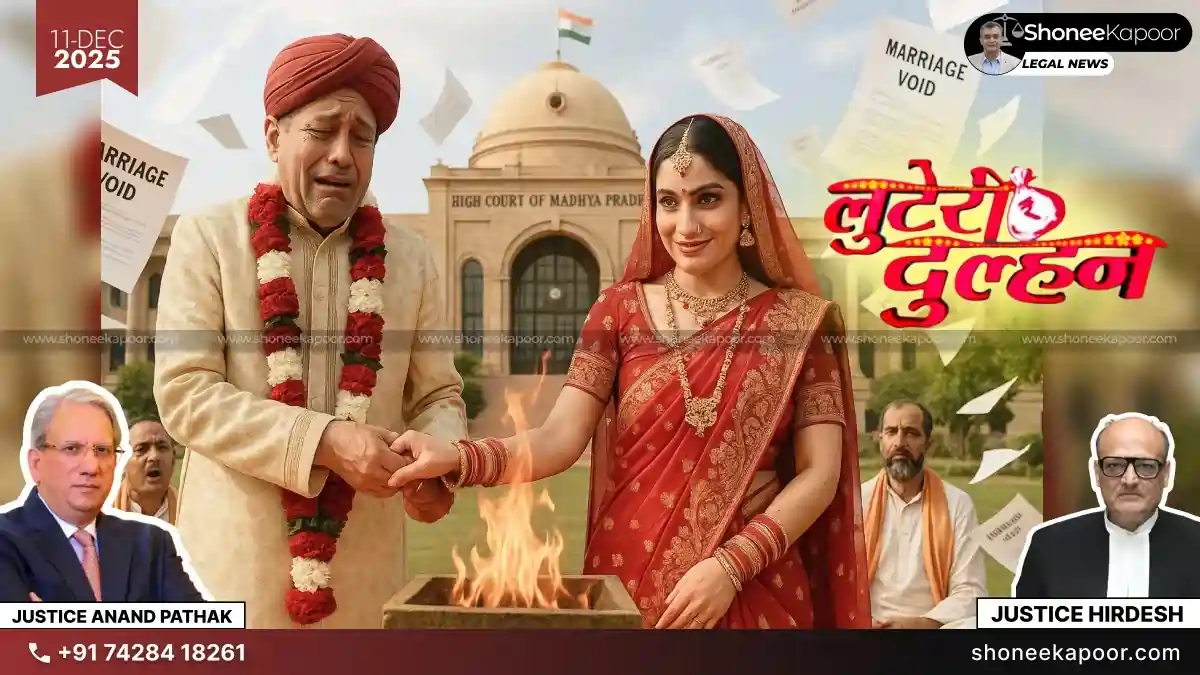
Marriage Void Without Sacred Fire, Pheras & Saptapadi: MP High Court Shuts Down Fake Arya Samaj Shaadi Used To Trap An Elderly Man

Written and analysed by Vaibhav Ojha
Head Of Legal CommunicationsThe Madhya Pradesh High Court has ruled that an Fake Arya Samaj marriage certificate cannot prove a valid Hindu marriage unless essential rituals—especially Saptapadi—are actually performed. The Court declared that the woman in this case was not the legally wedded wife, as no sacred ceremonies were proved.
Shuts Down Fake Arya Samaj Shaadi: The Madhya Pradesh High Court has made it clear that simply having an Arya Samaj marriage certificate is not enough to prove a valid Hindu marriage. The Court held that a marriage cannot be recognised under the Hindu Marriage Act unless essential ceremonies—like sacred fire, pheras and especially Saptapadi—are actually performed.
A Division Bench of Justice Anand Pathak and Justice Hirdesh set aside a Family Court judgment that had wrongly declared a woman as the legally wedded wife of a 75-year-old retired company commander. The High Court said the trial court had committed a serious error by treating the Arya Samaj certificate and register entry as conclusive proof of marriage.
The Court explained that under Hindu law, marriage is not just an event or celebration but a sacred union that must satisfy the requirements of Section 7 of the Hindu Marriage Act.
As the judges observed:
“In Hindu religion, marriage is a sacrament and has a sacred character. Marriage is not an event for mere ‘song and dance’ or ‘wining and dining.’ Hindu marriage is conducted as per Vedic procedure, which includes customs and rites such as Kanyadana, Panigrahan, Saptapadi, and chanting of mantras while applying vermilion. Any Hindu marriage solemnized in accordance with Vedic procedure constitutes a valid marriage if it fulfills requirements of Section 7 of Hindu Marriage Act. Hindu marriage facilitates procreation, consolidates unit of family, and strengthens spirit of fraternity within various communities.
Marriage is sacred in that it provides a lifelong, dignity-affirming, equal, consensual, and healthy union of two individuals, acknowledging both material and spiritual aspects of lives of married couple.”
Court’s Key Observation on Missing Rituals
When the Court examined the evidence, it found that no witness confirmed the performance of Saptapadi or any other essential ceremony. Even the photographs produced did not show sacred fire, pheras, or Saptapadi.
The Court specifically noted:
“On perusal of evidence of both parties as well as impugned record, it reveals that witnesses…of Arya Samaj, as well as respondent herself, never stated that Saptpadi or any other essential ceremony was performed. The photographs produced on behalf of respondent before the Trial Court do not depict any sacred fire, pheras, or Saptpadi. There is no evidence that both parties were followers of the Arya Samaj or that rituals prescribed under the Arya Marriage Validation Act were followed.
Consequently, material on record fails to establish factum of valid ‘Hindu marriage’ as defined under Section 7 of the Hindu Marriage Act…Therefore, it is found that the Trial Court erred in treating Arya Samaj certificate (Ex.D-3) and register entry (Ex.D-4) as conclusive proof of marriage. Essential ceremonies of Hindu marriage, particularly Saptpadi, were not proved”.
The Court also relied on the Supreme Court judgment in Dolly Rani v. Manish Kumar Chanchal, where the apex court explained the meaning of “solemnised marriage” and the mandatory nature of ceremonies.
The Supreme Court had held:
“Section 7 of the Act speaks of the ceremonies of a Hindu marriage… Unless and until the marriage is performed with appropriate ceremonies and in due form, it cannot be said to be ‘solemnised’… Where a Hindu marriage is not performed in accordance with the applicable rites or ceremonies, such as Saptapadi when included, the marriage will not be construed as a Hindu marriage… a mere issuance of a certificate… would neither confer any marital status upon the parties nor establish a marriage under Hindu law.”
Facts of the Case: Allegations of Blackmail & Concealed Marriages
The original plaintiff, late Brahmswaroop Sharma, was a 75-year-old widower. He published a matrimonial advertisement for his son, after which the respondent woman contacted him. He alleged that she took advantage of his loneliness, repeatedly visited his home, and eventually blackmailed him. He claimed she had multiple previous marriages and obtained a fabricated Arya Samaj marriage certificate dated 26 March 2012.
He also argued that she had disclosed another husband’s name—Ashok Sharma—during her arrest in a criminal case under the Immoral Traffic (Prevention) Act. Furthermore, he claimed she had a pattern of keeping multiple husbands to gain money and pension benefits.
The woman denied all allegations and insisted that the marriage was genuine. She argued that she had married the plaintiff legally through Arya Samaj and that the suit should be dismissed for lack of notice and proper pleadings.
The Family Court dismissed the suit and accepted her claim, holding that the plaintiff failed to prove invalidity of marriage.
High Court: No Marriage in the Eyes of Law
After reviewing all evidence and legal principles, the High Court held that no valid marriage ever took place because:
- No sacred rituals were proved
- No Saptapadi was performed
- Photographs did not show Vedic procedures
- There was no evidence they belonged to Arya Samaj
- A mere certificate cannot create a marriage
The Bench concluded that the Family Court’s judgment suffered from “misreading of evidence” and incorrect application of law.
Final Order
The High Court declared that the woman was not the legally wedded wife and that the Arya Samaj certificate dated 26 March 2012 did not prove any marriage. A permanent injunction was also granted, preventing her from claiming any marital rights.
Explanatory Table Of All Laws & Sections Mentioned
| Law / Section | What It Says (Simple Explanation) | Relevance in This Case |
| Section 7 – Hindu Marriage Act, 1955 | Hindu marriage must be solemnised with proper customary rites. If Saptapadi is part of custom, the marriage becomes valid only when the 7th step is taken around the sacred fire. | Court held that no Saptapadi, no sacred fire, no pheras were proved. Therefore, no valid Hindu marriage took place. |
| Section 5 – Hindu Marriage Act, 1955 | Lists conditions for a valid Hindu marriage, including that neither party should have a living spouse at the time of marriage. | Respondent allegedly had earlier marriages (Ashok Sharma / Aashiq Kalbhor). If true, then any later marriage is void. |
| Section 8 – Hindu Marriage Act, 1955 | Registration of marriage is allowed for documentation but does not itself create a valid marriage. | Arya Samaj certificates (Ex-D3, D4) cannot prove marriage without actual rituals. |
| Section 19 – Family Courts Act, 1984 | Provides for appeals to the High Court from Family Court judgments. | Used by the appellant’s son to file the present appeal. |
| Section 80(2) – Code of Civil Procedure (CPC) | Certain suits against the government require notice before filing. | Respondent falsely argued suit not maintainable for lack of notice. Court did not accept this as grounds to validate marriage. |
| Section 370(2) – IPC | Relates to human trafficking and exploitation. | Respondent was arrested earlier; during arrest she gave the name “Ashok Sharma” as her husband — used by appellant to show she had another spouse. |
| Sections 4–8 – Immoral Traffic (Prevention) Act | Offences related to trafficking, prostitution, running brothels, etc. | Respondent was charged earlier; documents mentioned another husband’s name, supporting appellant’s case that she concealed marriages. |
| Article 142 – Constitution of India (Referenced via Supreme Court case) | Empowers Supreme Court to pass orders “to do complete justice”. | Quoted in the Dolly Rani case that clarified Saptapadi is mandatory if part of custom. |
| SLP No. 15315/2022 (Reference) | Supreme Court stayed certain observations regarding Arya Samaj institutions. | Respondent tried to rely on this, but High Court said rituals still must be proved, not assumed. |
Case Summary
- Case Title: Brahmswaroop Sharma (Dead) Through LR Ashwini Kumar vs. Smt. Kiran Sharma
FA-1998-2024 - Bench (Judges): Hon’ble Justice Anand Pathak & Hon’ble Justice Hirdesh
Counsels
For Appellant (Plaintiff / Legal Representative):
- Senior Advocate Harish Dixit
- Advocate Parth Dixit
For Respondent (Woman claiming marital status):
- Advocate Madan Mohan Shrivastava
Case Facts
- The original plaintiff was 75-year-old retired Company Commander, widower, living alone.
- Respondent contacted him after he published a matrimonial advertisement.
- Plaintiff alleged she:
- Took advantage of his loneliness
- Concealed multiple past marriages
- Obtained a fabricated Arya Samaj certificate dated 26.03.2012
- Was already married (Ashok Sharma / Aashiq Kalbhor)
- Was involved in a criminal case mentioning another husband
- Was in the habit of blackmailing men
- Respondent denied all allegations and claimed she married him through Arya Samaj after her divorce.
- Trial Court dismissed plaintiff’s suit.
- High Court examined photographs, witnesses, rituals, legal requirements.
Final Holding of the High Court
- No Saptapadi → No valid marriage
- Arya Samaj certificate is NOT proof of marriage
- Respondent is NOT the legally wedded wife
- Permanent injunction granted restraining her from:
- Claiming marital rights
- Interfering in family matters
- Trial Court judgment set aside
Key Takeaways
- An Arya Samaj certificate alone cannot force a man into a marriage; without sacred fire, pheras and Saptapadi, there is no valid Hindu marriage.
- High Court exposed how fabricated certificates are misused to trap men into false marital claims.
- The woman’s previous marriages and contradictory statements showed how easily men can be targeted through concealment and manipulation.
- Trial Court’s blind acceptance of a certificate was overturned, proving that men have the right to challenge fraudulent marriages.
- The judgment reinforces that marriage under law requires real rituals and genuine consent, not paperwork created to claim money, rights or benefits from men.
This Could Change Your Case-Get FREE Legal Advice-Click Here!
Disclaimer: The views and opinions expressed in this article are those of the Indian courts and do not necessarily reflect the official policy or position of “ShoneeKapoor.com” or its affiliates. This article is intended for informational and educational purposes only. The content provided is not legal advice, and viewers should not act upon this information without seeking professional counsel. Viewer discretion is advised.
Related Articles
Can Husband Stop Maintenance If Wife Is Working? Indian Law, Supreme Court Judgments & The Reality Men Must Know
Can a husband stop paying maintenance if wife is working in India? Read the latest legal position, Supreme Court judg...
Relevant Judgements
Can an NRI Husband Be Forced to Pay Maintenance in India? Supreme Court Rules Explained for Overseas Indian Men
Living abroad does not automatically protect an NRI husband from maintenance claims in India.But can Indian courts pa...
Share Your Thoughts
Comments are moderated before publication.