
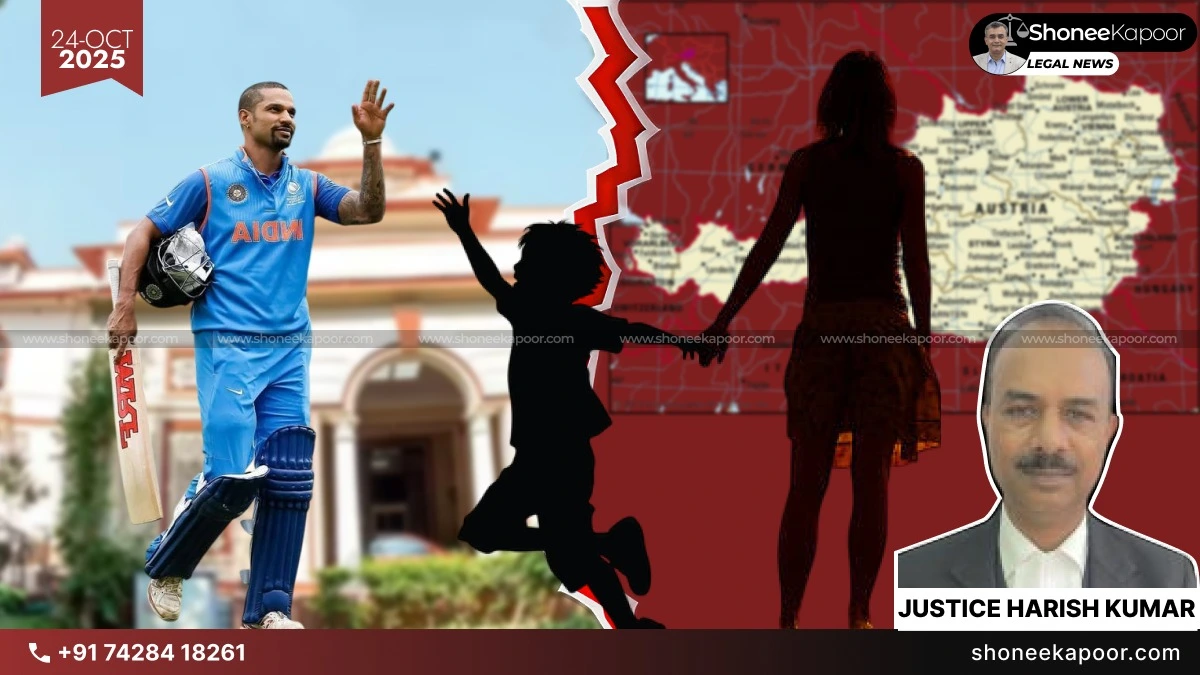
Not Just a Cricketer, a Father Fighting the System: Shikhar Dhawan’s Court Win Is Every Man’s Story

Curated by NEWS DESK
Editorial DeskIn a landmark judgment, the court held that no parent has an exclusive right over a child and that alienating a father from his son amounts to mental cruelty — a crucial precedent for shared parenting in India.
NEW DELHI: On June 6, 2023, the Patiala House Family Court in New Delhi, presided over by Judge Harish Kumar, issued a landmark ruling in Aesha Dhawan v. Shikhar Dhawan where the court ordered that Dhawan’s young son Zoravar be brought to India from Australia for a family reunion and to meet his father after years of forced separation. The cricket player had repeatedly requested visitation rights under Section 26 of the Hindu Marriage Act, 1955, after his estranged wife, Australian-born Aesha Dhawan, allegedly denied him access to his son. This order came after a protracted legal and emotional battle.
In 2012, Shikhar Dhawan and Aesha tied the knot, and in 2013, their son was born. What started out as a picture-perfect marriage quickly devolved into a story of parental alienation, emotional manipulation, and unrelenting financial demands. Aesha was charged by Dhawan with: denying him access to his son’s emotions and contact; giving the court misleading information in order to prevent visitation; financial exploitation by means of pressures related to property and maintenance; defamation and public humiliation via private and internet communications.
Dhawan made numerous attempts to stay in touch with his child in spite of his international cricket commitments. He travelled to Australia, paid for all of the costs, and even rescheduled family events to coincide with the boy’s school breaks. Aesha made a false claim that the school was open when the court first denied his request to take the boy to India. Dhawan reapplied after demonstrating that the child’s school was closed for the holidays, which resulted in the landmark June 6, 2023, order acknowledging his right to see his son.
Court’s Findings
The ruling from the Delhi Family Court served as a mirror for the battles many Indian fathers face to gain access to and affection for their own children. When granting Dhawan’s application, Judge Harish Kumar made a number of poignant and compassionate remarks.
The Court noted that “the mother alone does not have the right over the child”, emphasising that both parents share equal emotional and moral obligations. It also rebuked the wife’s contradictory conduct; first claiming school schedules to block visitation, then objecting even when holidays matched the rescheduled date. The court has stated: “Why then is she opposing the petitioner meeting his own child when the respondent admits he is not a bad father?” Despite the father’s demonstrated love and involvement, the court determined that this kind of resistance amounted to mental and emotional cruelty.
According to the Court, a child’s right to emotional stability and reciprocal parental love are essential components of their welfare. It remarked: “The more the restriction in meeting the child, the more would be the distance between the two.” It cautioned that supervised visitation and overly protective custody might cause the boy to become psychologically estranged from his father, which is never good for the child.
The wife’s allegations of the child’s “panic and unwillingness”, the court determined, were an afterthought that had never been brought up in previous pleadings. It acknowledged this as a calculated barrier to prevent entry. The judge noted that Dhawan would not have legitimately asked the court for custody permission if he had any malice. “If the petitioner had intended to take the law into his own hand for taking custody of the child, he would not have approached the court in India.”
Aesha Dhawan had claimed that the child was placed on a “watch list” by an Australian Family Court order, which limited his travel without her permission. Nothing stopped her from taking the child with her or sending him through a reliable person, the Delhi Court ruled, dismissing this as unimportant. The judge made the observation that fatherhood cannot be denied by jurisdiction.
Aesha Dhawan had alleged that an Australian Family Court order had put the child on a “watch list” and restricted his travel without getting her consent. The Delhi Court dismissed this as irrelevant and decided that nothing prevented her from taking the child with her or sending him through a trustworthy individual. The judge made the observation that fatherhood cannot be denied by jurisdiction.
Shikhar Dhawan’s continued commitment as a responsible father was demonstrated by the Court’s order to cover all travel, boarding, and lodging expenses while granting the petition. Because Aesha “is not working for gain” and maintenance proceedings are still pending, it denied his request that she cover the cost of the trip.
The court directed:
Child Zoravar to be brought to Delhi by 27 June 2023 and the Custody to be handed to Shikhar Dhawan on 28 June 2023 at 10 a.m. He shall be returned to Australia by 04 July 2023.Additionally, If Aesha is unable to travel, she must inform within 72 hours, enabling Dhawan to travel and bring the child himself. She must obtain and provide visa/clearance documents by 17 June 2023.
Legal Significance of the Judgement
This decision goes far beyond a celebrity custody dispute; it is a landmark decision in gender-neutral family law and serves as a reminder that a father’s love is unconditional. In a high-profile case, the Delhi Family Court recognised for the first time that, according to matrimonial law, denying a father emotional access to his child is cruel in and of itself. It cautioned against parental alienation turning into a form of emotional punishment and re-centred fatherhood as an equal pillar of a child’s welfare.
This matter reflects a growing judicial consciousness that custody battles are not about winning against a spouse but about preserving the child’s right to both parents. The court’s empathy for the father’s emotional pain marks a shift from decades of mother-centric custody practice toward a more balanced, compassionate interpretation of justice. Wherein the court has stated : “Mother alone does not have right over the child.”
“Respondent must demonstrate in reality her gesture of not willing to come in between the father and the son.”
Explanatory Table of Laws & Sections Mentioned
| Law / Case | Section | Explanation / Relevance in this Case |
| Hindu Marriage Act, 1955 | Section 26 | Empowers the court to decide interim custody, education, and maintenance of minor children during matrimonial proceedings. Dhawan invoked this to seek visitation and custody of his son. |
| Code of Civil Procedure, 1908 | Section 151 | Grants inherent powers to courts to ensure justice; used to issue flexible child-custody directions. |
| Family Courts Act, 1984 | Section 10 & 14 | Allows Family Courts to adopt informal procedures and consider digital/affidavit evidence like school calendars and communication records. |
| Hague Apostille Convention (1961) | – | Enabled use of authenticated foreign documents such as the Australian school term calendar in Indian proceedings. |
| Delhi Family Court (Patiala House) | Order dated 6 June 2023 | Directed that the child be brought to India, recognized father’s right to meet his son, and imposed costs on father to show continued responsibility. |
CASE SUMMARY
| Case Title | Aesha Dhawan v. Shikhar Dhawan |
| Court | Family Court, Patiala House, New Delhi |
| Date of Judgment | 6 June 2023 |
| Judge | Harish Kumar |
| Statutory Ground | Section 26, Hindu Marriage Act, 1955 – Custody & Welfare of Minor |
| Main Issue | Whether denying a father access to his child amounts to cruelty and violates the child’s welfare? |
| Judgment Outcome | Petition allowed; child directed to visit India; access restored to father |
| Result | Landmark affirmation of a father’s emotional and parental rights |
Why This Judgement Matters for Every Indian Father?
Indian men have been treated like guests in their own children’s lives for far too long; they pay maintenance but aren’t shown any affection. That silence is broken by this ruling.
The court acknowledged that withholding love is cruel and that fatherhood is a natural right that results from care, effort, and emotional dedication rather than a privilege bestowed by the mother. It dispelled the misconception that only mothers are capable of providing for their children’s needs and demonstrated that fathers are also capable of providing for, protecting, and giving selflessly.
By allowing Shikhar Dhawan to meet his son, the Delhi Family Court offered hope to thousands of estranged fathers whose only “crime” is wishing to love their kids. It stated that the goal of the law must change from defending one gender to defending humanity and truth. This is not just Shikhar Dhawan’s victory; it’s every father’s victory who fights to hold his child again.
This Could Change Your Case-Get FREE Legal Advice-Click Here!
Disclaimer: The views and opinions expressed in this article are those of the Indian courts and do not necessarily reflect the official policy or position of “ShoneeKapoor.com” or its affiliates. This article is intended for informational and educational purposes only. The content provided is not legal advice, and viewers should not act upon this information without seeking professional counsel. Viewer discretion is advised.
Related Articles

Real Court Cases Where False Allegations Backfired On Wife
Real Indian court cases where false 498A, dowry, cruelty and defamatory allegations against husbands backfired, leadi...
Share Your Thoughts
Comments are moderated before publication.