
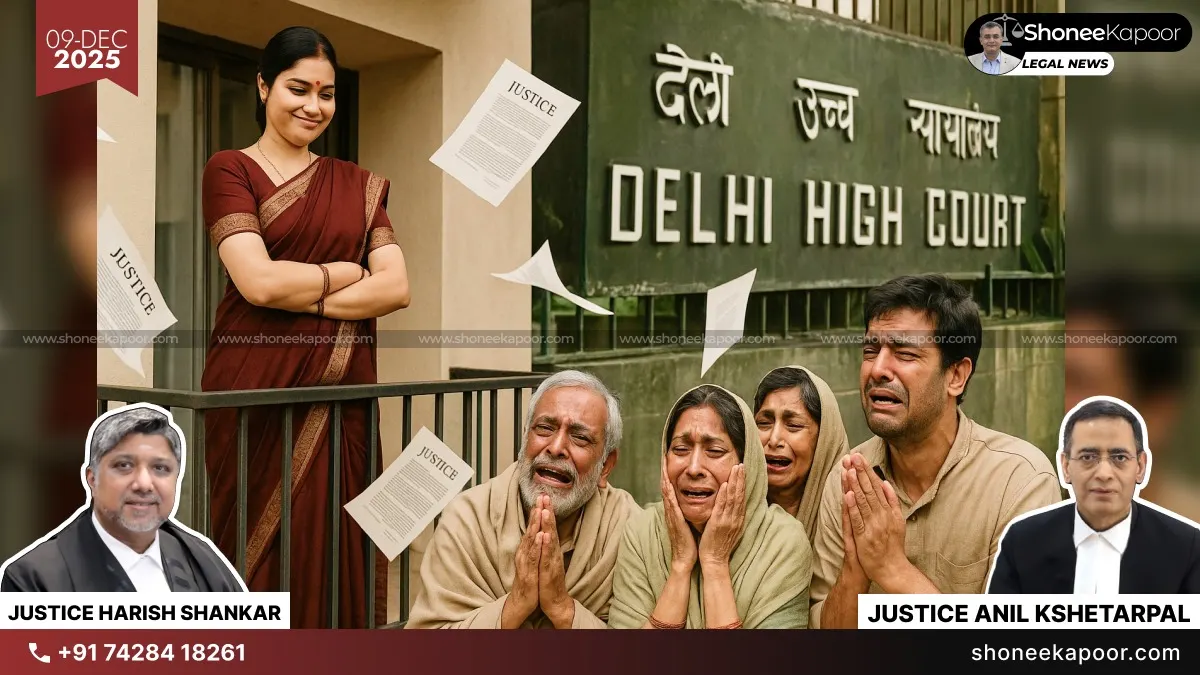
The Delhi High Court has ruled that a woman’s right to a shared household under the Domestic Violence Act is a protective right—not a right to permanently stay in her in-laws’ home when it harms senior citizens. The Court upheld an order directing the woman to shift to a fully-funded alternate accommodation.
NEW DELHI: In a major judgment, the Delhi High Court has clearly said that a woman’s right to a shared household under Section 17 of the Protection of Women from Domestic Violence Act (PWDV Act) is only a right to protection and not a right to ownership or a licence to live forever in the house of her in-laws.
The Court also held that this right must always be balanced with the rights of senior-citizen parents-in-law to live peacefully in their own property.
A Division Bench of Justice Anil Kshetarpal and Justice Harish Vaidyanathan Shankar noted that the Supreme Court has repeatedly said that the residence right under the PWDV Act is not absolute, and courts must protect senior citizens from mental stress, health issues, and lack of peaceful enjoyment of their home.
The Bench relied on its earlier ruling in Manju Arora v. Neelam Arora & Anr., where it held that a daughter-in-law cannot insist on living indefinitely in her in-laws’ home when such residence harms their dignity, health, and peaceful life.
Reading the reports submitted to the Single Judge—especially the counsellor’s report and medical documentation—the High Court found that the atmosphere inside the home had become “toxic”, and the continued presence of the daughter-in-law was worsening the medical condition of the senior-citizen mother-in-law, who suffers from Parkinson’s disease. It held:
“The right of residence cannot be interpreted to curtail an owner’s right to peaceful enjoyment of his or her property, particularly where uncontroverted material demonstrates that such residence is aggravating the senior citizen’s medical condition.”
The Bench upheld the earlier order in which the Single Judge had directed the daughter-in-law to vacate the in-laws’ home within two months and shift to alternate rented accommodation. However, this alternate residence was ordered to be fully arranged and funded by her in-laws.
The Court found this arrangement fair, saying that it protects the woman and children financially and residentially while protecting the senior citizens from further harm. It said the Single Judge “cannot be faulted” for concluding that the daughter-in-law’s continued stay caused “manifest hardship” to the in-laws.
The Court noted that the Single Judge had taken a balanced approach by ensuring that the woman was offered a good alternative residence—one comparable to her lifestyle—along with the husband’s continuing monthly maintenance and the in-laws’ responsibility to pay rent, advance amounts, brokerage, security deposit, and even the children’s school fees.
It said that the arrangement “strikes the correct balance” because the woman’s needs are protected without forcing senior citizens to continue suffering emotionally, mentally, and medically in their own home.
The Bench also made an important remark:
“The law does not require that senior citizen parents should continue to suffer a corrosive domestic environment merely because the daughter-in-law asserts a residence right under the PWDV Act, especially when adequate and dignified alternative arrangements are offered and funded by the parents-in-law themselves.”
The Court also made it clear that this is not a case where the woman is being made “helpless” or “homeless”. It pointed out that the Single Judge had fully protected her by ensuring a good alternative house at the same standard, with all costs to be paid by the in-laws. The Court also reviewed the maintenance the husband was already paying and the educational expenses being covered.
The appeal by the woman (Appellant) was therefore dismissed. The High Court held that the interim order was necessary, fair, and proportionate to prevent further deterioration in the household environment and the health of the senior-citizen mother-in-law. It also said that, during an appeal against an interim order, the question is not whether another view is possible, but whether the view taken is reasonable. Here, the Court found no illegality or perversity in the Single Judge’s decision.
The Bench then reproduced and upheld all the operative directions of the Single Judge, including the full list of obligations on the in-laws to provide alternate accommodation, maintain the children’s education, cover all essential expenses, pay rent, and ensure shifting support.
These directions were reiterated exactly as originally written:
- Accordingly, the plaintiffs are directed to provide an alternate accommodation to defendant no. 2 on the following terms and conditions:
- Rental of Rs. 2.50 lakhs per month with a bi-annual increase of 10%.
- Security deposit demanded by the landlord to be paid by the plaintiffs.
- The plaintiffs will bear the brokerage charges.
- Advance rent equivalent to 6 months to be deposited by the plaintiffs with the defendant no. 2.
- A registered lease deed/rent agreement will be executed for a minimum period of two years.
- Maintenance charges payable to the RWA/Managing Agency of the Complex, on actual basis and the electricity/water charges, on actual basis to be borne by the plaintiffs.
- The plaintiffs will bear the cost of shifting/transportation of the goods of defendant no. 2 from the suit property to the rental property.
- The defendant no. 2 will be at liberty to select an apartment of her choice within 30 days from today. The defendant no. 2 may select the apartment in the same Complex where defendant no. 1 is residing or any other Complex or neighbourhood, whether in Delhi or in Gurugram.
- The rental of Rs.2.50 lakhs per month has been fixed keeping in view the facilities available in the suit property for its residents.
- In case, the defendant no. 2 fails to select an apartment of her choice within 30 days, the plaintiffs will be at liberty to select an apartment in Central Park-II township, situated in Sector – 48, Gurugram, Haryana.
- The defendant no. 2 will vacate the suit property within 60 days from the passing of this order.
- Defendant no. 2 is hereby injuncted from entering the suit property after expiry of the 60 days.
- It is made clear that in case, the plaintiffs default in making payments towards rental, etc. as stipulated in paragraph 39 above, resulting in the defendant no. 2’s being evicted from the rental property, the defendant no. 2 will be entitled to return the suit property and reside therein.
- This application also seeks an interim mandatory injunction against defendant no. 1 [son of the plaintiffs] for vacating the suit property…. The plaintiffs and the defendant no. 1 are accordingly bound down to the said submissions and it is directed that the defendant no. 1 will not shift back into the suit property without seeking prior permission of this Court.
- … this Court takes note of this fact and does not find this to be any ground for denying the relief of interim mandatory injunction against defendant no. 2.
- It is directed that the plaintiffs will continue to pay the school fees including tuition fees and all other educational expenses of the grandchildren as averred in the pleadings.
- … the plaintiffs will not create any third-party interests in the suit property until the final disposal of the suit…
- The aforesaid arrangement shall continue during the subsistence of the matrimonial relationship between defendant no. 1 and defendant no. 2.
The Court finally dismissed the appeal and clarified that the Single Judge will decide the main suit independently based on evidence and without being influenced by observations made in this interim order.

Explanatory Table Of All Laws & Sections Mentioned
| Law / Section | What It Means (Simple Explanation) | How It Applied in This Case |
| Section 17 – Protection of Women from Domestic Violence Act (PWDV Act) | Gives a woman the right to live in the shared household. It is a protection right, not ownership. | Court held this right cannot override senior citizens’ right to peaceful enjoyment of their property, especially when the atmosphere has become toxic. |
| Section 19(1)(f) – PWDV Act | Allows courts to order alternate accommodation for a woman instead of allowing her to live in the disputed premises. | Used to justify shifting the daughter-in-law to a fully funded rented flat, balancing everyone’s rights. |
| Section 19(1)(e) – PWDV Act | Prevents alienation/transfer of property to protect a woman’s residential security. | Court ordered that in-laws cannot create third-party rights in the property till the case ends. |
| Sections 498A/406/354/506/509/377/34 – Indian Penal Code (IPC) | Criminal provisions used in the FIR filed by the wife alleging cruelty, dowry demands, sexual offences, and criminal acts. | Mentioned as part of the background of matrimonial disputes; not directly adjudicated here. |
| Order XXXIX Rules 1 & 2 – Code of Civil Procedure (CPC) | Allows courts to give temporary injunctions (stop someone or restrain someone) to prevent harm. | Single Judge used this to issue an interim mandatory injunction directing the woman to vacate. |
| Section 13(1)(i) & (ia) – Hindu Marriage Act, 1955 | Grounds for divorce — adultery and cruelty. | Husband had already filed for divorce under these grounds in a separate proceeding. |
| Section 26 – Hindu Marriage Act, 1955 | Allows court to decide custody, maintenance, and education of children. | Both parties filed applications regarding custody & visitation. |
| Section 151 – CPC | Court’s inherent powers to pass orders necessary for justice. | Husband used this for interim applications in custody/visitation matters. |
| Section 7 – Family Courts Act, 1984 | Gives Family Courts power to hear matrimonial and custody matters. | Basis for husband’s interim custody and visitation applications. |
| Dorab Cawasji Warden v. Coomi Sorab Warden (1990) | Landmark SC judgment on when interim mandatory injunctions can be granted — only when extremely necessary. | Appellant cited it to argue eviction cannot be ordered at interim stage. Court disagreed. |
| Satish Chander Ahuja v. Sneha Ahuja (2021) | Major ruling on “shared household”. Court held daughter-in-law can claim residence in certain cases. | Appellant relied on it, but Bench said it cannot override senior citizens’ rights in this situation. |
| Manju Arora v. Neelam Arora (2025) | Delhi HC Division Bench ruling that daughter-in-law cannot live indefinitely in in-laws’ self-owned house. | Bench relied heavily on this to uphold eviction + alternative accommodation. |
- Case Title: SM vs RM FAO(OS) 119/2025
- Bench: Hon’ble Mr. Justice Anil Kshetarpal, Hon’ble Mr. Justice Harish Vaidyanathan Shankar
Counsels
- For Appellant (Wife)
- Mr. Prashant Mendiratta
- Ms. Malvika Choudhary
- Ms. Neha Jain
- Mr. Taarak Duggal
- Ms. Sneha Mathew
- Ms. Vaishnavi Saxena
- For Respondents (Husband + In-Laws)
- For Respondent Nos. 1 & 2 (in-laws):
- Mr. Parag P. Tripathi, Senior Advocate
- Mr. Prabhjit Jauhar
- Ms. Nattasha Garg
- Mr. Aadarsh Kothari
- Mr. Utpal Sharma
- Ms. Rini Mehra
- For Respondent No. 3 (Husband):
- Mr. Prabhjit Jauhar
- Mr. Arjun Syal
- Mr. Naman Verma
Key Takeaways
- The Delhi High Court made it clear that the right to a “shared household” is a protection—not a perpetual licence for a daughter-in-law to occupy her in-laws’ self-owned home.
- Senior citizens’ right to peaceful living, dignity, and health cannot be sacrificed simply because a daughter-in-law asserts residence rights.
- When the environment becomes toxic, courts can lawfully direct the daughter-in-law to vacate, even at the interim stage, if alternate accommodation is provided.
- The Court recognised that men’s parents cannot be forced to suffer endless hostility, police complaints, and domestic friction inside their own home.
- The judgment reinforces that the PWDV Act does not override property rights and that balanced, fair solutions—like alternate housing—must prevail.
This Could Change Your Case-Get FREE Legal Advice-Click Here!
Disclaimer: The views and opinions expressed in this article are those of the Indian courts and do not necessarily reflect the official policy or position of “ShoneeKapoor.com” or its affiliates. This article is intended for informational and educational purposes only. The content provided is not legal advice, and viewers should not act upon this information without seeking professional counsel. Viewer discretion is advised.
