
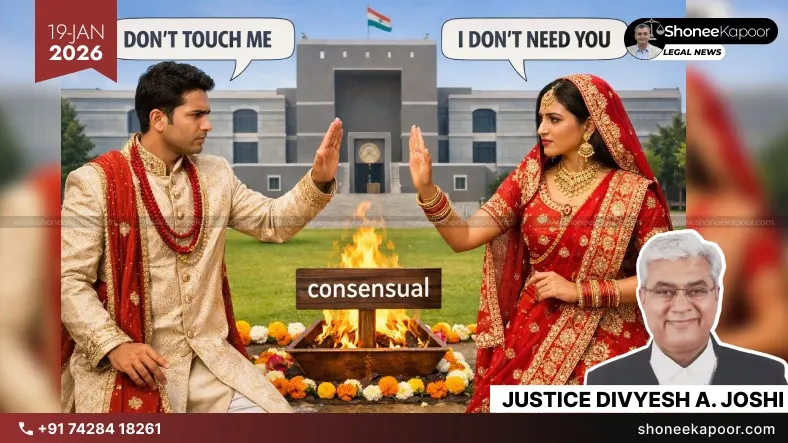
Sex Between Husband and Wife Needs Consent Every Time From Both Partners: Gujarat High Court Says Forced Unnatural Acts Cause Serious Trauma

Curated by NEWS DESK
Editorial DeskThe Gujarat High Court has clearly said that marriage does not mean automatic consent for sex. Any forced or unnatural sexual act between spouses can cause deep physical and mental trauma and cannot be justified in the name of marriage.
Ahmedabad: In an observation on marital intimacy and personal liberty, the Gujarat High Court has stated that physical intimacy between husband and wife is normal, but it must always be based on consent and mutual respect. The Court made it clear that marriage cannot be treated as a permanent license to force sexual acts on a spouse.
While dealing with a serious anticipatory bail application, the High Court under Justice Divyesh A. Joshi observed that forced sexual acts, especially unnatural sex without consent, can leave a person with lasting physical, mental and emotional scars.
The Court noted that although society has traditionally believed that marriage itself implies sexual consent, modern legal thinking has moved away from that idea. The law now recognises that every individual has bodily autonomy, even after marriage.
The Court recorded in clear words:
“Having unnatural sex by any spouse against the will and wish of other partner not only causes immense physical pain but it also gives mental, and emotional trauma to the unconsented spouse”
The Court further reiterated its view in strong terms:
“Intimacy is normal between every married couples, however, the same has to be a consensual and mutually respectful act. Having an unnatural sex by any spouse against the will and wish of other partner not only causes immense physical pain but it also gives mental, and emotional trauma to the unconsented spouse.”
These observations came while hearing an anticipatory bail plea filed by a husband who was accused by his wife of dowry harassment, physical violence and sexual abuse. The wife specifically alleged that the husband used to force her into “unnatural sex” against her will. She also levelled allegations of sexual abuse against her father-in-law.
As placed before the Court, the parties were married in 2022 in Delhi, while the FIR was lodged in October 2025. The husband was described as a wealthy businessman based in Gurugram, while the complainant was stated to be a law graduate and a chartered accountant.
The defence argued that the criminal case was filed as a counterblast to a divorce petition already filed by the husband in the family court at Gurugram. On the other hand, the wife’s counsel submitted that she had faced repeated incidents of violence, including beating, strangulation and having her head hit against walls during the marriage.
After examining the record, the High Court observed that the allegations were extremely serious and went far beyond routine matrimonial disputes. The Court took note of the claim that the complainant was allegedly burnt with lit cigarettes on her private parts and that abusive WhatsApp chats were placed on record to show aggressive behaviour.
The Court specifically remarked:
“Very grave and serious allegations of giving burn on the private part of the complainant with the lit cigarretes are made in the body of the FIR against the present applicant. Not only that, learned counsel for the complainant has placed on record certain WhatsApp chats between the complainant and the applicant, wherein very abusive language has been used by the applicant towards the complainant, which clearly shows the mentality of the applicant and his aggressive nature.”
Rejecting the argument that this was just a normal marital conflict, the Court observed:
“It prima facie seems to be something beyond the general and usual allegations stated to be being made in every matrimonial disputes by the wife.”
On the sensitive allegation of forced “unnatural sex”, the Court made a broader societal observation:
“We do understand that no women in our civilised and cultured society would come forward and confront such sensitive issues in public until the level of such harassment and abuse goes beyond her tolerance. The record indisputably further reveals that the applicant has married second time to the complainant and the first wife of the applicant had also made the similar kind of allegations against the applicant, which shows that the applicant is a repeat offender and is habitual in doing such kind of acts.”
Taking into account the gravity of the allegations, the High Court concluded that custodial interrogation of the accused was necessary at this stage.
The Court finally held:
“In view of above discussion and considering the materials produced before this Court, I am of the opinion that there seems to be a prima facie involvement of the present applicant in the commission of the alleged offence.”
Accordingly, the anticipatory bail application was rejected.
Explanatory Table: Laws and Sections Involved
| Act & Section | Purpose of the Law | How It Was Applied in This Case |
| Bharatiya Nagarik Suraksha Sanhita, 2023 – Section 482 | Inherent powers of High Court to prevent abuse of process of law | The husband approached the High Court under this provision seeking anticipatory bail |
| Bharatiya Nagarik Suraksha Sanhita, 2023 – Section 183 | Recording of statement during investigation | Statement of the complainant was recorded and relied upon during investigation |
| Indian Evidence Act, 1872 – Section 65B | Admissibility of electronic evidence | WhatsApp chats between husband and wife were examined for prima facie authenticity |
| IPC – Section 376 | Punishment for rape | Allegations under this section were stated against the father-in-law |
| IPC – Section 354 | Assault or criminal force to woman with intent to outrage modesty | Alleged acts of sexual misconduct were referred to in the FIR |
| IPC – Section 354B | Assault with intent to disrobe a woman | Serious allegations of sexual abuse were mentioned in the complaint |
| CrPC – Section 438 | Anticipatory bail provision | Principles governing anticipatory bail were discussed by the Court |
| CrPC – Section 439 | Regular bail | Distinguished from anticipatory bail while explaining legal standards |
| Dowry Prohibition Act, 1961 | Prevention of dowry demand and harassment | Allegations of dowry demand and related cruelty were part of the FIR |
Case Details
- Court: Gujarat High Court
- Case Title: R/Criminal Misc. Application (For Anticipatory Bail) No. 26922 of 2025 Applicant (Husband) vs State of Gujarat
- Neutral Citation: 2026:GUJHC:16
- Date Reserved: 24/12/2025
- Date Pronounced: 05/01/2026
- Bench: Hon’ble Mr. Justice Divyesh A. Joshi
Counsels Appearing
- For the Applicant (Accused Husband): Senior Advocate Yatin Oza
- With Advocates:
- Sudhir Walia
- Aditya A. Gupta
- Harshal Baradia
- Neeharika Walia
- For the Original Complainant (Wife): Senior Advocate Jal Unwalla
- With Advocate: Bomi H. Shethna
- For the State: Additional Public Prosecutor Soham Joshi
Key Takeaways
- Marriage is not automatic or permanent consent; consent must exist every time, and false assumptions around marriage often become weapons in criminal cases against men.
- Courts now openly treat marital intimacy as a legal issue, which means private marital conflicts are increasingly judged through criminal law lenses.
- Anticipatory bail can be denied purely on allegations at the FIR stage, even before full evidence is tested in trial.
- Matrimonial disputes are no longer seen as family matters and can quickly turn into custodial cases with serious criminal sections.
- Men must understand that delayed FIRs, overlapping civil disputes, and past matrimonial history can be used to build a narrative of habitual conduct.
This Could Change Your Case-Get FREE Legal Advice-Click Here!
Disclaimer: The views and opinions expressed in this article are those of the Indian courts and do not necessarily reflect the official policy or position of “ShoneeKapoor.com” or its affiliates. This article is intended for informational and educational purposes only. The content provided is not legal advice, and viewers should not act upon this information without seeking professional counsel. Viewer discretion is advised.
Related Articles
Can a ‘girlfriend’ of the husband be implicated under Section 498A?
From landmark Supreme Court rulings to ground-level misuse, this article unpacks how Section 498A defines ‘husband’ a...
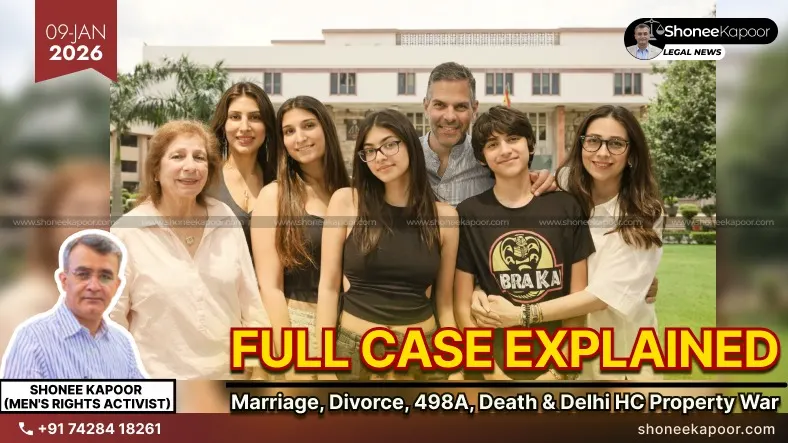
Karisma Kapoor – Sunjay Kapur Case Explained: Marriage, Divorce, 498A, Death & the Delhi High Court Property War
From a celebrity wedding to IPC 498A allegations, a Supreme Court-linked divorce settlement, and now a Delhi High Cou...
Share Your Thoughts
Comments are moderated before publication.