
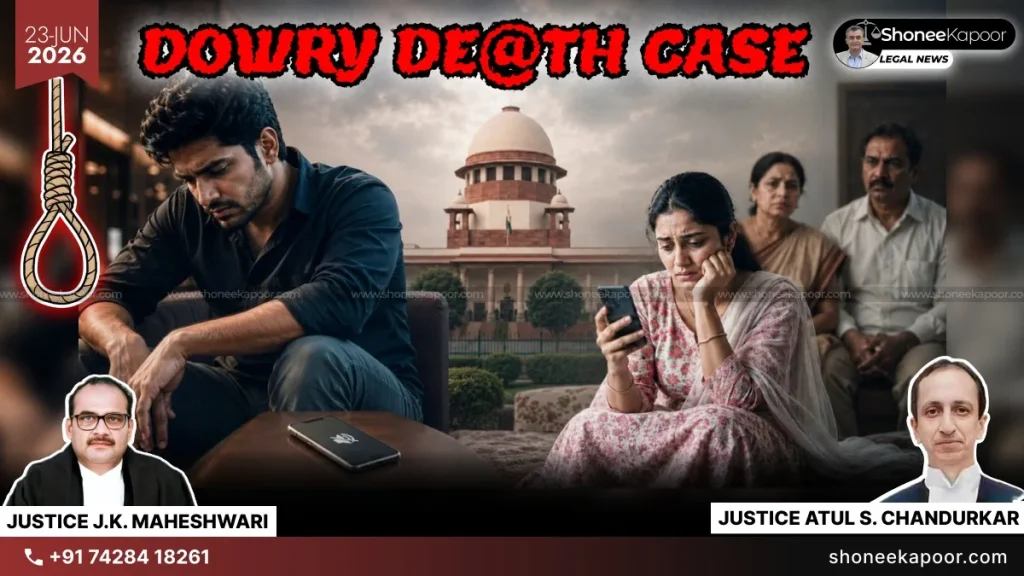
Can WhatsApp silence alone prove cruelty against the husband? The Supreme Court held that not sending WhatsApp messages is not sufficient because communication could have taken place through normal phone calls.
NEW DELHI: The Supreme Court Bench of Justice J.K. Maheshwari and Justice Atul S. Chandurkar has set aside a husband’s conviction under Section 498A IPC, holding that mere phone silence for some days cannot become cruelty unless the prosecution proves the legal ingredients with cogent evidence.
The case started after the wife died by suicide at her parental home on 31 January 2015. The prosecution alleged dowry demand, harassment and cruelty. The case was initially connected with dowry death under Section 304B IPC and cruelty under Section 498A IPC.
The Trial Court found that dowry death was not proved. The in-laws were acquitted. The husband was also acquitted from dowry death, but he was convicted under Section 498A IPC mainly on the allegation that he did not speak to his wife on phone after she went to her parental home.
The Madras High Court upheld the conviction. The matter then reached the Supreme Court, where the main question was whether non-communication for a few days could amount to cruelty under Section 498A IPC.
The Supreme Court referred to the meaning of cruelty under Section 498A IPC and noted that cruelty includes-
“Any willful conduct which is of such a nature as is likely to drive the woman to commit suicide”
Or harassment connected with unlawful demand for property or valuable security.
The Court also explained that cruelty cannot be decided mechanically. The Court relied on the settled principle that:
“Petty quarrels cannot be termed as “cruelty” to attract the provisions of Section 498-A IPC.”
It also noted that:
“Causing mental torture to the extent that it becomes unbearable may be termed as cruelty.”
In this case, the Supreme Court found that the allegations of dowry demand and harassment were not proved. The allegation of abetment of suicide was also not proved. The only remaining allegation was that the husband allegedly did not talk to the wife on phone between 18 January 2015 and 31 January 2015.
The Court said that if the prosecution wanted to prove lack of communication, it should have produced call detail records of the husband, wife and her parents. Mere oral statements were not enough to prove such a serious allegation.
The Supreme Court also rejected the argument based only on WhatsApp silence. The Court observed that “not sending messages over WhatsApp is also not sufficient” because communication could have taken place through normal phone calls.
The Court made it clear that:
“Mere non-communication with the deceased for thirteen days without proper evidence cannot, in any stretch of the imagination, fall within the ambit of cruelty in the facts of this case.”
Finally, the Supreme Court held that:
“Prosecution has utterly failed to establish the ingredients to prove the charge under Section 498A IPC.”
The conviction and sentence were set aside, the husband’s bail bonds were discharged, and his passport was directed to be returned.
EXPLANATORY TABLE: LAWS AND SECTIONS INVOLVED
| Law / Section | Purpose | Role In This Case |
| Section 498A IPC | Cruelty by husband or his relatives against a married woman. | Husband was convicted under this section, but Supreme Court set aside the conviction. |
| Section 304B IPC | Dowry death within 7 years of marriage. | Case started as a dowry death matter, but dowry death was not proved. |
| Section 494 IPC | Bigamy during a valid marriage. | Mentioned only through an earlier Supreme Court judgment, not as a charge in this case. |
| Indian Penal Code, 1860 | Main criminal law covering offences like cruelty and dowry death. | Sections 498A and 304B IPC were applied in the case. |
CASE DETAILS
- Case Title: Jayesh Kanna v. The Assistant Commissioner Law and Order (West) Etc.
- Court: Supreme Court of India
- Criminal Appeal Numbers: Criminal Appeal Nos. 2382–2383 of 2026
- Neutral Citation: 2026 INSC 615
- Order Date: 07 May 2026
- Bench: Justice J.K. Maheshwari | Justice Atul S. Chandurkar
- Counsels:
- For Appellant: Mr. R. Basant, learned senior counsel
- For Respondent: Mr. Balaji Subramanian
KEY TAKEAWAYS
- 498A conviction cannot be based on emotions; it must be proved with solid evidence.
- Mere phone silence or WhatsApp silence cannot automatically become cruelty.
- Dowry death allegation failed, dowry harassment failed, and finally even 498A failed.
- Oral allegations are not enough when call records and evidence could have been produced.
- A husband’s liberty cannot be destroyed on assumptions, improvements and matrimonial misunderstandings.
This Could Change Your Case-Get FREE Legal Advice-Click Here!
Disclaimer: The views and opinions expressed in this article are those of the Indian courts and do not necessarily reflect the official policy or position of “ShoneeKapoor.com” or its affiliates. This article is intended for informational and educational purposes only. The content provided is not legal advice, and viewers should not act upon this information without seeking professional counsel. Viewer discretion is advised.