
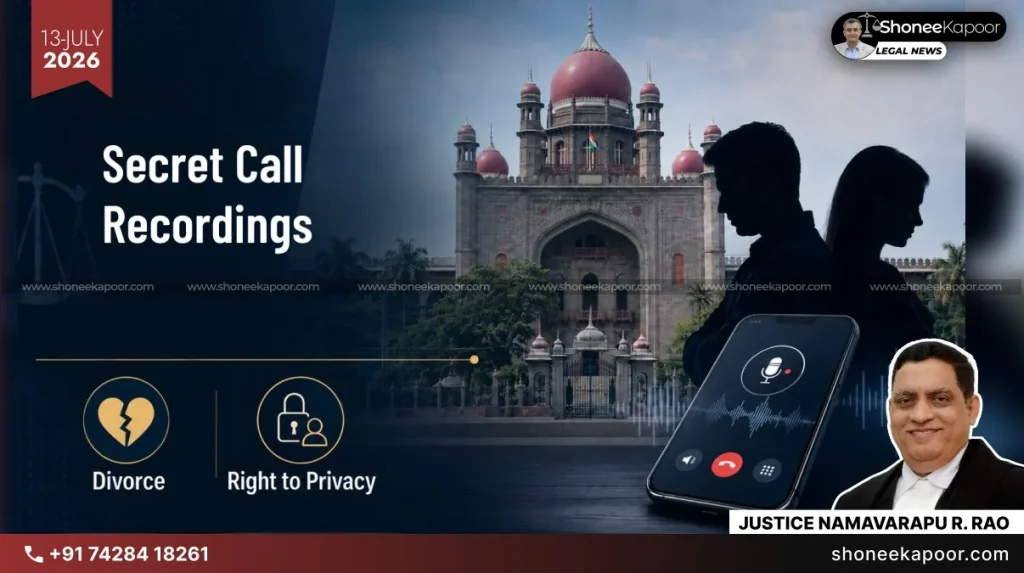
Can a spouse secretly record private calls and use them to prove cruelty in a divorce case? The Telangana High Court rejected the husband’s recordings and also refused to accept his financial and travel records—but why?
HYDERABAD: The Telangana High Court has ruled that secretly recording a spouse’s telephone conversations without consent violates the right to privacy under Article 21 of the Constitution. Justice Namavarapu Rajeshwar Rao held that such recordings cannot be admitted as evidence in matrimonial proceedings.
The Court made the observation while dismissing two civil revision petitions filed by a husband. He had challenged a trial court order refusing to accept call recordings and several other documents in his divorce case based on cruelty.
The High Court observed:
“With regard to the recordings of conversations between the parties, the trial Court rightly held that recording calls without the consent of the other party constitutes a breach of privacy and the right to privacy guaranteed under Article 21 of the Constitution of India. Therefore, in the absence of consent, such recordings cannot be admitted in evidence.”
The ruling is important because the Supreme Court had taken a different view in Vibhor Garg v. Neha in 2025. In that matrimonial case, the Supreme Court held that secretly recording a spouse’s conversations did not violate the fundamental right to privacy and that such recordings could be admitted under the Indian Evidence Act.
In the present case, the husband had filed a divorce petition against his wife on the ground of cruelty. During the trial, he sought permission to produce primary and secondary evidence, including electronic records.
The trial court rejected his applications. It found that the call recordings were not supported by the mandatory certificate required under Section 65-B of the Indian Evidence Act. There was also no clarity about whether the original mobile phone containing the recordings was available.
The husband argued before the High Court that the documents should first have been taken on record. According to him, their admissibility and evidentiary value could have been examined at the final stage of the case.
He also claimed that the authenticity of the call and voice recordings had been verified by Truth Labs and that the recordings were submitted to the trial court in a sealed cover.
The husband further sought to produce medical records, bank and credit card payment details, air tickets, photographs, travel expenses and money transfer records. He submitted that several documents had been downloaded directly from official bank and credit card websites and that he was ready to prove their authenticity before the trial court.
However, the High Court found that these documents did not help him establish cruelty. According to the Court, the documents
“appear to relate to the cordial and successful marital life shared by the petitioner and the respondent.”
The Court observed:
“We are not able to understand how these documents would assist the petitioner in proving the allegation of cruelty.”
Instead of supporting the husband’s divorce plea, the documents appeared to show a “cordial and successful marital life” between the parties.
The Court further observed:
“As a husband-petitioner, it is the petitioner’s responsibility to incur expenses for the wife-respondent while they are leading a normal married life together.”
This meant that the husband’s records of payments, travel expenses and money transfers were treated as part of his normal marital responsibility rather than evidence supporting his allegation of cruelty. Consequently, despite his attempt to place extensive financial and electronic material before the court, he was not permitted to use it to strengthen his case.
The High Court held that electronic evidence cannot be accepted merely because it is available in digital form. It must satisfy the legal requirements for admissibility and must have a clear connection with the dispute being decided.
Finding no error in the trial court’s order, the High Court refused to interfere and dismissed both civil revision petitions without imposing costs.
EXPLANATORY TABLE OF LAWS AND SECTIONS
| LAW OR PROVISION | SIMPLE EXPLANATION | HOW IT WAS USED IN THIS CASE |
| Article 21, Constitution of India | Protects life and personal liberty. Courts have interpreted it to include the right to privacy. | The High Court held that recording a spouse’s calls without consent breached privacy under Article 21 and refused to admit the recordings. |
| Order VII Rule 14(3), Code of Civil Procedure, 1908 | Allows a party to seek the court’s permission to produce documents that were not filed earlier with the pleadings. | The husband relied on this provision to seek permission to introduce additional documents during the divorce trial. |
| Section 151, Code of Civil Procedure, 1908 | Preserves the court’s inherent powers to pass necessary orders for justice or to prevent misuse of the court process. | It was invoked along with Order VII Rule 14(3) to request that the additional documents be accepted. |
| Section 65-A, Indian Evidence Act, 1872 | States that the contents of electronic records must be proved according to Section 65-B. | The trial court referred to this provision while examining whether the electronic records could legally be admitted. |
| Section 65-B, Indian Evidence Act, 1872 | Provides the legal procedure for proving electronic records, including the requirement of a certificate in appropriate cases. | The call recordings were not accompanied by the required Section 65-B certificate. There was also no clarity about the original mobile phone or efforts to obtain the certificate. |
| Article 227, Constitution of India | Gives High Courts supervisory jurisdiction over subordinate courts and tribunals. | The order describes the matters as civil revision petitions, but the specific revisional provision under which they were filed is not expressly stated in the judgment. Article 227 should therefore not be presented as a confirmed invoked provision. |
| Cruelty as a ground for divorce | A spouse may seek dissolution of marriage by proving legally recognised matrimonial cruelty. | The husband’s divorce petition was based on cruelty, but the Court found that the proposed documents did not help prove that allegation. |
| Section 13(1)(ia), Hindu Marriage Act, 1955 | Provides cruelty as a ground for divorce between parties governed by the Hindu Marriage Act. | The judgment says that divorce was sought on the ground of cruelty, but it does not expressly mention Section 13(1)(ia). It should not be attributed to the order as an expressly cited provision. |
CASE DETAILS
| PARTICULAR | DETAILS |
| Case Title | KGS vs IS |
| Court | High Court for the State of Telangana at Hyderabad |
| Case Numbers | Civil Revision Petition Nos. 247 and 253 of 2025 |
| Petitioner | Husband |
| Respondent | Wife |
| Bench | Hon’ble Sri Justice Namavarapu Rajeshwar Rao |
| Decision Date | 18 June 2026 |
| Nature of Order | Common Order |
| Original Matrimonial Case | H.M.O.P. No. 153 of 2023, previously H.M.O.P. No. 144 of 2019 |
| Applications Challenged | I.A. Nos. 47 of 2023 and 79 of 2023 |
| Trial Court | Senior Civil Judge-cum-Assistant Sessions Judge, Metpalli |
| Trial Court Order Date | 23 December 2024 |
| Ground for Divorce | Cruelty |
COUNSELS
| SIDE | COUNSEL |
| Petitioner/Husband | N. Naveen Kumar |
| Respondent/Wife | K. Venumadhav |
KEY TAKEAWAYS
- A husband’s evidence is not automatically proof: Every recording and document must satisfy strict rules of admissibility and relevance.
- Men must collect evidence legally: Secret recordings may be rejected despite containing material relevant to the matrimonial dispute.
- Financial support may not prove cruelty: Payments, trips and money transfers can be treated as normal duties of a husband rather than evidence supporting him.
- Providing for the wife can be interpreted against the husband’s case: Records showing expenditure may be viewed as proof of a cordial marriage.
- Men need a legally planned evidence strategy: Collecting hundreds of documents is useless unless each document directly proves cruelty and meets evidentiary requirements.
This Could Change Your Case-Get FREE Legal Advice-Click Here!
Disclaimer: The views and opinions expressed in this article are those of the Indian courts and do not necessarily reflect the official policy or position of “ShoneeKapoor.com” or its affiliates. This article is intended for informational and educational purposes only. The content provided is not legal advice, and viewers should not act upon this information without seeking professional counsel. Viewer discretion is advised.