
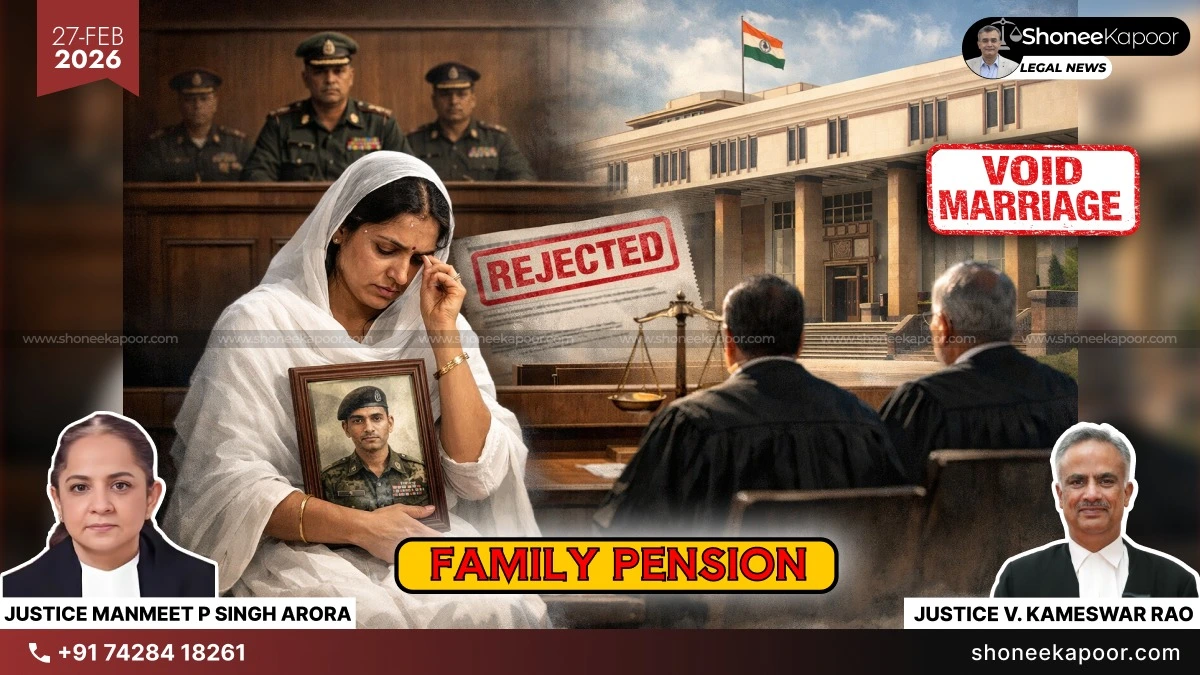
Second Wife From Void Marriage Cannot Claim Army Family Pension Even After First Wife’s Death: Delhi High Court Cites Army Rules

Curated by NEWS DESK
Editorial DeskCan the death of a legally wedded wife validate a void marriage that was invalid from the start? The Delhi High Court answers with a firm no. In a ruling that clarifies pension law under Army Regulations, the Court shut the door on claims arising from unlawful marriages — reinforcing that legality at inception is decisive.
NEW DELHI: The Delhi High Court bench of Justice V. Kameswar Rao and Justice Manmeet Pritam Singh Arora dismissed a writ petition filed by a woman seeking family pension as the widow of a deceased Army sepoy and upheld the Armed Forces Tribunal’s decision.
The Court made it clear that pension benefits are payable strictly in accordance with the Army Pension Regulations and only to a legally wedded spouse.
The petitioner claimed that she married the Army personnel after being informed that he was unmarried and lived with him for several years, during which children were born. However, it later came on record that the officer already had a legally wedded wife who was alive at the time of the second marriage. On this basis, the authorities refused to record the petitioner as next of kin and rejected her claim for family pension.
After the officer’s death in 2011, the first wife claimed pension as the surviving widow. The petitioner argued that after the first wife died in 2012, pension entitlement should pass to her. She relied on certain judicial precedents to support her case.
The Court examined the legal provisions under the Hindu Marriage Act, 1955 and the Army Pension Regulations. It clearly recorded:
“It is an admitted fact that the petitioner’s marriage to the officer Lt. Udey Singh was solemnised during the lifetime of his first wife, Smt. Satwati Devi and therefore the petitioner’s marriage was void in law.”
The bench further observed:
“Consequently, the widow who is entitled to a family pension is the ‘wife’ who was lawfully married to the officer.”
Rejecting the argument that the death of the first wife could cure the defect, the Court categorically held:
“The second marriage of Lt. Udey Singh with the petitioner herein, therefore, continued to remain unlawful until his demise in 2011 and therefore the demise of Smt. Satwati Devi in 2012 would not make the petitioner’s marriage valid.”
The Court also clarified that reliance on other memoranda was misplaced and that the applicable rules did not extend pension rights to a spouse whose marriage is void. It concluded that the decision of the authorities declining family pension was legally correct.
Finally, the Court held: “The present petition is without any merit and is accordingly dismissed.”
With this, the Delhi High Court reaffirmed that family pension is a statutory benefit limited strictly to lawful marital relationships and cannot be claimed on the basis of a void marriage.
Explanatory Table: Laws And Provisions Involved
| Law / Section | Purpose | Court’s application in case |
| Article 226 Constitution of India | Empowers High Courts to exercise writ jurisdiction for judicial review of administrative and tribunal decisions | Petition filed challenging Armed Forces Tribunal order refusing family pension |
| Pension Regulations for the Army, 1961 | Governs entitlement and distribution of pension and family pension for Army personnel | Court held family pension payable only to legally wedded widow under these regulations |
| Hindu Marriage Act, 1955 — Section 5 | Prescribes conditions for valid Hindu marriage, including requirement that neither spouse has a living spouse at time of marriage | Court held second marriage invalid because first wife was alive |
| Hindu Marriage Act, 1955 — Section 11 | Declares marriages void if performed in violation of Section 5 conditions | Court relied on this to hold second marriage legally void |
| Central Civil Services (Pension) Rules, 2021 | Governs pension for civil employees of central government | Court held rules inapplicable as case governed by Army Pension Regulations |
| Supreme Court precedent: Shriramabai case | Recognizes presumption of valid marriage after divorce and long cohabitation in peculiar facts | Distinguished by Court as first marriage here was never dissolved |
| Supreme Court precedent: Raj Kumari v. Krishan (2015) | Clarifies pension rights belong to legally wedded spouse | Relied upon to reinforce denial of pension to second wife |
Case Details
- Case title: Vidya Devi v. Union of India & Ors.
- Case number: W.P.(C) 2333/2026
- Court: High Court of Delhi at New Delhi
- Neutral citation: 2026:DHC:1436-DB
- Date of decision: 18 February 2026
- Bench: Justice V. Kameswar Rao & Justice Manmeet Pritam Singh Arora
- Counsels:
- For petitioner: Mr. Girindra Kumar Pathak, Advocate
- For respondents: Mr. Syed Abdul Haseeb, CGSC with Ms. Nasreen Khatoon, Government Pleader; Major Kanika Sharma (Army)
Key Takeaways
- Family pension is a statutory right, not a sympathy-based benefit — it flows strictly from a legally valid marriage.
- A second marriage performed while the first spouse is alive remains void in law, and no later event can convert an illegal marriage into a lawful one.
- Pension entitlement cannot be claimed on emotional grounds, cohabitation, or passage of time; the legality of marital status is decisive.
- Government service benefits are governed by specific regulations, and courts will not stretch those rules beyond what the statute permits.
- Marriage fraud, concealment, or informal arrangements cannot override clear provisions of the Hindu Marriage Act — legal validity determines financial rights.
This Could Change Your Case-Get FREE Legal Advice-Click Here!
Disclaimer: The views and opinions expressed in this article are those of the Indian courts and do not necessarily reflect the official policy or position of “ShoneeKapoor.com” or its affiliates. This article is intended for informational and educational purposes only. The content provided is not legal advice, and viewers should not act upon this information without seeking professional counsel. Viewer discretion is advised.
Related Articles
Karisma Kapoor – Sunjay Kapur Case Explained: Marriage, Divorce, 498A, Death & the Delhi High Court Property War
From a celebrity wedding to IPC 498A allegations, a Supreme Court-linked divorce settlement, and now a Delhi High Cou...
Matrimonial Maintenance for NRIs: The Untold Legal Battle Every Overseas Indian Must Know
NRI Men, Take Note: A Power-Packed Guide to Indian Maintenance Laws from Section 125 CrPC to Cross-Border Enforcement...
Share Your Thoughts
Comments are moderated before publication.