
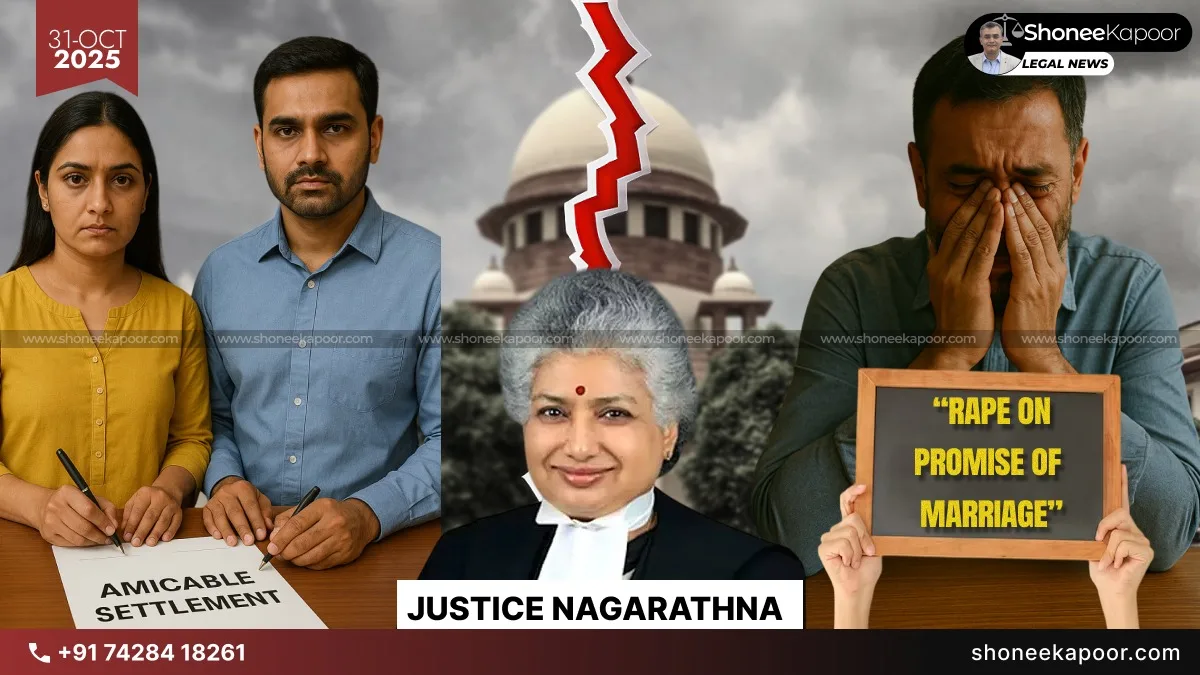
Another Life Saved from a False Rape Allegation? Supreme Court Recognizes Settlement and Brings Relief to Kerala Man

Curated by NEWS DESK
Editorial DeskIn a major boost for men’s rights, the Supreme Court settled a 2022 rape case after the man returned money and gold as part of an amicable resolution. The verdict highlights growing concern over misuse of false rape allegations in India.
NEW DELHI: An amicable settlement in a “false promise to marry” case was permitted by the Supreme Court of India in a landmark decision that upholds fairness in cases of consensual relationships later termed as “rape”. This decision provides long-awaited relief to men accused in such disputes. The ruling in X v. State of Kerala & Anr. (2025 INSC 1243), rendered on September 15, 2025, by a bench of Justices B.V. Nagarathna and R. Mahadevan, represents a sea change in the way Indian courts handle claims that adult relationships are reclassified as rape following emotional breakdowns.
Facts of the Case
In this matter, as per the complainant, who is a divorced woman, alleged that the accused promised to marry her and maintained a physical relationship with her. She further claimed he had accepted ₹3.54 lakh and gold ornaments worth 2.5 sovereigns from her, later refusing to return them. In consequence of the same, FIR was registered at Balussery Police Station, Kozhikode, under Sections 376(2)(n), 406, and 506 of the Indian Penal Code, alleging repeated rape, breach of trust, and criminal intimidation.
The accused first sought anticipatory bail under Section 438 CrPC, which was rejected by the Kerala High Court on July 6, 2022. Later, his subsequent petition under Section 482 CrPC to quash the FIR was also dismissed on November 8, 2024. When he approached the Supreme Court, the Bench encouraged both sides to explore an amicable resolution. To which, the man offered to refund the alleged monetary amount and return the gold ornaments, leading both parties to express a desire to end the dispute and move on with their lives.
Police & Procedural Background:
- FIR: No. 333/2022 dated 24 May 2022
- Police Station: Balussery, Kozhikode, Kerala
Charges against the accused:
- Section 376(2)(n) IPC – Repeated sexual intercourse (rape)
- Section 406 IPC – Criminal breach of trust
- Section 506 IPC – Criminal intimidation
Petitions involved in the matter:
- Dismissed Bail Application No. 4814/2022
- Quash petition dismissed: Crl. M.C. No. 4857/2022
- Petition before the Supreme Court: SLP (Crl.) Nos. 17845 & 18408 of 2024
Court’s Findings
As the Supreme Court assembled on September 15, 2025, Justices B.V. Nagarathna and R. Mahadevan chose restraint over rhetoric. After hearing both sides, Justice Nagarathna observed that the parties had already express As the Supreme Court convened on September 15, 2025, Justices B.V. Nagarathna and R. Mahadevan chose restraint over rhetoric.
After hearing both sides, Justice Nagarathna noted that the parties had already stated their intention “to give a quietus to the entire dispute,” pointing out that the man was prepared to give the complainant back the gold and money. The Bench granted the liberty “to arrive at an amicable settlement”, putting closure ahead of confrontation.
The Court stated in unambiguous terms that the ₹ 3.54 lakh that was deposited with the Trial Court “shall be permitted to be withdrawn either by the second respondent or the nominee of the second respondent after due verification.” The judges also ordered that “gold weighing 20.040 grammes shall be deposited before the Registrar General of the Kerala High Court” so that it could be securely released to the woman upon her request.
“We order that the amount of ₹3,54,000 (Rupees Three Lakhs and Fifty-Four Thousand Only) which is deposited by the appellant(s) herein before the Trial Court (Judicial Magistrate of First Class-II, Perambra) shall be permitted to be withdrawn either by the second respondent or the nominee of the second respondent.”
“If such an application is made on behalf of the second respondent, the same shall be released to the second respondent or her nominee after due verification.”
“Gold weighing 20.040 grams weight which the appellant(s) is willing to return to the second respondent, shall be deposited before the Registrar General of the Kerala High Court.”
“Learned Registrar General, Kerala High Court to receive the aforesaid gold from the appellant(s) and retain the same in safe custody.”
“The said gold shall be released either to the second respondent or to her nominee… after due verification.”
Finally, Justice Nagarathna pronounced the closing words that sealed the matter:
“The appeal arising out of SLP (Crl.) No. 17845 of 2024 is allowed in the aforesaid terms. Consequently, the appeal is disposed of in the aforesaid terms. Pending application(s), if any, shall stand disposed of.”
Explanatory Table of Laws, Cases & Sections Referenced
| Law / Provision | Section/ citation | Explanation/Relevancy | |
| Indian Penal Code (IPC), 1860 | Section 376(2)(n) | Alleged repeated rape: held consensual, hence settlement allowed. | |
| Indian Penal Code (IPC), 1860 | Section 406 | Criminal breach of trust for alleged money/gold: resolved via restitution. | |
| Indian Penal Code (IPC), 1860 | Section 506 | Threat allegation: no evidence, settled mutually. | |
| Code of Criminal Procedure (CrPC), 1973 | Section 438 | Anticipatory bail: denied by HC, rendered infructuous after settlement. | |
| Code of Criminal Procedure (CrPC), 1973 | Section 482 | Quashing petition before HC: later succeeded before SC via settlement | |
Case Summary
- Case Title: X v. State of Kerala & Another
- Court: Supreme Court of India
- Bench: Justice B.V. Nagarathna & Justice R. Mahadevan
- Judgment Date: September 15, 2025
- Citation: 2025 INSC 1243
- FIR No.:333/2022, Balussery Police Station, Kozhikode
- Provisions: Sections 376(2)(n), 406, 506 IPC; Sections 438, 482 CrPC
- Result: Settlement allowed; all proceedings closed
Question in Issue: Can a rape case filed on the allegation of a “false promise to marry” be settled amicably when both parties agree and the relationship was consensual?
Supreme Court Breaks the Silence on Misuse of Rape Laws
A Judgment Every Man Should Read
The Supreme Court’s ruling in X v. State of Kerala & Anr. (2025 INSC 1243) is more than the closure of one case, it’s a judicial recalibration of how the Indian legal system must treat adult consensual relationships that later spiral into criminal allegations. By permitting an amicable settlement in a rape case based on a “false promise to marry”, the Bench of Justices B.V. Nagarathna and R. Mahadevan has silently but powerfully rewritten the boundaries between consent, deceit, and misuse.
This verdict recognizes what men’s-rights advocates have long argued; that not every failed relationship is a crime, and that consent given in mutual intimacy cannot later be retroactively criminalizedsimply because the relationship ends in disappointment or dispute.
For the first time, the Supreme Court has formally endorsed the idea that closure and accountability can coexist that a man accused under such circumstances can make restitution without being branded a rapist for life.
This ruling also sends a broader message to investigating officers and trial courts that is rape law is not a substitute for relationship regret, criminal prosecution must not become a weapon of emotional revenge and consent, once mutually given, cannot be transformed into coercion by hindsight. Supreme Court has acknowledged that criminal justice must protect men from the collateral damage of false or exaggerated allegations that stem from private disputes. It affirms that even in sensitive areas like sexual consent, gender-neutral fairness is essential to preserve faith in the rule of law.
Disclaimer: The views and opinions expressed in this article are those of the Indian courts and do not necessarily reflect the official policy or position of “ShoneeKapoor.com” or its affiliates. This article is intended for informational and educational purposes only. The content provided is not legal advice, and viewers should not act upon this information without seeking professional counsel. Viewer discretion is advise.
Related Articles

Supreme Court Guidelines That Protect Men From False 498A Arrests in India
The Supreme Court has ruled that arrest under Section 498A is not automatic and personal liberty under Article 21 app...
Share Your Thoughts
Comments are moderated before publication.