
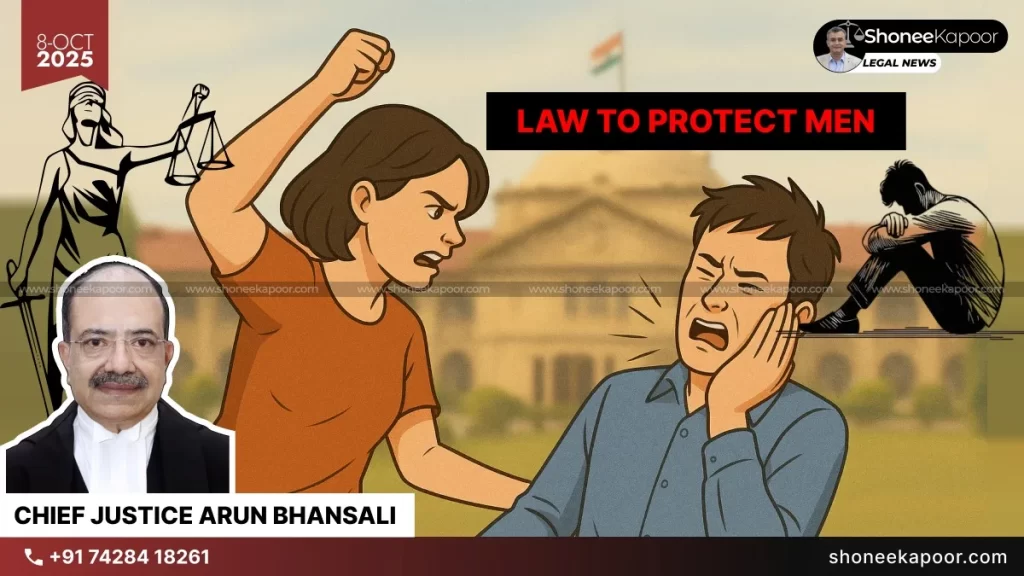
The Allahabad High Court has dismissed a PIL that demanded a special law to protect men from alleged misuse of women-centric laws. The bench found the plea to be vague, unsupported by evidence, and not fit to be treated as public interest litigation.
UTTAR PRADESH: The Allahabad High Court dismissed a Public Interest Litigation (PIL) filed by Chandrama Vishvakarma, who had sought a direction to the Union of India to enact a new law for the “protection of men (from illegal prosecution and other harassment by women)”.
The division bench of Chief Justice Arun Bhansali and Justice Kshitij Shailendra observed that the petition, though presented as a matter of public interest, lacked the necessary details, materials, and legal foundation to justify court interference.
The Court recorded:
“This petition purportedly in public interest has been filed seeking a direction to the respondents to make an ‘Act’ for protection of men (from illegal prosecution and other harassment by the women).”
However, upon reviewing the PIL, the judges noted that the petitioner had only attached references to a few news stories without offering any real evidence or research to back the claims.
The bench stated:
“A perusal of the petition indicates that except for reference to certain news items, wholly cursory averments have been made in the petition seeking the relief, as indicated.”
The petitioner had contended that the current legal framework, including laws on dowry, domestic violence, and sexual assault, was being “misused” by some women to harass men and their families. He further argued that obtaining a divorce under existing laws is “very difficult”, which aggravates the suffering of men trapped in toxic or false cases.
Before filing the case, Chandrama Vishvakarma claimed to have written to several top officials — including the Prime Minister, Union Home Minister, Lok Sabha Speaker, Rajya Sabha Chairman, Governor of Uttar Pradesh, and the Chief Minister of Uttar Pradesh — appealing for reforms. Having received no response, he moved the High Court as a “last resort.”
The PIL urged the court to issue directions to the Central Government to draft and enact legislation that would specifically prevent “illegal prosecution and harassment of men by their estranged wives.”
But the Court was not convinced. It pointed out that the plea did not cite any legal grounds, case studies, or statistical backing to demonstrate widespread misuse in a way that warranted judicial action through a public interest route. Finding the petition entirely unsustainable, the bench concluded:
“No case is made out in the petition for entertaining the same as public interest litigation. The petition is, therefore, dismissed.”
Thus, the Allahabad High Court made it clear that while public interest litigation is a powerful legal tool, it cannot be used without substantive material or to push personal or unsubstantiated causes.

The judgment underscores that demands for new laws — including those for men’s protection — must be based on evidence, legal reasoning, and proper legislative engagement rather than general grievances or media reports.
Explanatory Table Of Relevant Laws & Sections Referred / Implied
| Law / Section | Purpose / Subject | How It Relates to the Case | Explanation |
| Section 498A, Indian Penal Code (IPC) | Cruelty by husband or relatives of husband | The petitioner alleged misuse of this section by women to harass men and their families. | Section 498A criminalizes cruelty by the husband or his relatives. It was enacted to protect women from domestic violence but is often criticized for alleged misuse. |
| Section 406, IPC | Criminal Breach of Trust | Often invoked alongside 498A in matrimonial disputes involving stridhan (dowry articles). | The petitioner implied that such laws are being used vindictively in false cases. |
| Section 125, Code of Criminal Procedure (CrPC) | Maintenance for wife, children, and parents | Though not directly cited, the PIL’s context refers to men’s obligations under maintenance laws perceived as one-sided. | It ensures financial support for dependents but is often debated for alleged gender imbalance. |
| Dowry Prohibition Act, 1961 | Prohibits the giving and taking of dowry | The petitioner referenced news items about misuse of dowry laws. | The Act criminalizes dowry demands but is frequently mentioned in claims of false dowry harassment cases. |
| Protection of Women from Domestic Violence Act, 2005 (PWDVA) | Provides civil remedies to women facing domestic violence | The PIL indirectly sought parity or a “mirror law” to protect men from similar harassment. | The Act offers protection orders, residence rights, and maintenance to women. Critics argue it lacks gender neutrality. |
| Section 376, IPC (Rape Law) | Punishment for rape | Cited by petitioner as another law allegedly prone to misuse in false cases. | While the law protects women against sexual violence, certain PILs in the past have questioned its alleged misuse in consensual relationships. |
| Hindu Marriage Act, 1955 – Section 13 | Divorce on grounds including cruelty and desertion | The petitioner said obtaining divorce is “very difficult” under current provisions, increasing men’s suffering. | This section allows either spouse to seek divorce, but men often claim judicial delays and bias make it harder for them. |
| Article 226, Constitution of India | Power of High Courts to issue writs | The PIL was filed under this Article seeking a direction to the government. | Allows High Courts to issue orders for enforcement of fundamental rights or legal duties of authorities. |
| Public Interest Litigation (PIL) Doctrine | Allows citizens to approach courts in the interest of public welfare | The petitioner invoked this concept to argue for men’s welfare laws. | The Court held that the PIL lacked bona fide public interest and was not maintainable. |
Case Summary
- Court Name: High Court of Judicature at Allahabad
- Case Type & Number: Public Interest Litigation (PIL) No. 2985 of 2025
- Case Title: Chandrama Vishvakarma v. Union of India & 3 Others
- Date of Judgment: September 24, 2025
- Coram (Bench): Hon’ble Arun Bhansali, Chief Justice and Hon’ble Kshitij Shailendra, J.
- Petitioner(s): Chandrama Vishvakarma
- Respondent(s): Union of India and 3 Others
- Counsel for Petitioner(s): A.K. Maurya I
- Counsel for Respondent(s): A.S.G.I. Jagdish Pathak (S.C.), Shiv Kumar Pal
- Nature of Petition: Public Interest Litigation seeking framing of a law to protect men from harassment and false prosecution by women
- Judgment Summary: The Court held that the petition lacked substantial material, was based only on news reports, and did not justify judicial intervention through PIL.
- Outcome: Petition dismissed.
Court’s Key Observations
- The Court found the PIL unsupported by facts or data.
- The petition merely relied on media reports without any legal or statistical foundation.
- The bench ruled that creating laws is the job of the legislature, not the judiciary.
- Since the PIL lacked any public importance or specific harm demonstrated, it was dismissed outright.

Disclaimer: The views and opinions expressed in this article are those of the Indian courts and do not necessarily reflect the official policy or position of “ShoneeKapoor.com” or its affiliates. This article is intended for informational and educational purposes only. The content provided is not legal advice, and viewers should not act upon this information without seeking professional counsel. Viewer discretion is advised