
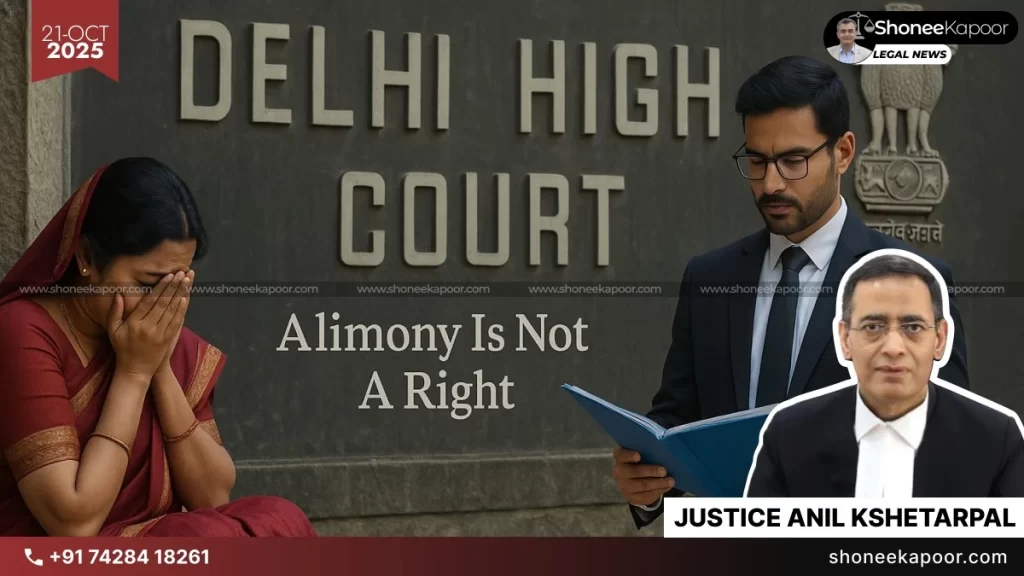
Delhi High Court ruled that permanent alimony can’t be granted just to equalise wealth when both spouses are financially independent. The bench dismissed a senior officer’s plea seeking ₹50 lakh, holding that Section 25 of the Hindu Marriage Act protects only a genuinely dependent spouse.
NEW DELHI: The Delhi High Court has clearly ruled that permanent alimony is not meant to equalise the financial position between two self-sufficient partners. It is meant only to help the spouse who genuinely needs financial protection after divorce.
A Division Bench of Justice Anil Kshetarpal and Justice Harish Vaidyanathan Shankar gave this important decision while dismissing an appeal by a senior government officer, Rita Raj, who had sought permanent alimony after her marriage with Pabitra Roy Chaudhuri, an advocate, was dissolved on the ground of cruelty.
The Court stated:
“It is a settled principle that permanent alimony is intended as a measure of social justice and not as a tool for enrichment or equalizing the financial status of two capable individuals. The law requires that the applicant demonstrate a genuine need for financial assistance. In the present case, the Appellant’s position as a senior government officer, her steady and substantial income, and the absence of dependents collectively establish that she is fully capable of maintaining herself. No evidence of financial incapacity, duress, or other compelling circumstances has been presented to justify judicial intervention.”
Background of the Case
The marriage between Rita Raj, a Group ‘A’ officer of the Indian Railway Traffic Service, and Pabitra Roy Chaudhuri, an advocate, was solemnised in January 2010. It was the second marriage for both, and no children were born from the union.
Soon after marriage, serious disputes arose. The husband alleged that the wife used abusive language, insulted his family, and even sent him humiliating text messages. One such shocking message read:
“Now I realise why you resemble jethu (uncle). Yr character speaks of yr illegitimate origin. Goodbye.”
The Family Court found these messages and conduct sufficient to constitute mental cruelty and dissolved the marriage under Section 13(1)(ia) of the Hindu Marriage Act.
The wife appealed, challenging both the divorce decree and the refusal to grant her alimony under Section 25 HMA. She argued that despite her employment, she suffered emotional trauma and contributed to the marriage, so she deserved permanent alimony.
Husband’s Defence
The husband opposed the plea, stating that the wife’s demand for ₹50 lakh as a precondition for divorce showed her financial motivation. He pointed out that she was highly paid, well-settled, and self-reliant.
He also argued that she insulted him and his family by using words like “janwar”, “haramzada”, “kutta”, and “son of a bitch”, and even denied him conjugal relations — all of which amounted to extreme cruelty.
The Family Court found evidence supporting his version, noting that her verbal and written communications were full of “filthy and scandalous” language and that her explanations were afterthoughts.
Court’s Key Observations
The Delhi High Court examined the intent behind Section 25 of the Hindu Marriage Act, which empowers courts to grant permanent alimony to a spouse who is unable to maintain themselves.
The Court explained:
“The provision under Section 25 is fundamentally equitable in nature and aims to secure financial justice between spouses, ensuring that a party lacking independent means of subsistence is not left destitute following the dissolution of marriage.”
While reaffirming the divorce decree, the Court noted that the Family Court’s decision was:
“Based on a cogent and balanced appreciation of the evidence and a correct application of legal principles.”
The Court also made an important clarification:
“Mere assertion of counter-cruelty does not automatically nullify established acts of cruelty; each averment must be judged on its evidential merits.”
It further remarked that when a spouse demands a large sum before agreeing to divorce, such conduct reflects monetary motives rather than any emotional desire to save the marriage:
“When a spouse, while ostensibly resisting the dissolution of marriage, simultaneously predicates consent thereto upon payment of a substantial sum, such conduct inevitably indicates that the resistance is not anchored in affection, reconciliation, or the preservation of the marital bond, but in pecuniary considerations.”
The Court also concluded that:
“The material on record does not disclose any evidence of financial hardship, dependency, or extraordinary circumstances that would render her incapable of maintaining herself with dignity.”
Final Ruling
Concluding the case, the Bench categorically stated:
“The law requires that the applicant demonstrate a genuine need for financial assistance.”
Since Rita Raj was an established officer with a secure income and no dependents, her plea for permanent alimony was “wholly unjustified.”
The appeal was dismissed, and the Family Court’s order was upheld in full.
Summary of Legal Principle
- Law applied: Section 25 of the Hindu Marriage Act, 1955
- Court’s stance: Permanent alimony is a relief for a dependent spouse, not a wealth equaliser.
- Ruling: Financially capable individuals cannot claim alimony merely because of emotional suffering or marital breakdown.
- Outcome: Appeal dismissed; divorce decree on cruelty upheld; no alimony granted.
Explanatory Table – Laws and Sections Referred in the Case
| Law / Statute | Section(s) | Provision Summary (in simple English) | Application in This Case |
|---|---|---|---|
| Hindu Marriage Act, 1955 | Section 13(1)(ia) | Divorce can be granted when one spouse treats the other with cruelty — physically or mentally. | The Family Court dissolved the marriage on the ground of cruelty by wife, supported by abusive messages and conduct. |
| Hindu Marriage Act, 1955 | Section 25 | Court may grant permanent alimony and maintenance to a spouse who cannot maintain themselves after divorce. | The wife sought ₹50 lakh as permanent alimony, but the High Court held she was financially independent and thus not entitled. |
| Family Courts Act, 1984 | Section 19 | Allows appeals from Family Court decisions to the High Court. | The wife filed this appeal under Section 19 challenging the Family Court judgment. |
| Family Courts Act, 1984 | Section 14 | A Family Court can receive any document or statement as evidence, even if not strictly admissible under the Evidence Act. | Used to accept electronic messages (SMS) as valid evidence of cruelty. |
| Indian Evidence Act, 1872 | Section 65B | Sets rules for admitting electronic records (like SMS, emails) as evidence—requires a certificate for authenticity. | The wife challenged admissibility of text messages; the Court confirmed a valid 65B certificate existed, making them admissible. |
| Protection of Women from Domestic Violence Act, 2005 | (Mentioned contextually) | Protects women from domestic violence; allows complaint against husband/family. | Wife had earlier filed DV case against husband, which was dismissed. |
| Indian Penal Code, 1860 | Section 498A | Punishes husband or relatives for cruelty to wife. | Husband was discharged in the 498A FIR; Court noted misuse of this provision. |
| Code of Civil Procedure, 1908 (CPC) | (Referenced via Family Court procedure) | Governs civil trials; made applicable to Family Courts. | Mentioned in context of procedure, not dispute itself. |
Case Summary
- Case Title: Rita Raj v. Pabitra Roy Chaudhuri
- Case Number: MAT.APP. (F.C.) 2/2024 & CM APPL. 360/2024
- Court: High Court of Delhi at New Delhi
- Judgment Reserved On: 11 September 2025
- Judgment Pronounced On: 17 October 2025
- Bench / Coram: Hon’ble Mr. Justice Anil Kshetarpal & Hon’ble Mr. Justice Harish Vaidyanathan Shankar
- Appellant (Wife): Rita Raj, Group ‘A’ Officer, Indian Railway Traffic Service (IRTS)
- Respondent (Husband): Pabitra Roy Chaudhuri, Advocate
- Appellant’s Counsel: Mr. Sarim Naved and Mr. Zeeshan Ahmad, Advocates; Appellant also appeared in person through VC
- Respondent’s Counsel: Mr. Rakesh Tiku, Senior Advocate with Ms. Arpan Wadhawan, Advocate; Respondent in person
- Family Court Judgment Appealed: Judgment dated 31 August 2023, Principal Judge, Family Court, Shahdara, Karkardooma Courts, Delhi
- Marriage Date: 25 January 2010
- Ground for Divorce: Cruelty under Section 13(1)(ia) of Hindu Marriage Act, 1955
- Date of Separation: 8 March 2011
- Duration of Cohabitation: Around 10 months
- Children: None
- Result: Appeal dismissed; Divorce upheld; No permanent alimony granted
Essence of the Ruling
- Alimony ≠ Financial Equalisation
- Only dependent spouse qualifies under Section 25 HMA
- Both parties here were educated, employed, and self-reliant
- Emotional distress alone doesn’t create entitlement to alimony
- Court reaffirmed social justice, not financial parity

Disclaimer: The views and opinions expressed in this article are those of the Indian courts and do not necessarily reflect the official policy or position of “ShoneeKapoor.com” or its affiliates. This article is intended for informational and educational purposes only. The content provided is not legal advice, and viewers should not act upon this information without seeking professional counsel. Viewer discretion is advised