
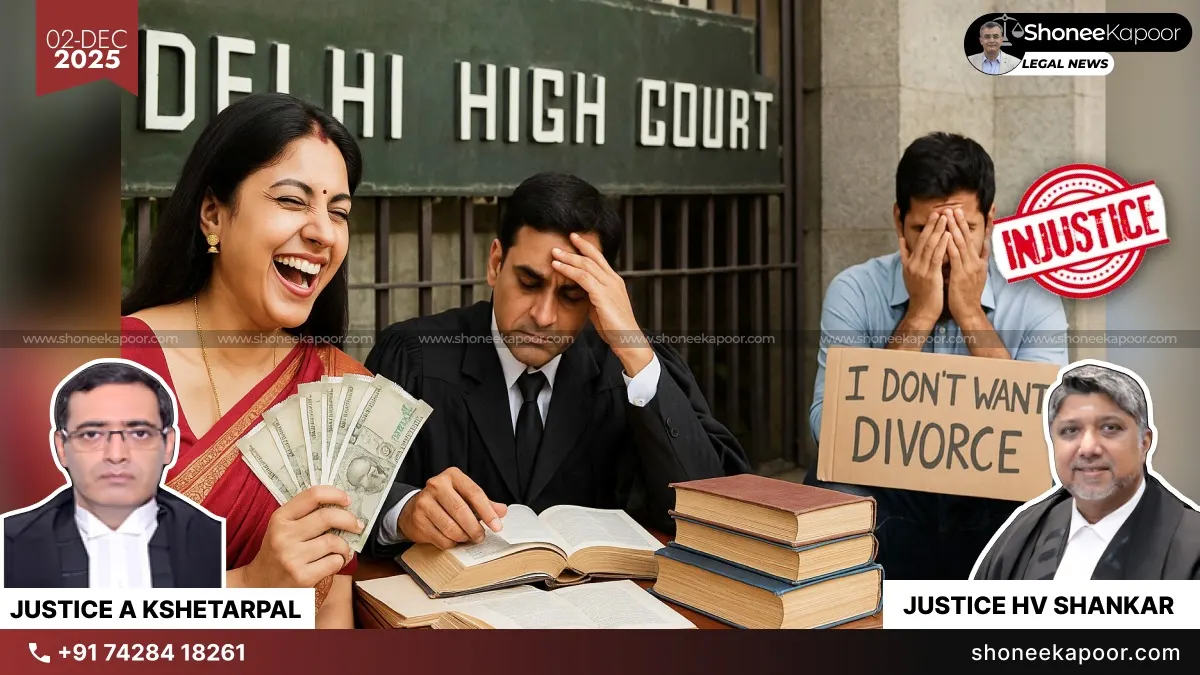
Judge Biased Towards Wife? “He Made Laws That Don’t Even Exist”: Delhi High Court Directs Re-Training For Family Court Judge

Written and analysed by Shonee Kapoor
Legal Consultant, Author & Men's Rights ActivistThe Delhi High Court has set aside a divorce decree after finding that a Family Court judge relied on a non-existent Section 28A of the Special Marriage Act and mixed-up unrelated laws. Calling it a “troubling lack of understanding”, the Court ordered immediate retraining for the judge at the Delhi Judicial Academy.
Delhi High Court Directs Re-Training For Family Court Judge: The Delhi High Court strongly criticised a Family Court judge in Delhi for repeatedly misunderstanding basic matrimonial laws and even relying on a non-existent legal provision to grant a divorce.
Because of these serious legal mistakes, the High Court has ordered that the judge must undergo “an appropriate and comprehensive refresher training program” before he handles any more matrimonial disputes.
A Division Bench of Justice Anil Kshetarpal and Justice Harish Vaidyanathan Shankar said that the judge had “repeatedly ignored clear statutory mandates” and had mixed up different laws in several divorce cases.
The High Court was hearing an appeal filed by a husband whose marriage was dissolved by the Family Court on the ground of cruelty. The judges expressed strong disapproval right at the beginning about how the Family Court judge had been handling matrimonial matters.
According to the High Court, the Family Court judge had confused completely separate laws: the Hindu Marriage Act (HMA) and the Special Marriage Act (SMA). These two laws have different procedures, different grounds for divorce and are designed for different types of marriages. Despite this, the judge mixed both laws and ended up distorting the legal framework.
In this particular case, the divorce petition was filed under Section 13(1)(ia) of the Hindu Marriage Act which deals with cruelty. But instead of deciding the matter under the HMA, the judge brought in the Special Marriage Act and even used a provision that does not exist at all.
The judgment notes:
“We were, in fact, taken aback to find that the learned Judge relied upon, in the Impugned Judgement, a provision, Section 28A of the SMA, that does not exist on the statute book, and on this basis granted a decree of divorce.”
The Bench said it is shocking that a Family Court judge relied on a provision that does not even exist in Indian law:
“It is incomprehensible how a Judicial Officer of the rank of a Family Court Judge could rely upon a non-existent statutory provision to grant a decree of divorce.”
The judge had justified this by saying this approach would “save precious judicial time and spare the parties another round of litigation”. But the High Court said that convenience cannot override the law.
The High Court was also disturbed by the way the Family Court judge shut down the wife’s opportunity to give evidence. On the very first date fixed for her statement, her evidence was closed without giving her a proper opportunity. Despite this, the judge proceeded to decide the case without hearing either side’s evidence.
The High Court said the Family Judge had acted “in a tearing hurry” and delivered a judgment without proper appreciation of facts, evidence and procedure.
The Court observed:
“The Family Court judge’s overall conduct showed: a troubling lack of understanding of basic legal principles, statutory provisions and jurisdictional boundaries.”
The High Court stated:
“The manner in which the learned Family Court Judge has proceeded reveals a serious misapprehension of the limits of judicial authority and undermines the integrity of the adjudicatory process.”
The High Court reviewed earlier cases decided by the same judge and noted a pattern where he granted divorces without following proper legal requirements. The Court cited earlier instances where he had bypassed mandatory procedures under Section 13B (mutual consent divorce) and had passed decrees without evidence.
The judgment also quotes an earlier observation of the judge which the High Court disapproved of. He had written:
“Under Hindu Law marriage is considered holy union and unbreakable for seven births… Marriages under the Special Marriage Act, 1954 cannot be termed as holy union…”
The Delhi High Court criticised this strongly, saying:
“Whether a marriage is viewed as a sacrament or as a civil contract under different personal laws has no bearing whatsoever on the sanctity, legitimacy, or legal force of a marriage solemnised under the SMA… To characterise marriages under the SMA as not being a ‘holy union’ is therefore neither appropriate nor appreciable.”
The Bench clarified that the Supreme Court has repeatedly advised High Courts not to make personal remarks against judicial officers. However, the situation in this case left them with no choice:
“The manner in which the learned Family Court Judge has repeatedly conducted proceedings not only disturbs judicial conscience but also threatens the integrity of the administration of justice.”
Because of all these issues, the High Court has cancelled the divorce decree passed by the Family Court and ordered a fresh trial before the Principal Judge, Family Court, Patiala House. Both husband and wife have been allowed to present fresh oral and documentary evidence.
The High Court stressed that it is not deciding whether the original divorce petition was maintainable under the Hindu Marriage Act. That question will be examined by the Family Court during the new trial.
Finally, the Court issued a firm direction:
“The concerned learned Family Court Judge, Sh. Harish Kumar, shall undergo an appropriate and comprehensive refresher training program in Matrimonial Laws, under the aegis of the Delhi Judicial Academy, post-haste, before he adjudicates any further matrimonial matters.”
The Registry has been instructed to implement this immediately.
Both parties must now appear before the Principal Judge, Patiala House Family Court, on 05.12.2025 for further proceedings.
Explanatory Table Of All Laws & Sections Mentioned
| Act / Law | Section | What It Means (Simple Explanation) | How It Was Involved in This Case |
| Hindu Marriage Act, 1955 (HMA) | Section 13(1)(ia) | Divorce on the ground of cruelty | Wife filed the divorce petition under this section. |
| Hindu Marriage Act, 1955 | Section 13B | Divorce by mutual consent | Judge wrongly used this provision in earlier unrelated cases; HC cited pattern. |
| Special Marriage Act, 1954 (SMA) | Section 13 | Marriage registration under SMA | Husband claimed his marriage was done under SMA. |
| Special Marriage Act, 1954 | Section 27 | Grounds for divorce under SMA | HC explained differences vs HMA. |
| Special Marriage Act, 1954 | Section 28A (Non-Existent) | This section does NOT exist | Family Judge relied on this imaginary section to grant divorce. |
| Family Courts Act, 1984 (FC Act) | — | Gives procedure + powers to Family Courts | Judge overused FC Act to bypass statutory requirements. |
| Code of Civil Procedure, 1908 (CPC) | Order VII Rule 11 | Rejection of plaint if barred by law or no cause of action | Husband sought rejection of the petition. |
| Code of Civil Procedure, 1908 (CPC) | Order VII Rule 14 | Filing documents with pleadings | Husband filed documents; later withdrawn. |
| Code of Criminal Procedure, 1973 (CrPC) | Section 125 | Maintenance for wife/child | Wife filed maintenance case in Siliguri. |
| Code of Criminal Procedure, 1973 (CrPC) | Section 340 | Inquiry into offences like perjury | Husband filed two 340 CrPC petitions against wife. |
| IPC – Indian Penal Code, 1860 | Section 498A | Cruelty by husband/relatives | Wife filed FIR; husband acquitted. |
| IPC | Section 506 | Criminal intimidation | Part of wife’s FIR. |
| IPC | Sections 406, 120B, 34 | Criminal breach of trust, criminal conspiracy, common intention | Wife filed another criminal complaint. |
| Dowry Prohibition Act, 1961 | Sections 3 & 4 | Penalty for dowry demand & giving/taking dowry | Wife filed FIR including these sections. |
| Protection of Women from Domestic Violence Act, 2005 | — | Domestic violence proceedings | Wife filed DV Act case in Siliguri. |
| Guardians and Wards Act, 1890 (GWA) | — | Custody of children | Husband filed two custody cases. |
| Transfer Petitions – Supreme Court | — | Transfer of civil & criminal cases | SC transferred all matters to Delhi. |
Case Title
MAT.APP.(F.C.) 115/2024 & CM APPL. 21304/2024
SSB (Appellant) vs. DBC (Respondent)
Court & Bench
- Court:
- High Court of Delhi, New Delhi
- Bench:
- Hon’ble Mr. Justice Anil Kshetarpal
- Hon’ble Mr. Justice Harish Vaidyanathan Shankar
Judgment Dates
- Reserved on: 04.11.2025
- Pronounced on: 27.11.2025
Appellant (Husband) – Counsels
- Represented by
- Mr. Prosenjeet Banerjee
- Ms. Shreya Singhal
- Ms. Mhasilenuo Keditsu
- Ms. Kushagra
- Ms. Anshika
- Ms. Vijayrajeshwari
- Mr. Sarthak
Respondent (Wife) – Counsels
- Represented by
- Ms. Padma Priya
- Ms. Chitrangda Rastrauara
- Mr. Abhijeet Singh
- Mr. Anirudh Singh
- Mr. Aishwaray Mishra
- Mr. Dhananjay Shekhawat
- Mr. Sakshi Aggarwal
- Mr. Yuvraj Singh
- Ms. Pearl Pundir
- Ms. Bhumika
Impugned Order Under Appeal
- Divorce granted by Family Court, Patiala House Courts, New Delhi
- Date: 28.03.2024
- Case: HMA No. 93/2023 (previously Matrimonial Suit No. 410/2021)
Key Findings Of The High Court
- Judge relied on non-existent Section 28A SMA
- Mixed HMA and SMA unlawfully
- Closed wife’s evidence on first date itself
- Decided divorce without any evidence from either side
- Acted “in a tearing hurry”
- Showed “a troubling lack of understanding”
- Made remarks calling SMA marriages “not holy unions”
- High Court ruled these comments are “neither appropriate nor appreciable”
Final Directions
- Divorce decree set aside.
- Matter remanded for fresh (de novo) trial before Principal Judge, Patiala House.
- Both sides may lead fresh oral and documentary evidence.
- Question of maintainability kept open.
- Judge Harish Kumar must undergo mandatory training at Delhi Judicial Academy before handling matrimonial cases again.
- Next appearance before Family Court: 05.12.2025
Key Takeaways
- A Family Court judge granted divorce using a law that doesn’t even exist, proving how casually men’s lives can be decided without legal basis.
- The judge mixed Hindu Marriage Act and Special Marriage Act as if men’s matrimonial rights are optional and not protected by clear statutes.
- The wife’s evidence was closed on the very first day, but the husband’s entire marriage was dissolved without a single day of proper trial.
- The High Court exposed a pattern where the same judge has repeatedly bypassed mandatory procedures, showing systemic negligence in cases that directly affect men.
- The Delhi High Court had to intervene, cancel the divorce, order a fresh trial, and send the judge for compulsory training—because men deserve lawful, fair, and competent adjudication in matrimonial disputes.
This Could Change Your Case-Get FREE Legal Advice-Click Here!
Disclaimer: The views and opinions expressed in this article are those of the Indian courts and do not necessarily reflect the official policy or position of “ShoneeKapoor.com” or its affiliates. This article is intended for informational and educational purposes only. The content provided is not legal advice, and viewers should not act upon this information without seeking professional counsel. Viewer discretion is advised.
Related Articles
The Silent Crisis: Men Destroyed by False Allegations in India – How Laws Meant for Protection Are Destroying Innocent Men
Laws Meant for Protection Are Destroying Innocent Men. An FIR is filed and a man’s life collapses before any evidence...
Karisma Kapoor – Sunjay Kapur Case Explained: Marriage, Divorce, 498A, Death & the Delhi High Court Property War
From a celebrity wedding to IPC 498A allegations, a Supreme Court-linked divorce settlement, and now a Delhi High Cou...
The Law That Forgot Its Sons: How India’s Gender Laws Turn Protection into Persecution
India’s gender laws were designed to protect women — but today, countless innocent men are being destroyed by false c...
Share Your Thoughts
Comments are moderated before publication.