
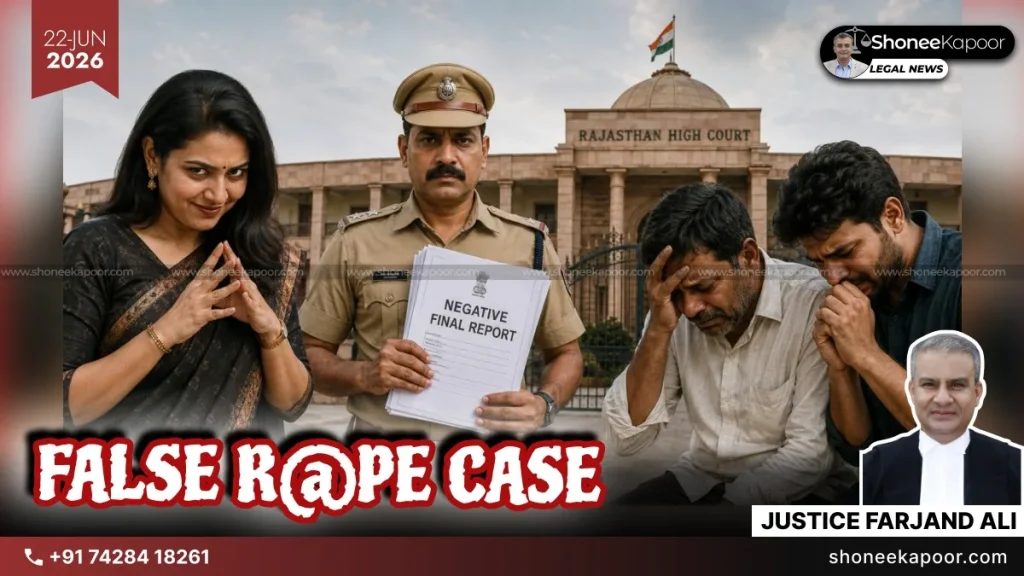
Can police closure report be ignored without giving reasons? Rajasthan High Court held that a negative Final Report cannot be brushed aside mechanically, and the Magistrate must record clear reasons for disagreeing with police.
JODHPUR: The Rajasthan High Court at Jodhpur through Justice Farjand Ali has quashed criminal proceedings in a rape case involving allegations under Sections 366, 376 and 384 IPC, after finding that the Magistrate had taken cognizance without properly dealing with the negative Final Report filed by the police.
The case started when a woman filed an FIR at Kotgate Police Station, Bikaner, alleging abduction, rape and extortion against two accused persons. After investigation, the police filed a negative Final Report, saying that no case was made out against them.
The complainant then filed a protest petition before the Magistrate. The Chief Judicial Magistrate, Bikaner disagreed with the police report, took cognizance of the offences and issued arrest warrants against the accused men. Later, the Sessions Court changed the arrest warrants into bailable warrants but continued the cognizance order.
The accused persons then approached the Rajasthan High Court. They argued that the Magistrate had not given any proper reason for rejecting the police closure report. According to them, the Magistrate simply relied on the protest petition and ignored the investigation material collected by the police.
The Court made it clear that a Magistrate is not bound to accept the police report. But if the Magistrate wants to reject a negative Final Report, the order must show proper application of mind.
The High Court found that the Magistrate mainly relied on the protest petition and the statements of the complainant and her parents. The Magistrate did not properly discuss the police investigation or explain why the police conclusions were wrong.
The High Court also noted that the Magistrate did not discuss why the findings of the Investigating Officer were unacceptable. The order did not explain which part of the police investigation was wrong, perverse, unsupported by record or illegal.
The Court strongly stressed the importance of reasons in judicial orders and said:
“The requirement of recording reasons is not an empty formality.”
It further observed:
“Reasons constitute the heartbeat of a judicial order.”
The High Court then looked at the material considered by the police during investigation. The police had found that the complainant and the accused were known to each other for a considerable time. The investigation also showed that the complainant had allegedly remained in the company of one of the accused for a long period and had accompanied him on several occasions.
The Court noted that, according to the investigation, the circumstances did not prima facie show any immediate threat, compulsion, coercion or physical restraint. The police had also found that the complainant had several chances to inform her family, acquaintances or public authorities, but no immediate complaint or protest was made.
After examining the record, the High Court said:
“The investigation was conducted in a fair and comprehensive manner and the conclusions reached therein were supported by material collected during investigation.”
The Court held that the Magistrate’s order taking cognizance suffered from non-consideration of relevant material and failure to record reasons for disagreeing with the Final Report.
Accordingly, the Rajasthan High Court quashed the order dated 28.05.2011 passed by the Chief Judicial Magistrate, Bikaner and the appellate order dated 09.09.2014 passed by the Additional Sessions Judge, Bikaner.
The petition filed by the accused was allowed, while the petition filed by the complainant was dismissed, as the complainant had died during the pendency of the proceedings and no legal representative had sought substitution.
EXPLANATORY TABLE: LAWS AND SECTIONS INVOLVED
| Law / Provision | Purpose | How It Applied in This Case |
| Section 366 IPC | Kidnapping, abducting or inducing a woman to compel marriage or illicit intercourse. | The FIR alleged this offence against the accused persons. |
| Section 376 IPC | Rape. | This was one of the main offences alleged in the FIR. |
| Section 384 IPC | Extortion, meaning dishonestly putting a person in fear and forcing delivery of money/property/valuable security. | The FIR also alleged extortion against the accused persons. |
| Negative Final Report / Closure Report | A police report saying that after investigation, no prosecutable case is made out. | Police filed a negative Final Report saying no case was made out against the accused. |
| Protest Petition | A petition filed by the complainant when they disagree with the police closure report. | The complainant filed it after police filed the negative Final Report. |
| Cognizance | The stage where a Magistrate takes judicial notice of an offence and starts court process against accused persons. | The Magistrate took cognizance despite the negative Final Report. |
| Warrant of Arrest | A court order directing arrest of the accused. | The Magistrate issued arrest warrants after taking cognizance. |
| Bailable Warrant | A warrant where the accused can secure release by furnishing bail. | The Sessions Court changed arrest warrants into bailable warrants. |
| Reasoned Judicial Order | A court order must show why the court reached a conclusion. | The High Court held that the Magistrate did not give proper reasons for rejecting the police report. |
| Non-application of Mind | When a court passes an order without properly considering the material on record. | The accused argued, and the High Court accepted, that the cognizance order suffered from non-application of mind. |
CASE DETAILS
- Case Title: Manisha Jain v. State of Rajasthan & Ors.
- Connected Petition: Nawla Ram & Anr. v. State of Rajasthan & Anr.
- Court: High Court of Judicature for Rajasthan at Jodhpur
- Case Number: S.B. Criminal Miscellaneous (Petition) No. 2195/2014
- Connected Case Number: S.B. Criminal Miscellaneous (Petition) No. 2330/2014
- Bench: Hon’ble Mr. Justice Farjand Ali
- Neutral Citation: 2026:RJ-JD:26965
- Counsels:
- For Petitioner(s): Mr. Kapil Purohit.
- For Respondent(s): Mr. N.S. Chandawat, Public Prosecutor; Mr. J.S. Choudhary, Senior Advocate assisted by Mr. Pradeep Choudhary and Ms. Sampati Choudhary.
KEY TAKEAWAYS
- Allegations may be enough to start an investigation, but they cannot be enough to punish a person or drag him endlessly without evidence.
- If police file a closure report after investigation, the court cannot reject it casually. The court must clearly explain why the investigation is wrong.
- A protest petition is only an objection by the complainant. It cannot replace the investigation record, witness statements, documents, conduct and surrounding facts.
- In serious criminal cases, delay, silence, continued association, opportunities to complain, and overall conduct cannot be ignored. These facts may change the entire story.
- Due process is not sympathy for the accused. It is the basic protection that prevents the criminal justice system from becoming a weapon against innocent people.
This Could Change Your Case-Get FREE Legal Advice-Click Here!
Disclaimer: The views and opinions expressed in this article are those of the Indian courts and do not necessarily reflect the official policy or position of “ShoneeKapoor.com” or its affiliates. This article is intended for informational and educational purposes only. The content provided is not legal advice, and viewers should not act upon this information without seeking professional counsel. Viewer discretion is advised.