
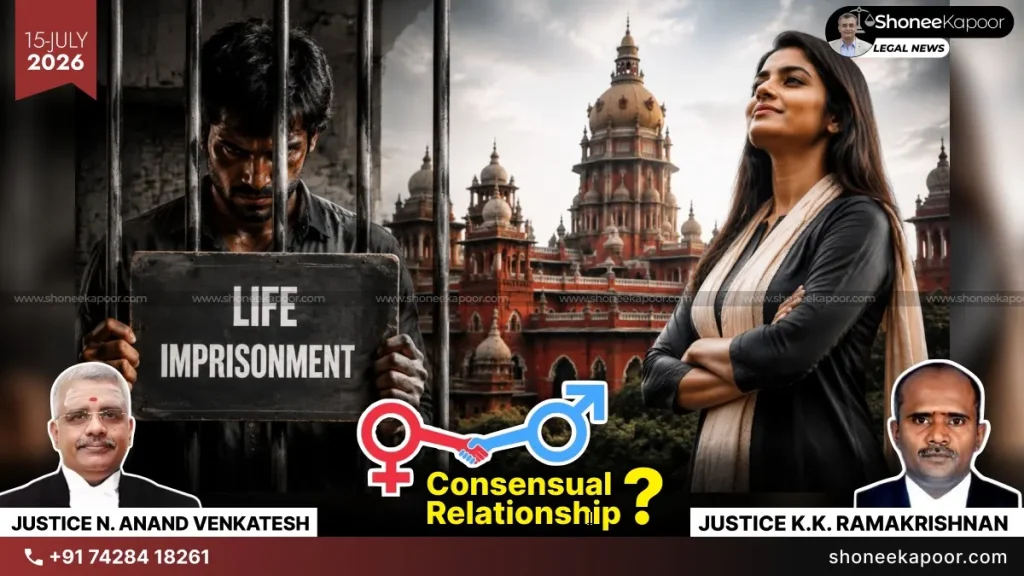
Can a relationship turn into a life-changing criminal battle for a man? Madras High Court ruled that a relationship alone cannot establish consent when the Court finds allegations of deception, threats or coercion.
RAPE CASE MADURAI: The Madurai Bench of Madras High Court dismissed the criminal appeal filed by the accused, who challenged his conviction and sentence awarded by the Fast Track Mahila Court, Nagercoil. The Trial Court had convicted him under serious criminal charges including Section 376(2)(n) IPC and awarded life imprisonment till natural death along with other punishments.
The judgment was delivered by Justice K. Ramakrishnan and Justice N. Anand Venkatesh of the Madurai Bench of Madras High Court. The Bench examined whether the conviction was legally sustainable and whether the evidence presented during the trial was sufficient to uphold the punishment.
The case involved allegations that the accused developed contact with the victim through social media and allegedly gained her trust by promising marriage and employment. The prosecution claimed that the relationship later involved deception, threats and misuse of private photographs and videos. The accused, however, argued that the relationship was consensual and that the evidence presented against him was unreliable.
The defence argued that there were contradictions in the victim’s statements, delay in filing the complaint and doubts regarding electronic evidence. It was also argued that a consensual relationship between two adults cannot later be converted into a criminal allegation merely because the relationship failed.
The High Court, after analysing the evidence, rejected these arguments and observed that the case could not be decided only on public sentiment or the seriousness of allegations. The Court stated that criminal cases must be decided only on legally admissible evidence.
The Bench held that the victim’s testimony was consistent and trustworthy. It observed that in appropriate cases, conviction can be based on the testimony of the victim if the Court finds the evidence reliable.
The Court relied on the principle that:
“There is no rule of law that her testimony cannot be acted upon without corroboration in material particulars.”
And further referred to the observation that:
“Seeking corroboration of her statement before relying upon the same, as a rule, in such cases amounts to adding insult to injury”.
The Court further noted the legal position that:
“Corroborative evidence is not an imperative component of judicial credence in every case of rape. Corroboration as a condition for judicial reliance on the testimony of the prosecutrix is not a requirement of law but a guidance of prudence under given circumstances…”
While discussing the role of evidence, the Court observed that the victim’s evidence was found to be credible and that there was no material suggesting false implication. The Court held that the prosecution had successfully proved the charge under Section 376(2)(n) IPC beyond reasonable doubt.
The judgment also discussed the concept of deception and coercion in relationships, observing that an apparent relationship cannot automatically mean valid consent if circumstances show manipulation, intimidation or fear.
The accused had challenged the conviction claiming that he was falsely implicated and that the relationship was consensual. However, the High Court found that the defence failed to create sufficient doubt in the prosecution case and upheld the findings of the Trial Court.
The Court ultimately dismissed the appeal and confirmed the conviction and sentence imposed by the Trial Court.
EXPLANATORY TABLE: LAWS AND SECTIONS INVOLVED
| Law/Section | Purpose | Application In This Case |
| Section 376(2)(n), Indian Penal Code (IPC) | Punishes repeated sexual acts committed against the same woman without lawful consent. | The Court held that the prosecution proved repeated acts and upheld conviction under this provision. |
| Section 417 IPC (Cheating) | Punishes dishonest deception causing wrongful loss or inducement. | Allegation involved deception through false assurances of marriage and employment. |
| Section 354(A) IPC | Deals with sexual harassment. | Trial Court had convicted the accused under this provision based on allegations of sexual misconduct. |
| Section 354(C) IPC | Deals with voyeurism, including capturing or sharing private images without consent. | Alleged recording and misuse of intimate photographs/videos formed part of prosecution evidence. |
| Section 506(II) IPC | Punishes criminal intimidation involving serious threats. | Prosecution alleged threats were used to intimidate the victim. |
| Section 294(b) IPC | Punishes obscene acts or words in public places. | One of the charges considered by the Trial Court. |
| Section 66E, Information Technology Act, 2000 | Punishes violation of privacy by capturing/transmitting private images. | Electronic material and alleged misuse of private content were examined. |
| Section 114A, Indian Evidence Act, 1872 | Creates presumption regarding absence of consent in certain rape prosecutions when conditions are fulfilled. | High Court discussed its application after accepting the victim’s testimony regarding lack of consent. |
| Section 374(2), Criminal Procedure Code (CrPC) | Provides right to appeal against conviction by Sessions Court. | The accused filed the criminal appeal under this provision. |
| Section 207 CrPC | Requires supply of prosecution documents to accused. | Trial procedure followed this requirement before framing charges. |
| Section 313 CrPC | Allows accused to explain circumstances appearing against him. | The accused denied allegations during examination under this provision. |
| Section 27, Indian Evidence Act | Relates to discovery of facts based on information provided by accused. | Court discussed recovery and discovery evidence connected with investigation. |
CASE DETAILS
- Case Title: Suji @ Kasi Vs. The State Rep. By Inspector of Police, CBCID, Nagercoil
- Case Number: Crl.A(MD).No.644 of 2023
- Court: Madurai Bench of Madras High Court
- Date Of Judgment:14.07.2026
- Bench: Justice N. Anand Venkatesh | Justice K. Ramakrishnan
- Counsels:
- For Appellant: Mr. V. Kathirvelu, Senior Counsel
- For Respondent: Mr. G. Karuppasamy Pandian, Counsel for State of Tamil Nadu
KEY TAKEAWAYS
- Serious allegations can destroy a man’s life instantly, but conviction must always depend on strict legal scrutiny and evidence.
- Courts must protect genuine victims, but also ensure that every accused receives a fair trial and the right to defend himself.
- A failed relationship cannot automatically become a criminal case; the difference between consent, deception and coercion must be examined carefully.
- Electronic evidence, allegations and testimonies must be tested through proper legal procedures before taking away a person’s liberty.
- In criminal justice, neither public pressure nor emotions should replace evidence — because one wrong conviction can destroy an innocent man forever.
This Could Change Your Case-Get FREE Legal Advice-Click Here!
Disclaimer: The views and opinions expressed in this article are those of the Indian courts and do not necessarily reflect the official policy or position of “ShoneeKapoor.com” or its affiliates. This article is intended for informational and educational purposes only. The content provided is not legal advice, and viewers should not act upon this information without seeking professional counsel. Viewer discretion is advised.