
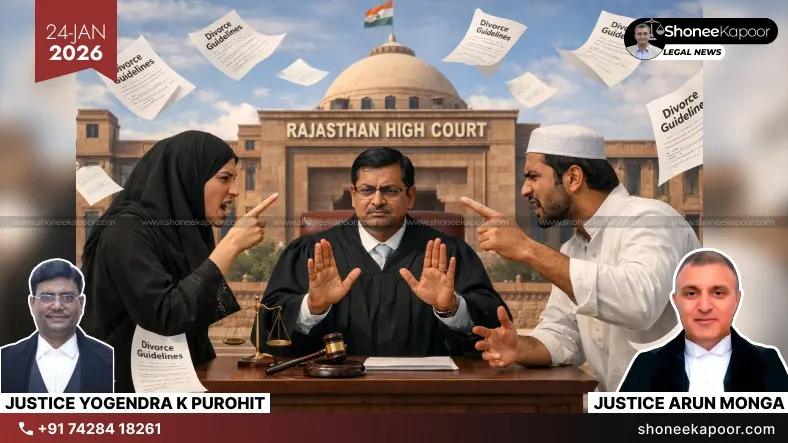
The Rajasthan High Court ruled that Family Courts must recognise valid Muslim divorces like Talaq-ul-Hasan and Mubarat. Courts cannot deny relief on technical excuses when both parties freely ended the marriage.
HC Lays Guideline For Divorce: The Rajasthan High Court has clearly held that Family Courts are legally bound to recognise and declare a marriage dissolved when a valid divorce has already taken place under Muslim Personal Law. The Court said that Family Courts cannot reject such cases on hyper-technical grounds and must respect lawful extra-judicial divorces such as Talaq-ul-Hasan and Mubarat.
The case came before a Division Bench of Justice Arun Monga and Justice Yogendra Kumar Purohit after a Family Court dismissed a woman’s suit seeking a declaration that her marriage already stood dissolved. The Family Court refused relief despite the fact that both the wife and the husband admitted that the divorce had already happened under Muslim law.
The parties were married according to Muslim customs in February 2022. No child was born from the marriage. Due to serious differences and breakdown of the relationship, they decided to separate. During the marriage, the husband pronounced talaq three times on three separate dates — 08.06.2024, 08.07.2024, and 08.08.2024 — each during a separate tuhar period. The wife accepted all three pronouncements. As per Muslim law, the marriage stood dissolved after the third pronouncement.
After this, both parties also executed a written mutual divorce agreement (Mubarat) on stamp paper on 20.08.2024. Under this agreement, the wife received mehr, iddat maintenance, lifelong maintenance in lump sum, and her stridhan was returned. Both sides clearly stated that there was no possibility of reconciliation.
Despite all this, the Family Court rejected the case. One of the main reasons given was that the talaq was not pronounced in the presence of two male witnesses. The High Court strongly criticised this approach. It clarified that this requirement applies under Shia law, not Sunni law, and the parties in this case were governed by Sunni law. Under Sunni law, witnesses are not mandatory when the talaq is admitted and not disputed by either spouse.
The High Court also noted that the Family Court completely ignored the Mubarat agreement, which is a well-recognised and valid mode of divorce under Muslim Personal Law. Ignoring such an agreement, despite both parties accepting it voluntarily, was termed a “material irregularity”.
The Court reminded that Section 7 of the Family Courts Act gives Family Courts the power to decide all matrimonial disputes, including declaring the marital status of parties. When a marriage is already dissolved under personal law, the role of the court is not to frustrate the process but to verify voluntariness and legality.
While the law is often discussed only from one side, this judgment quietly highlights an important reality — when both spouses agree that a marriage has ended, forcing them to remain legally tied serves no one. Prolonged technical litigation only increases mental, social, and financial damage, especially when the legal system ignores clear admissions and lawful personal practices.
The Court relied on earlier Supreme Court and High Court rulings and clearly stated the legal position in the following words:
“Family Court is competent to endorse extra Judicial divorces such as khula and mubaarat after verifying their validity through a summary process, primarily ensuring voluntariness and proper documentation. The Supreme Court…reaffirmed that a Mubaarat agreement, entered into voluntarily by both parties, is a valid mode of divorce under Muslim law, and the Family Court can declare the marital status as dissolved based on such an agreement.”
Taking note of repeated complaints that Family Courts routinely reject such petitions, the Rajasthan High Court also laid down clear guidelines. It directed that when parties claim that marriage is already dissolved under Muslim law, the Family Court must call both parties, record their statements, verify that there is no pressure or coercion, examine any written agreement, and then pass a reasoned order under Section 7 of the Family Courts Act.
The High Court finally set aside the Family Court’s order and declared that the marriage between the parties stood dissolved. It also directed that these guidelines must be followed by all Family Courts in Rajasthan to prevent unnecessary suffering caused by rigid and mechanical approaches.
Explanatory Table: Laws & Sections Referred In The Case
| Law / Statute | Section | Simple Explanation |
| Family Courts Act, 1984 | Section 7 | Gives Family Courts power to decide all matrimonial disputes, including divorce, nullity of marriage, and declaration of marital status. |
| Dissolution of Muslim Marriages Act, 1939 | Section 2 | Lists the grounds on which a Muslim woman can seek dissolution of marriage through court. |
| Dissolution of Muslim Marriages Act, 1939 | Section 2(ix) | Allows divorce on any ground recognised as valid under Muslim Personal Law, including extra-judicial modes like Mubarat. |
| Muslim Personal Law (Shariat) Application Act, 1937 | — | Recognises Muslim Personal Law as applicable to marriage, divorce, and related matters for Muslims. |
| Muslim Personal Law | Talaq-ul-Hasan | A valid form of divorce where the husband pronounces talaq in three separate tuhar periods, becoming irrevocable after the third. |
| Muslim Personal Law | Mubarat | A mutual divorce by agreement of both husband and wife, based on free consent without coercion. |
| Family Courts Act, 1984 | Section 7(b) | Empowers the Family Court to declare marital status when parties seek official recognition of divorce already effected. |
| Code of Criminal Procedure, 1973 | Section 127(3) | Referred in Supreme Court precedent to explain maintenance consequences after different modes of Muslim divorce. |
Case Details
- Case Title: Ayasha Chouhan v. Waseem Khan
- Case Number: D.B. Civil Misc. Appeal No. 1319/2025
- Court: High Court of Judicature for Rajasthan at Jodhpur
- Neutral Citation: 2026:RJ-JD:1211-DB
- Date of Judgment: 07 January 2026
- Bench: Hon’ble Mr. Justice Arun Monga & Hon’ble Mr. Justice Yogendra Kumar Purohit
- Counsels:
- For Appellant (Wife): Mr. Vishal Sharma
- Respondent (Husband): Mr. Ravindra Kumar Purohit
Key Takeaways
- Courts cannot trap men in dead marriages by refusing to recognise a legally valid divorce already accepted by both spouses.
- Forcing continuation of a dissolved marriage only exposes men to future misuse of maintenance, harassment, and false matrimonial litigation.
- Sunni Muslim men cannot be denied divorce recognition by wrongly importing Shia law witness requirements.
- Mutual divorces like Mubarat protect both parties, but delays in legal recognition disproportionately harm men through endless legal exposure.
- Family Courts are meant to certify reality, not manufacture disputes by ignoring consent and personal law.
This Could Change Your Case-Get FREE Legal Advice-Click Here!
Disclaimer: The views and opinions expressed in this article are those of the Indian courts and do not necessarily reflect the official policy or position of “ShoneeKapoor.com” or its affiliates. This article is intended for informational and educational purposes only. The content provided is not legal advice, and viewers should not act upon this information without seeking professional counsel. Viewer discretion is advised.