
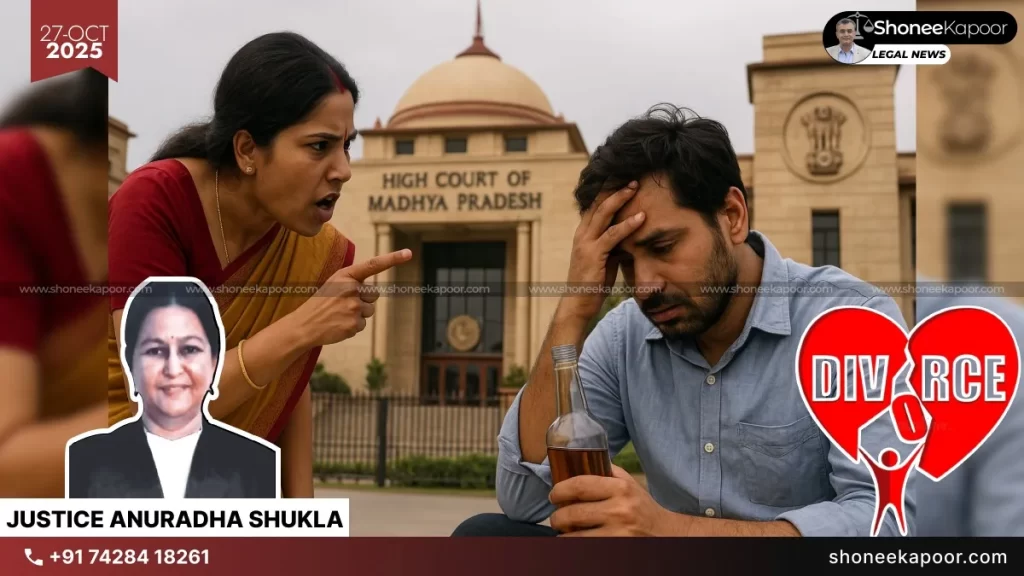
The Madhya Pradesh High Court ruled that when a wife falsely labels her husband as an alcoholic and persistent humiliation him publicly, it amounts to mental cruelty. The Court dissolved the marriage, restoring the husband’s dignity.
JABALPUR: The Madhya Pradesh High Court has granted a divorce to a man after finding that his wife falsely accused him of being an alcoholic and persistent humiliation him socially instead of trying to save the marriage.
A Division Bench of Justice Vishal Dhagat and Justice Anuradha Shukla said that constantly ridiculing a husband as a drunkard among friends, family, or colleagues amounts to serious mental cruelty.
The Court observed:
“In the case on hand, the wife, in order to avoid marital obligations, has made unfounded allegation of habit of intoxication against the appellant/husband and has thus exposed him to social sham and contempt by compromising his social position of a public servant. Her act of baseless accusation definitely has a decisive impact on the future relationship of the parties…”
The couple got married in 2004 and have two children. However, they have been living separately since 2017. The wife had earlier filed a complaint under the Protection of Women from Domestic Violence Act, but the case was later closed.
In 2018, the husband filed for divorce alleging that his wife’s behaviour was cruel and that she used to make false allegations against him. The wife opposed the petition, claiming that she was the one facing cruelty and that the couple had reached a compromise after her husband’s apology.
In 2021, the Family Court rejected the husband’s plea, saying he was a habitual drinker who harassed his wife. The man then approached the High Court.
After carefully reviewing the case records, the Madhya Pradesh High Court found that the family court’s finding was unsupported by evidence. The judges noted that the documents the lower court relied upon to prove alcoholism had no evidentiary value.
The Bench stated:
“…In none of these documents, it is mentioned that the appellant/husband had any habit of taking liquor. The last document was Ex. D/4, which was a complaint given to Police Paramarash Kendra on 24.02.2015 by respondent/wife, but it appears that police did not take any follow-up action on its basis. Thus, whatever wicked deeds were confessed by appellant/husband in the year 2011, under Ex.-D/2, had evidently no recurring episodes in subsequent years of his marital life. Further, whatever was stated by the wife regarding this habit to intoxication, the same was rebutted by appellant-husband in his statement given on oath,” the Court found.
The High Court concluded that the wife failed to prove her allegations and that the trial court erred in assuming that the husband was addicted to liquor.
The Court also pointed out that the wife seemed determined to humiliate her husband publicly. Both the husband and wife were working in the public sector — the husband as a Class IV employee and the wife as an officer-cadre employee — yet her behaviour towards him showed persistent contempt.
The judges noted:
“In the present case, wife has shown no hesitation in declaring that her husband/appellant was alcoholic and was thus given to intolerable habits. Admittedly, appellant/husband is a class IV employee while respondent/wife is in the Officer cadre, but both are serving in public sector. We have no hesitation in observing that normal bickering and quarrels between the parties, happening in their day to day life, can not be taken as a matter of grave concern, but a persistent resolved attitude of respondent-wife to see that her husband is ridiculed and humiliated in his social circle as an alcoholic is definitely a serious affair.”
Based on these findings, the High Court allowed the appeal and granted divorce to the husband under Section 13(1)(ia) of the Hindu Marriage Act, holding that the wife’s false allegations and humiliation amounted to mental cruelty.
Explanatory Table of Laws & Sections Mentioned
| Law / Act | Section | Provision Title / Description | Court’s Observation / Relevance |
|---|---|---|---|
| Hindu Marriage Act, 1955 | Section 13(1)(ia) | Divorce on the ground of cruelty | The husband was granted divorce as the wife’s false allegation of alcoholism and public humiliation amounted to mental cruelty. |
| Protection of Women from Domestic Violence Act, 2005 | — | Protection for women from physical, emotional, verbal, and economic abuse | The wife had filed a DV complaint earlier, but it was later closed. No evidence of cruelty by husband was found. |
| Indian Evidence Act, 1872 | — (Implied) | Rules for admissibility and evidentiary value of documents | The High Court found that the documents relied upon by the Family Court had no evidentiary value to prove the husband was an alcoholic. |
| Indian Penal Code (Not directly invoked) | — | General criminal law provisions | Not applied here, but referenced contextually regarding social defamation. |
| Civil Procedure / Family Court Procedure | — | Appeal from Family Court | The High Court overturned the Family Court’s denial of divorce, citing lack of evidence and mental cruelty. |
Case Summary
- Court: High Court of Madhya Pradesh
- Bench / Coram: Justice Vishal Dhagat and Justice Anuradha Shukla
- Case Title: [Name not visible in provided text — likely “Husband v. Wife” or “Appellant v. Respondent” in a matrimonial appeal]
- Case Type: Matrimonial Appeal under Section 13(1)(ia) of the Hindu Marriage Act, 1955
- Decision Year: 2024
- Lower Court: Family Court (specific district not mentioned — possibly Bhopal or Jabalpur, based on MP HC jurisdiction)
- Appellant: Husband
- Respondent: Wife
- Counsels: Not visible in extract (requires text-searchable PDF for names of advocates)
- Judgment Result: Divorce granted to husband on ground of mental cruelty
- Key Findings: False allegation of alcoholism and public humiliation amount to mental cruelty
- Citation (Suggested Short Form): Husband v. Wife, 2024 SCC OnLine MP HC [Exact citation pending official publication]
Final Outcome
- The High Court granted divorce to the husband under Section 13(1)(ia) of the Hindu Marriage Act.
- The wife’s false accusations of alcoholism and continued public humiliation were deemed mental cruelty.
- The Court emphasized that such baseless allegations can destroy trust and respect — the foundation of any marriage.
Disclaimer: The views and opinions expressed in this article are those of the Indian courts and do not necessarily reflect the official policy or position of “ShoneeKapoor.com” or its affiliates. This article is intended for informational and educational purposes only. The content provided is not legal advice, and viewers should not act upon this information without seeking professional counsel. Viewer discretion is advise.