
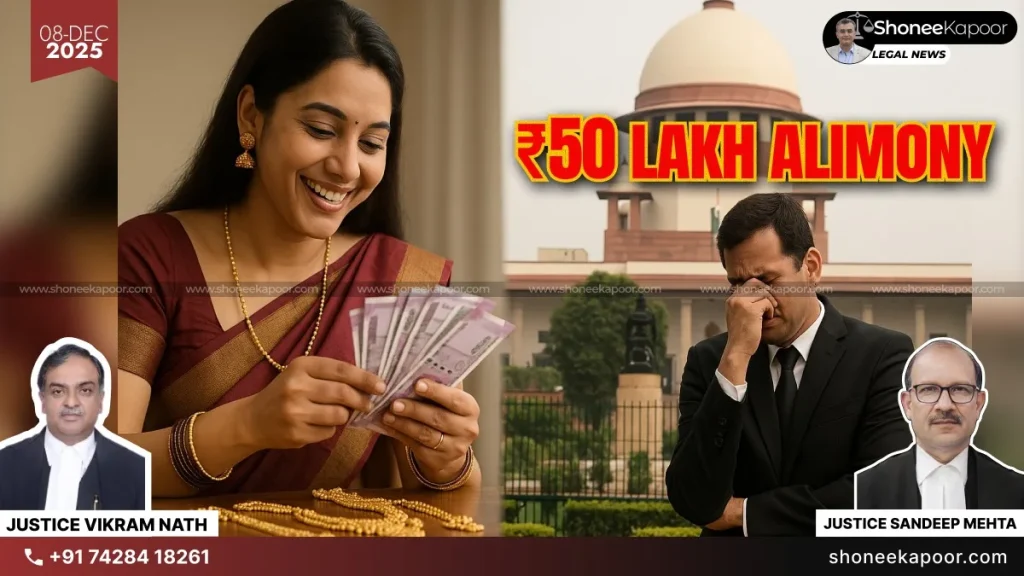
The Supreme Court upheld the divorce of a judicial officer and his wife and increased her permanent alimony from ₹30 lakh to ₹50 lakh. The Court said a wife is entitled to a lifestyle similar to what she enjoyed during the marriage.
Wife Must Live Same Standard as During Marriage: The Supreme Court of India delivered an important judgment in a matrimonial dispute involving a judicial officer and his estranged wife. While confirming the divorce granted by the Punjab & Haryana High Court, the Supreme Court increased the permanent alimony from ₹30 lakh to ₹50 lakh so that the wife can continue to live with dignity and financial security.
The Court clearly stated that the husband, being a judicial officer, carries a higher duty to ensure proper financial support for his wife and daughter.
The Division Bench of Justice Vikram Nath and Justice Sandeep Mehta noted:
“The respondent-husband is a serving judicial officer holding a responsible public position and is, therefore, under a heightened obligation to ensure fair, adequate, and dignified financial security for his wife and daughter.”
The Supreme Court further emphasised that the wife, who is no longer practising law, deserves to maintain the lifestyle she had during marriage.
The judgment says:
“The appellant-wife, who is presently not engaged in legal practice, is entitled to maintain a standard of living broadly commensurate with what she enjoyed during the subsistence of the marriage.”
Background of the Case
The couple married in 2008 according to Hindu rites. At that time, the husband was undergoing training at the Judicial Academy, Chandigarh, while the wife was practising as an Additional Advocate General. They have a daughter born in 2009.
The husband filed for divorce in 2018 alleging cruelty. His first petition was withdrawn; the second was returned due to lack of jurisdiction; the third petition was filed in Mohali in 2019. The Family Court rejected the divorce plea in 2023, saying the husband failed to prove cruelty and in fact, had subjected the wife to cruelty.
However, the High Court reversed this decision, granted divorce, and awarded ₹30 lakh alimony. The High Court also directed that ₹41 lakh from the husband’s LIC maturity be deposited in the daughter’s account, that he must pay ₹30,000 per month for her upkeep, bear her marriage expenses, and must not disinherit her.
Supreme Court on Breakdown of Marriage
The Supreme Court observed that the couple has been living separately since 2012 and there has been no real attempt to repair the relationship.
The Bench remarked:
“It is an admitted fact that the parties have been residing separately since 2012 which is more than thirteen years now, and no substantial or meaningful effort has been made in restoring their matrimonial relationship.”
After interacting with the couple personally, the Court found the relationship deeply bitter and damaged. It said continuing the marriage would only cause more hostility.
The order states:
“In these circumstances, we see no purpose in perpetuating a legal bond that has long ceased to have any substance. Continuing the marital tie would serve neither the spouses nor their child; rather, it would only prolong hostility and impede their ability to move forward with dignity.”
The Court concluded that the marriage had irretrievably broken down:
“We therefore affirm the view that the marriage has broken down beyond repair, and that dissolution is in the interest of justice and in the welfare of all concerned.”
Supreme Court Enhances Alimony to ₹50 Lakh
Considering the husband’s position, income, and future prospects, and to secure the wife’s financial independence, the Court increased the alimony to ₹50 lakh. The Bench stated:
“Accordingly, the sum of Rs.30,00,000/- (Rupees Thirty Lakhs only) awarded by the High Court is enhanced to Rs.50,00,000/- (Rupees Fifty Lakhs only).”
This amount must be paid within three months.
The Supreme Court also continued all other High Court directions, including deposits for the daughter, monthly maintenance, marriage expenses, and the direction that she must not be disinherited.
Finally, the Court made it clear that the ₹50 lakh is a complete and final settlement:
“The amount of Rs.50,00,000/- (Rupees Fifty Lakhs only) awarded herein as permanent alimony shall be treated as full and final settlement of all monetary and other claims arising out of the marital relationship between the parties.”
All civil and criminal cases between the couple arising from their marriage now stand closed. The wife must provide her bank details for payment.
The case has been formally disposed of.

Explanatory Table Of All Laws & Sections Mentioned In The Case
| Law / Section | Full Name | Purpose in the Case | How It Was Applied Here |
| Section 13(1)(ia), Hindu Marriage Act, 1955 | Divorce on the ground of cruelty | Allows a spouse to seek divorce if the other spouse treats them with cruelty | The husband filed the divorce petition under this section alleging cruelty. Family Court rejected it; High Court accepted it; Supreme Court upheld the divorce. |
| Hindu Marriage Act, 1955 (General) | Governs Hindu marriages, divorce, maintenance, etc. | Provides framework for filing and deciding divorce petitions | The entire divorce litigation, alimony, and separation are governed under this Act. |
| Civil Appellate Jurisdiction | Supreme Court’s power to hear appeals from High Courts | Empowers SC to modify, enhance, or overturn High Court judgments | Used by the wife to challenge the High Court judgment on divorce & alimony. |
| Permanent Alimony (Under HMA Section 25) (Though not explicitly named in text, this is the provision applied) | Section 25 allows the court to grant lump-sum or monthly maintenance after divorce | Enables court to decide financial settlement permanently | SC enhanced the alimony from ₹30 lakh to ₹50 lakh to secure wife’s standard of living. |
| Family Courts Act, 1984 (Contextual) | Governs Family Courts in India | Family Courts handle matrimonial disputes | The initial divorce petition was decided by the Family Court in Mohali. |
- Case Title: SV vs RV (Civil Appeal No. 14856 of 2024)
- Court & Jurisdiction:
- Supreme Court of India
- Civil Appellate Jurisdiction
- Judgment dated: 05 December 2025
- Bench (Judges)
- Justice Vikram Nath
- Justice Sandeep Mehta
Key Facts
- Date of Marriage: 6 December 2008
- Wife’s Profession at Marriage: Practising as Additional Advocate General
- Husband’s Profession at Marriage: Undergoing training as a Judicial Officer at Judicial Academy, Chandigarh
- Current Status at Time of Appeal:
- Husband: Family Court Judge, Jamnagar, Haryana
- Wife: No longer practising law
- Child: Daughter born on 13 November 2009 (now 17 years old)
- Divorce Litigation Timeline:
- 27 Nov 2018 – First divorce petition filed (cruelty)
- 04 Jan 2019 – Withdrawn
- 08 Mar 2019 – Second petition filed (returned for lack of jurisdiction)
- 05 Oct 2019 – Third petition filed at Mohali
- 11 Apr 2023 – Family Court dismissed petition
- 28 Aug 2024 – High Court granted divorce & ₹30 lakh alimony
- 05 Dec 2025 – Supreme Court upheld divorce & increased alimony to ₹50 lakh
- Supreme Court’s Reasoning:
- Couple living separately since 2012 (13 years apart)
- Relationship “deeply embittered and acrimonious”
- No meaningful chance of reconciliation
- Child’s well-being requires closure
- Marriage “broken down beyond repair”
Key Takeaways
- A husband working as a judicial officer is expected to pay heavy alimony, proving yet again how financial burdens fall only on men, regardless of the circumstances.
- Even after years of separation (13 years), the system still focuses on securing the wife’s “standard of living,” not the husband’s right to rebuild his own life.
- The Supreme Court upheld divorce but increased alimony from 30 lakh to 50 lakh, showing how men continue to shoulder lifelong financial liabilities even after marriage ends.
- The husband must fund the daughter’s education, marriage, monthly expenses, and cannot disinherit her—complete financial responsibility without shared accountability.
- The case highlights how men, even in respected public positions, face intensified obligations, proving once again the need for gender-neutral laws and equal financial standards.
This Could Change Your Case-Get FREE Legal Advice-Click Here!

Disclaimer: The views and opinions expressed in this article are those of the Indian courts and do not necessarily reflect the official policy or position of “ShoneeKapoor.com” or its affiliates. This article is intended for informational and educational purposes only. The content provided is not legal advice, and viewers should not act upon this information without seeking professional counsel. Viewer discretion is advised.