
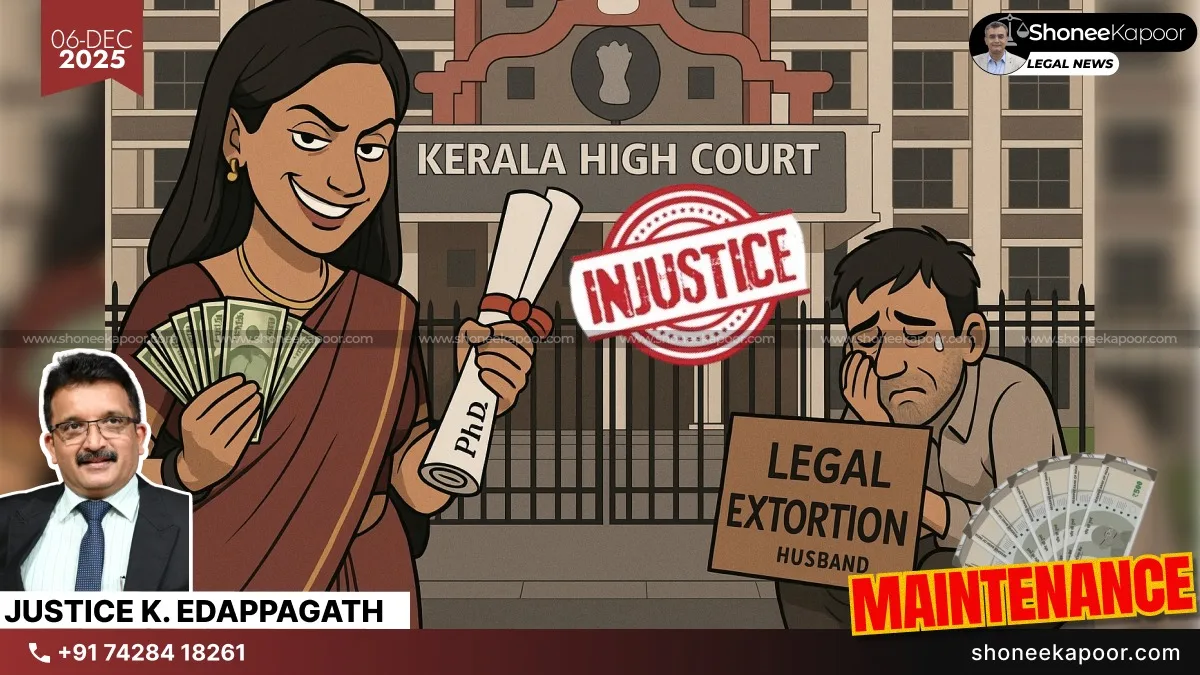
Kerala High Court: Even a Highly-Qualified Wife Can Claim Maintenance From Husband

Written and analysed by Vaibhav Ojha
Head Of Legal CommunicationsThe Kerala High Court has ruled that a Highly Qualified wife cannot be denied maintenance just because she could earn. Actual income and ability to maintain herself are what matter, not theoretical potential. The Court upheld maintenance for a wife and daughter after finding that the husband failed to prove she could support herself.
KOCHI: The Kerala High Court clarified that a wife who is highly educated but unemployed cannot be refused maintenance only because she has the capacity to work. The Court said that a woman must have actual income that allows her to live with dignity before maintenance can be denied.
This ruling came from Justice Kauser Edappagath while dismissing a husband’s revision petition challenging the order of the Family Court, Nedumangad.
The case began when the wife and her minor daughter filed a petition under Section 125 CrPC asking for monthly maintenance of ₹15,000 and ₹7,000. The husband argued that she was a B.Ed and M.A graduate, capable of earning her own income, and therefore not entitled to maintenance. He also alleged that she had left the matrimonial home without a valid reason.
However, the Family Court found no evidence to support his claims. It held that the husband’s siblings had moved into the home, creating tension, and that the wife’s decision to live separately was justified. It then ordered the husband to pay ₹6,000 per month to the wife and ₹4,500 to the daughter.
The husband challenged this order before the Kerala High Court. But the High Court agreed with the Family Court, noting that the law recognises a wife’s right to live separately for a valid cause and still seek maintenance.
The Court stated an important principle:
“A separated life of a wife for a valid cause is recognised by law, and that will not stand in the way of raising a claim for maintenance under Section 125 of Cr.P.C (Section 144 of BNSS).”
It further examined the meaning of “unable to maintain herself” under Section 125 CrPC, relying on several Supreme Court judgments. The Court emphasized that this term must be read in a humane and realistic way. It cannot be interpreted narrowly or harshly in a way that denies protection to those who genuinely need it.
The High Court made its central observation in a clear and powerful way:
“The expression ‘unable to maintain’ in Section 125 of Cr.P.C must be interpreted to mean the actual inability to sustain rather than mere potential earning capacity. The expression does not mean mere capacity or capability to earn. So much so, a highly qualified wife, if not working and earning, cannot be denied maintenance on the ground that she has the capacity to earn. In other words, a highly qualified jobless wife is entitled to maintenance until she secures sufficient means to support herself.”
Justice Edappagath said that Section 125 CrPC is a social justice provision meant to protect destitute wives, dependent children, and elderly parents. The purpose of this section is to ensure that those who cannot support themselves are not left without assistance.
The Court also refused to follow a recent Delhi High Court ruling in Megha Khetrapal v. Rajat Kapoor, which held that an educated wife who chooses not to work cannot claim maintenance. The Kerala High Court said that such an approach defeats the welfare nature of Section 125 CrPC.
The judge concluded that the husband had enough income to support his wife and daughter. He earned ₹66,900 per month and failed to show any valid ground to deny maintenance. Therefore, the Court upheld the Family Court order and dismissed the husband’s revision petition.

Explanatory Table Of All Laws & Sections Mentioned
| Law / Section | Full Name | What It Means (Simple Explanation) | How It Applies in This Case |
| Section 125 CrPC | Code of Criminal Procedure – Maintenance of Wife, Children & Parents | Provides quick maintenance to a wife, child, or parents who cannot maintain themselves. | Wife sought maintenance; HC interpreted “unable to maintain herself” broadly to protect jobless but qualified wives. |
| Section 144 BNSS | Bharatiya Nagarik Suraksha Sanhita (new code replacing CrPC) | Equivalent provision to Section 125 CrPC under new criminal law. | Court mentioned both as continuity; claim remains valid under BNSS too. |
| Article 15(3) Constitution of India | State can make special provisions for women & children | Supports welfare interpretation of maintenance laws. | Used to justify a liberal, welfare-based interpretation favouring wife & child. |
| Article 39 Constitution of India | Directive principles—State must ensure adequate means of livelihood & protect weaker sections | Strengthens the objective behind Section 125. | Court said maintenance is social justice aligned with these constitutional goals. |
| Rajnesh v. Neha (2021) 2 SCC 324 | Supreme Court ruling on maintenance guidelines | Even working wives may get maintenance if income insufficient. | HC used this to say earning alone doesn’t bar maintenance. |
| Shailja v. Khobbanna (2018) 12 SCC 199 | SC clarified difference between “capable of earning” and “actually earning” | Potential earning does not defeat a wife’s right to maintenance. | Directly supports HC view that qualifications alone are irrelevant. |
| Dr. Swapan Kumar Banerjee v. State of West Bengal (2020) 19 SCC 342 | SC ruling on assumption of income | Court cannot assume a woman is earning just because she is qualified. | HC used this to reject husband’s claim wife must be working. |
| Sunita Kachwaha v. Anil Kachwaha (2014) 16 SCC 715 | SC held earning some income is not enough to deny maintenance | Wife’s minor income does not disqualify claim. | Supports wife even if employed modestly. |
| Chaturbhuj v. Sita Bai (2008) 2 SCC 316 | Classic SC judgment on Section 125 | “Unable to maintain herself” does not mean she must be destitute. | Reinforces liberal, pro-maintenance approach. |
| Megha Khetrapal v. Rajat Kapoor (Delhi HC) | Delhi HC ruling against maintenance for unemployed educated wives | Said educated wives who choose not to work cannot claim maintenance. | Kerala HC rejected this view and refused to follow it. |
| Jayaprakash E.P v. Sheney P. (2025 (1) KLT 815) | Kerala HC ruling on wife’s temporary income | Temporary or small earnings do not bar maintenance. | HC used this to justify maintenance despite wife’s possible limited income. |
Case Summary
- Case Title: RPFC No. 310 of 2018 Husband vs. First Respondent (Wife) & Second Respondent (Minor Daughter)
- Court & Bench:
- High Court of Kerala, Ernakulam
- Hon’ble Dr. Justice Kauser Edappagath
- Order Date: 26 November 2025
- Type of Case: Revision Petition against order in M.C. No. 89/2017 from Family Court, Nedumangad
Counsels Appearing:
- For Husband (Revision Petitioner):
- Sri. Ajit G. Anjarlekar
- Sri. Govind Padmanaabhan
- Sri. G.P. Shinod
- For Wife & Daughter (Respondents):
- Sri. R.B. Rajesh
Key Takeaways
- Courts continue to treat “potential to earn” as irrelevant, placing the full financial burden on husbands even when wives are highly qualified.
- A wife can live separately, claim it is a “valid reason,” and still receive maintenance without proving real inability to maintain herself.
- The husband’s actual income is scrutinised closely, but the wife’s qualifications, skills, or ability to work are not given equal weight.
- Despite contrary precedents like the Delhi High Court ruling, the system still leans toward welfare for wives, not fairness for men.
- This judgment reinforces why men must keep fighting for balanced, gender-neutral maintenance laws that do not penalise them for simply being capable earners.
This Could Change Your Case-Get FREE Legal Advice-Click Here!
Disclaimer: The views and opinions expressed in this article are those of the Indian courts and do not necessarily reflect the official policy or position of “ShoneeKapoor.com” or its affiliates. This article is intended for informational and educational purposes only. The content provided is not legal advice, and viewers should not act upon this information without seeking professional counsel. Viewer discretion is advised.
Related Articles
Alimony vs Maintenance in India: The Real Legal Difference Every Man Must Know Before Divorce
Alimony and maintenance are not the same, but Indian courts often blur the line, creating lifelong financial pressure...
Legal Mistakes Men Make During Divorce: Costly Errors That Destroy Cases
Costly legal mistakes Indian men make during divorce, maintenance, custody, 498A/BNS cruelty cases and evidence colle...

Legal Risks Men Face In Modern Relationships In India: 498A, Maintenance, False Promise To Marry, Live-In Cases & DV Act
Modern relationships can expose Indian men to criminal cases, maintenance claims, DV Act proceedings, false promise t...
Relevant Judgements
Can an NRI Husband Be Forced to Pay Maintenance in India? Supreme Court Rules Explained for Overseas Indian Men
Living abroad does not automatically protect an NRI husband from maintenance claims in India.But can Indian courts pa...
Share Your Thoughts
Comments are moderated before publication.