
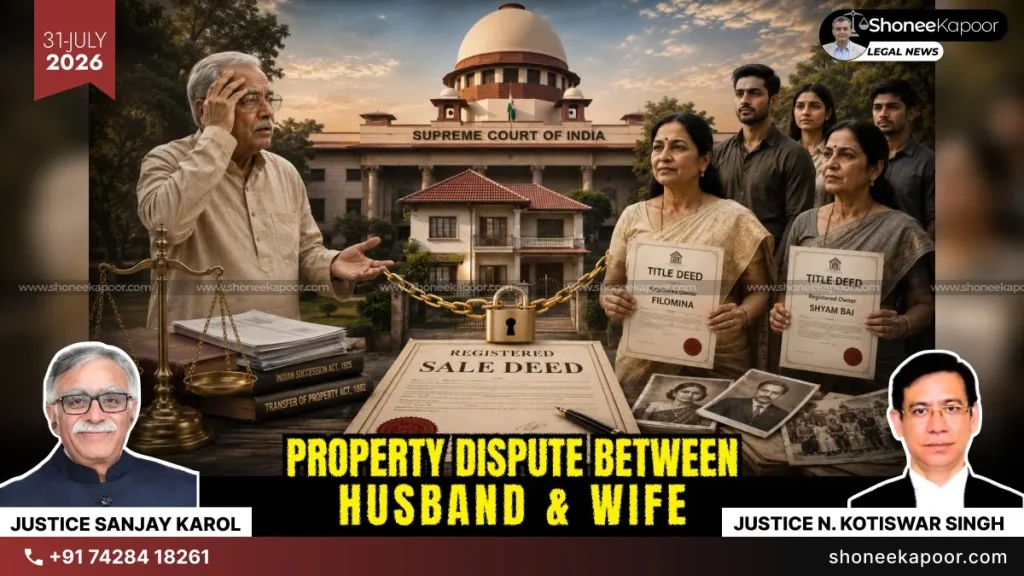
Can property purchased by a husband automatically become his estate merely because he paid for it?The Supreme Court has clarified that when property is legally purchased in the wife’s name, ownership and succession must follow her title—not assumptions about the husband’s money.
NEW DELHI: The Supreme Court has clarified thatproperty purchased by a husband in his wife’s name cannot automatically be treated as the husband’s property merely because he paid the purchase price.
A Bench of Justice Sanjay Karol and Justice Nongmeikapam Kotiswar Singh delivered the ruling. The appeal challenged a February 7, 2020 judgment of the Chhattisgarh High Court. The Supreme Court noted that the Trial Court, First Appellate Court and High Court had taken different views on the property dispute.
The dispute concerned land purchased in 1959 by Mattus Anthony for ₹300 in the names of his two wives, Filomina and Shyam Bai. Filomina had three children, while Shyam Bai had one son, John Anthony. All parties were Christians, and there was no dispute regarding the marriages or the children’s parentage.
Filomina died in 1985, Mattus Anthony died in 1991 and Shyam Bai died in 2000. John Anthony had predeceased his mother in 1985. In 2002, John Anthony’s legal heirs sold 888 square feet, claimed as half of the total property, to another purchaser. Filomina’s children then filed a civil suit challenging the sale.
The Trial Court declared the sale deed ineffective and granted shares to the plaintiffs. The First Appellate Court reversed that finding and held that the legal heirs of each wife were entitled to their respective mother’s half share. The High Court later treated both widows together as entitled to one-third of the property and Filomina’s children as entitled to the remaining two-thirds as lineal descendants.
The Supreme Court held that the High Court had wrongly applied Section 33 of the Indian Succession Act, 1925. Section 33 deals with succession where a male intestate dies leaving behind a widow and lineal descendants. It could not be applied to the entire property because the property never legally belonged to Mattus Anthony.
The Supreme Court explained that Section 33 applies only when the succession dispute concerns the estate of a deceased male. The documents clearly showed that Mattus Anthony had purchased the property directly in the names of his two wives.
The Court observed:
“…the application of Section 33 appears misplaced for the reason that, by its application, what the High Court implies is that the property that was legally bought in the name of the 2 wives of MA is, in fact, in the eyes of the law, his property, whereas that is not the case. Since the property is in the name of the 2 wives of MA, it is their property.”
The person who pays for a property and the person who legally owns it may not always be the same. Once the property was deliberately purchased in the wives’ names for their benefit, it could not later be converted into the husband’s estate merely to change the inheritance calculation.
Since Filomina died before her husband, the Court applied Section 35, which gives a surviving husband the same rights in his wife’s intestate property as a widow would have in her husband’s property.
The Court stated:
“…since Filomena predeceased MA, by virtue of the application of Section 35 of the ISA, MA would possess the same rights on Filomena’s property as she would have in the scenario that MA would have predeceased her.”
Therefore, from Filomina’s half share, one-third went to her husband, while the remaining two-thirds went to her children.
The Court further held:
“The effect thereof would be that with respect to the part of the property in the name of Filomena, one third would rest with MA and the remaining two thirds would go to her successors in interest, that is the Plaintiffs. There would be no application of Section 33 on the entirety of the property since never did the whole property rest in the name of MA.”
The Supreme Court emphasised that the property always remained owned by the two wives. Section 33, read through Section 35, could apply only to Filomina’s portion and not to the entire property.
After Mattus Anthony’s death, the share inherited by him from Filomina had to devolve upon his successors. The Court said:
“The one third of Filomena’s property received by MA upon her death, would then devolve upon the children of MA through Filomena and Shyam Bai i.e., the Plaintiffs and John Anthony. In other words, the one-third share would be divided amongst the four children of MA and Shyam Bai.”
Regarding Shyam Bai’s property, the Court held that the Hindu law concept of joint family property had no application. Christian heirs inherit as tenants-in-common. Since Shyam Bai died without making a Will and her only son had already died, Section 38 governed succession to her estate.
Accordingly, Shyam Bai’s property had to be divided equally among her surviving grandchildren.
The Court did not decide the questions concerning a benami transaction or the validity of the second marriage because neither issue was pressed by the parties.
However, while referring to the benami argument, it noted the legal principle:
‘intention of the parties is the essence of the benami transaction and the money must have been provided by the party invoking the doctrine of benami.’
The record showed that Mattus Anthony had purchased the property for his wives out of love and affection. The status of Shyam Bai as his wife and later widow was also not disputed.
The Supreme Court ultimately set aside the judgments of the courts below, allowed the appeal and directed that all legal consequences must follow. No costs were imposed.
EXPLANATORY TABLE OF NEWS AND SECTION
| Law and Provision | What It Means | Application in This Case |
| Section 25, Indian Succession Act, 1925 | Explains lineal relationship between ancestors and direct descendants. | The High Court relied on the concept of lineal descendants while calculating inheritance shares. |
| Section 33, Indian Succession Act, 1925 | When a Christian male dies intestate leaving a widow and children, one-third goes to the widow and two-thirds to lineal descendants. | The High Court wrongly applied it to the entire property even though the property stood in the wives’ names. |
| Section 33(a), Indian Succession Act, 1925 | Provides the one-third and two-thirds division where a male intestate leaves a widow and lineal descendants. | It became relevant indirectly through Section 35 while deciding the husband’s share in Filomina’s property. |
| Section 35, Indian Succession Act, 1925 | A widower has the same rights in his deceased wife’s intestate property as a widow has in her husband’s property. | Mattus Anthony inherited one-third of Filomina’s share, while her children inherited the remaining two-thirds. |
| Section 38, Indian Succession Act, 1925 | Where a person dies without a surviving child but leaves grandchildren, the property is divided equally among the grandchildren. | Shyam Bai’s son had predeceased her, so her property devolved upon her surviving grandchildren. |
| Benami transaction principle | The real intention behind the transaction and the source of funds are relevant in deciding whether the named owner is merely holding property for another person. | The benami issue was not pressed. The record indicated that the property was purchased for the wives out of love and affection. |
| Tenants-in-common principle | Each heir receives a separate, identifiable share rather than acquiring Hindu joint family property. | The Court held that the Hindu joint family concept did not apply to the Christian parties. |
CASE DETAILS
| Particular | Details |
| Case Title | Shakuntala & Others v. Robert Anthony & Others. |
| Court | Supreme Court of India |
| Jurisdiction | Civil Appellate Jurisdiction |
| Case Number | Civil Appeal arising out of SLP (C) No. 9449 of 2020 |
| Neutral Citation | 2026 INSC 765 |
| Judgment Date | July 30, 2026 |
| Bench | Justice Sanjay Karol and Justice Nongmeikapam Kotiswar Singh |
| Judgment Authored By | Justice Sanjay Karol |
COUNSELS APPEARED:
| Party | Counsel Details |
| For the Petitioners | Mr. Satish Pandey, AOR |
| For All Respondents | Mr. Gagan Gupta, Senior Advocate; Mr. Vikrant Singh Bais, AOR; Mr. Yogesh Tiwari, Advocate; Ms. Neema Singh, Advocate; Ms. Priya Hingorani, Senior Advocate; Mr. Nikhil Jain, AOR; Ms. Aditi Ladda, Advocate; Ms. Divya Jain, Advocate; Ms. Arveen Sekhon, Advocate; Ms. Ankita Sharma, AOR; Mr. Arjun D. Singh, Advocate; Ms. Ishika Neogi, Advocate; Mr. Divya Tripathi, Advocate; Mr. Gaurav Agrawal, Senior Advocate (Amicus Curiae); Ms. Akriti Chaubey, AOR; Ms. Shrija Rawat, Advocate; Mr. Darshan Sejwal, Advocate |
KEY TAKEAWAYS
- A husband may pay the full price, yet the wife remains the legal owner if the property is in her name.
- His payment alone may carry no ownership rights unless the title and intention support his claim.
- Section 33 cannot be used to treat the wife’s property as the husband’s estate.
- The husband gets only succession rights under Section 35, not automatic ownership.
- The warning for husbands is clear: paying for property is not enough; the title must protect your right
This Could Change Your Case-Get FREE Legal Advice-Click Here!
Disclaimer: The views and opinions expressed in this article are those of the Indian courts and do not necessarily reflect the official policy or position of “ShoneeKapoor.com” or its affiliates. This article is intended for informational and educational purposes only. The content provided is not legal advice, and viewers should not act upon this information without seeking professional counsel. Viewer discretion is advised.