
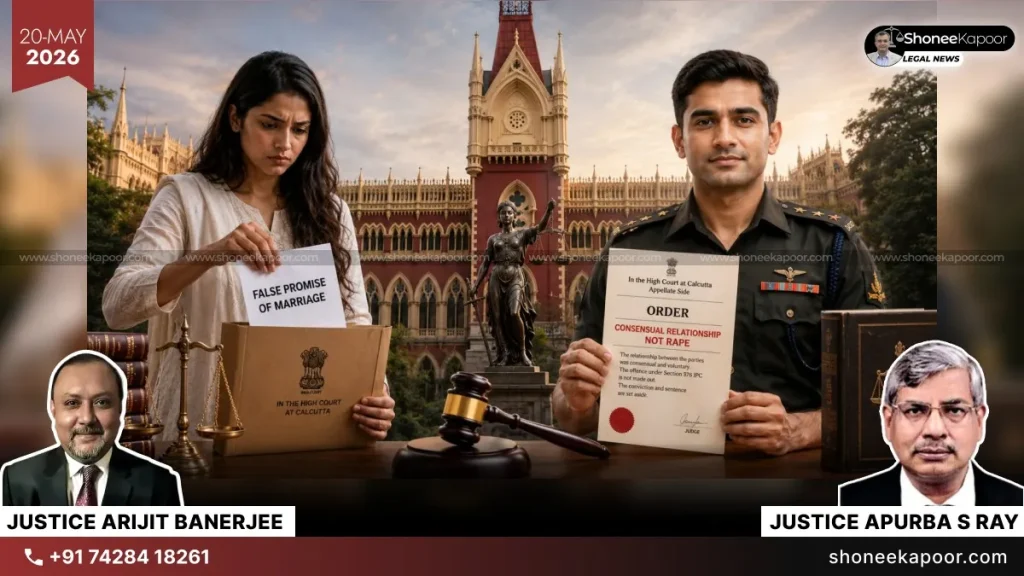
Can Mere Failure To Marry Make A Man Guilty Of Rape? The Calcutta High Court negated this view and held that every failed relationship or broken promise cannot later be converted into a rape prosecution.
KOLKATA: The Calcutta High Court, through Justice Arijit Banerjee and Justice Apurba Sinha Ray, set aside the rape conviction of a military officer accused of establishing physical relations on a false promise of marriage.
The Court held that the relationship between the parties was consensual and continued voluntarily for nearly three and a half years.
According to the case, the man and woman met through Tinder in 2018. The woman alleged that the man introduced himself as “single” and promised to marry her, after which she entered into a physical relationship with him. She later discovered that he was already married.
The woman further alleged that she became pregnant during the relationship and initially claimed in her complaint that the man forced her to undergo abortion. However, during her testimony before the Court, she stated that she suffered a miscarriage due to stress after learning about his marital status and refusal to marry her. The High Court later noted this contradiction while examining the reliability of the allegations.
However, during the trial, the woman admitted that even after learning about his marriage in September 2018, she voluntarily continued the relationship because he told her he was facing disputes with his wife and would marry her after divorce. Evidence also showed that both travelled together to several places across India, stayed together in Mumbai and Bangalore, and remained in a relationship even after the man obtained divorce in 2020.
The High Court observed that both parties were educated adults who fully understood the nature of their relationship. The judges noted that the woman herself admitted she was in love and continued the relationship for years without objection.
While discussing the law relating to “false promise to marry,” the Calcutta High Court referred to several Supreme Court judgments and reiterated that every failed relationship or broken promise cannot automatically become a rape case.
Relying upon the Supreme Court judgment in Pramod Suryabhan Pawar v. State of Maharashtra and Deepak Gulati v. State of Haryana, the Court highlighted the observation that:
“There is a distinction between the mere breach of a promise and not fulfilling a false promise.”
The High Court further observed:
“There is nothing on record to show that… from the very inception of his relationship… had no intention of marrying her.”
The Court also noted inconsistencies in the woman’s statements regarding pregnancy, miscarriage and abortion, along with the absence of medical documents supporting those allegations. It further observed that the FIR was filed after around three and a half years, only after the relationship had turned bitter.
Finally, the High Court held that the relationship was consensual and voluntary, and therefore the offence of rape under Section 376 IPC was not made out. The conviction was accordingly set aside.
Explanatory Table: Laws And Sections Involved
| Law / Section | Purpose | How It Was Used In This Case |
| Section 376(1) IPC | Punishment for rape | The trial court had convicted the accused under this section, but the High Court later set aside the conviction |
| Section 375 IPC | Defines what amounts to rape under Indian law | The High Court examined whether the physical relationship in this case legally amounted to rape |
| Section 90 IPC | Says consent obtained through fear or misconception of fact is not valid consent | The prosecution argued that the woman’s consent was obtained through a false promise of marriage |
| Section 417 IPC | Punishment for cheating | Charges were also framed under this section, but conviction was not sustained |
| Section 114A Evidence Act | Presumption regarding absence of consent in certain rape prosecutions | The High Court held that this provision was wrongly applied by the trial court |
| Section 313 Cr.P.C. | Allows the accused to personally explain circumstances appearing against him | The Court considered the accused’s explanation while appreciating the evidence |
| Section 164 Cr.P.C. | Recording of statement before a Magistrate | The woman’s statement was recorded under this provision during investigation |
| Section 482 Cr.P.C. | Gives inherent powers to the High Court | Mentioned while discussing Supreme Court precedents cited before the Court |
| Section 3 Evidence Act | Defines what legally amounts to “evidence” | Discussed while examining the evidentiary value of statements under Section 313 Cr.P.C. |
Case Details
- Case Title: Nikhil Kumar Chandrakala Vs The State of West Bengal & Anr.
- Court: High Court at Calcutta
- Case Number: C.R.A (DB) 67 of 2025
- Date of Order: 15 May 2026
- Bench: Hon’ble Justice Arijit Banerjee | Hon’ble Justice Apurba Sinha Ray
- Counsels:
- For Appellant: Ms. Monika Kalra, Mr. Shatadru Lahiri, Mr. Wasim Akram, Mr. Debarshi Das, Mr. Shantam Gulati, Ms. Prerna Vishwas, Mr. Saswata Tripathi
- For De Facto Complainant: Mr. Moyukh Mukherjee, Mr. Koustav Lal Mukherjee, Ms. Sagnika Banerjee, Ms. Sarmistha Basak, Mr. Koustav Bhattacharyya
- For State: Ms. Sreyashee Biswas and Ms. Rajnandini Das
Key Takeaways
- A failed relationship cannot automatically be converted into a rape allegation after years of consensual intimacy.
- Adult women making conscious relationship choices cannot later erase consent simply because the relationship ended badly.
- Long-term consensual relationships, travelling together, cohabitation, and continued intimacy weaken allegations of “false promise to marry.”
- Delay in filing FIRs, contradictions in statements, and lack of medical evidence seriously affect the credibility of allegations.
- Men cannot be presumed guilty merely because a relationship breaks down emotionally or marriage ultimately does not happen.
This Could Change Your Case-Get FREE Legal Advice-Click Here!
Disclaimer: The views and opinions expressed in this article are those of the Indian courts and do not necessarily reflect the official policy or position of “ShoneeKapoor.com” or its affiliates. This article is intended for informational and educational purposes only. The content provided is not legal advice, and viewers should not act upon this information without seeking professional counsel. Viewer discretion is advised.