
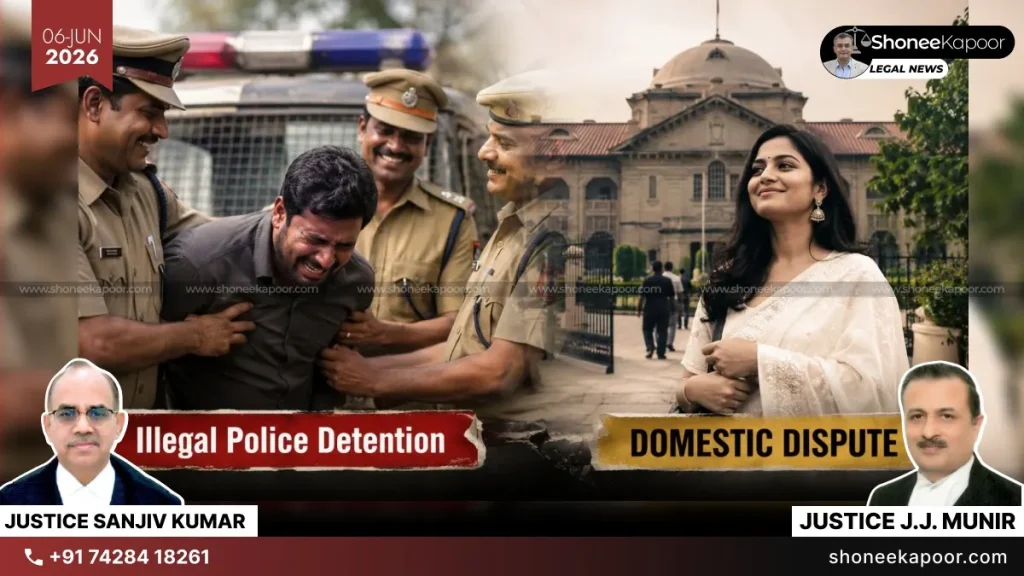
A man was taken from his home and kept in a police lockup for 24 hours—but was any crime even registered? The Allahabad High Court found serious violations of personal liberty and ordered compensation. What exactly happened?
PRAYAGRAJ: In a judgment delivered by Justice J.J. Munir and Justice Sanjiv Kumar, the Allahabad High Court held that police cannot detain a person merely because of a family or domestic dispute. The Court ruled that illegal detention directly violates the fundamental right to life and personal liberty guaranteed under Article 21 of the Constitution and awarded compensation to the victim for being unlawfully kept in police custody for nearly 24 hours.
The case involved Matambar Mishra, a resident of Varanasi, who had gone to his native village in Prayagraj district to look after his agricultural land. According to the petition, on November 26, 2022, Surya Prakash Dubey, then In-charge of Baraut Police Outpost, entered Mishra’s house, dragged him out while he was wearing only a lungi and kurta, and took him first to the police outpost and later to the lockup at Handia Police Station.
Mishra alleged that he remained confined in the lockup from November 26 to November 27, 2022. He further claimed that a demand of Rs. 20,000 was made for his release. Despite efforts by his younger brother and advocate Rahul Mishra to secure his freedom, he was allegedly released only after payment of the demanded amount.
Following the incident, Mishra’s son, an advocate practicing in Delhi, submitted complaints to senior authorities including the Chief Minister of Uttar Pradesh, the Director General of Police, and the Commissioner of Police, Prayagraj. An inquiry was ordered, but the petitioner argued that it was conducted unfairly because statements of important witnesses, including the petitioner himself, were never recorded.
Two days after Mishra’s release, proceedings under Sections 107 and 116 CrPC were initiated against him. Mishra argued that these proceedings were started only to justify and cover up the earlier illegal detention.
The petitioner submitted that his detention was a clear violation of his constitutional rights. He also argued that proceedings under Sections 107 and 116 CrPC are meant to prevent threats to public peace and cannot be used in a private family dispute involving his brother’s daughter-in-law, Ritika.
The State admitted that the notice under Section 111 CrPC had been issued solely on the basis of a police report. The Additional District Magistrate informed the Court that the domestic nature of the dispute had been overlooked due to an “inadvertent omission” and offered an unconditional apology. The State also stated that the notices were never served upon the petitioner and eventually lapsed.
In his affidavit, police officer Surya Prakash Dubey did not specifically deny allegations that Mishra had been dragged from his home and confined in the lockup. Instead, he claimed that both sides had voluntarily come to the police outpost and agreed to a compromise relating to a domestic violence complaint filed by Ritika.
While examining the case, the High Court observed:
“This is a writ petition, which discloses a very substantial cause of action, but seeks a non-substantial relief.”
The Court decided to exercise its power to grant complete justice and examined the legality of the police action.
While discussing the misuse of security proceedings in private disputes, the Court relied upon earlier judicial precedents and observed:
“Those proceedings are essentially designed to preserve peace and public tranquility. Such proceedings are about public peace and tranquility and not domestic peace or tranquility.“
The Court rejected the police officer’s claim that the petitioner had voluntarily come to the police station. Referring to the authority and influence exercised by police officials, the Court remarked:
“He is a police officer, who is feared because he possesses the coercive authority of the State.“
The Court further observed:
“It is impossible that the petitioner would have walked in to the police outpost or the station to compromise.“
The Court noted that if Ritika had any grievance relating to domestic violence, the law already provided a proper remedy before the Magistrate under the Protection of Women from Domestic Violence Act, 2005. The police could not assume powers that the law had not granted to them.
After examining the record, the Court concluded that the proceedings under Sections 107 and 116 CrPC were initiated later only to justify an action that was otherwise unauthorized.
On the violation of the petitioner’s fundamental rights, the Court made strong observations:
“We are convinced that Dubey has recklessly violated the most fundamental essence of this most valuable fundamental right by dragging the petitioner out of his home on the basis of a complaint, he was not authorized to act upon, and, then, carrying the petitioner away in custody, first to the police outpost, Baraut and then confining him in the police lockup at Police Station Handia from 26.11-2022 to 27.11.2022 without the authority of law..“
The Court referred to several important decisions of the Supreme Court and High Courts which recognize that constitutional courts can award monetary compensation when a citizen’s fundamental rights are violated by the State.
The Court also relied on the Uttar Pradesh Government policy dated March 23, 2021, which provides compensation of Rs. 25,000 to victims of illegal detention and permits recovery of the amount from the responsible officer.
Allowing the writ petition, the High Court awarded Rs. 25,000 as ad hoc compensation and Rs. 10,000 as litigation costs to Matambar Mishra. The Court directed the State of Uttar Pradesh to make the payment within thirty days.
Importantly, the Court granted liberty to the State to recover the entire amount from the salary of the concerned police officer, Surya Prakash Dubey. The Court also clarified that Mishra remains free to file a separate civil suit for damages, and any future compensation awarded would take into account the amount already granted through this writ petition.
EXPLANATORY TABLE OF LAWS, SECTIONS & PRECEDENTS
| LAW / SECTION | PURPOSE | HOW APPLIED IN THIS CASE |
| Article 21, Constitution of India | Protects life and personal liberty | Court held illegal detention violated the petitioner’s fundamental rights. |
| Section 107 CrPC | Security proceedings to prevent breach of public peace | Court held it cannot be invoked for a private domestic dispute. |
| Section 116 CrPC | Procedure relating to security proceedings under Section 107 | Court found proceedings were wrongly initiated after detention. |
| Section 111 CrPC | Notice to show cause in security proceedings | ADM admitted notice was issued based solely on police report and domestic nature was overlooked. |
| Chapter VIII CrPC | Security for keeping peace and good behaviour | Court held Chapter VIII applies to public tranquility, not domestic quarrels. |
| Protection of Women from Domestic Violence Act, 2005 | Civil remedies for domestic violence complaints | Court observed complainant’s remedy lay before the Magistrate under this Act, not through illegal police intervention. |
| Article 226 Constitution | High Court writ jurisdiction | Used to grant compensation and mould relief despite no specific prayer. |
IMPORTANT CASES RELIED UPON
| CASE | PRINCIPLE |
| Fayyaz Shamshoddin Attar v. State of Maharashtra | Section 107 CrPC cannot be used in purely matrimonial disputes. |
| Pankaj Kumar Sharma v. Govt. of NCT of Delhi | Compensation can be awarded for illegal police detention. |
| D.K. Basu v. State of West Bengal | Compensation available for unlawful deprivation of liberty. |
| Nilabati Behera v. State of Orissa | Constitutional courts can award compensation for Article 21 violations. |
| M. Sudakar v. V. Manoharan | Courts can mould relief to do complete justice. |
| Berhampur University v. Ganesh Chandra Behera | Relief can be granted even if not specifically prayed for. |
| Shiv Kumar Verma v. State of U.P. | Recognized U.P. policy granting ₹25,000 compensation for illegal detention. |
CASE DETAILS
- Case Title: Matambar Mishra v. State of U.P. and 3 Others
- Case Number: Criminal Misc. Writ Petition No. 3807 of 2023
- Court: High Court of Judicature at Allahabad
- Court No.: 47
- Bench: Justice J.J. Munir & Justice Sanjiv Kumar
- Judgment Date: 29 May 2026
- Counsel for Petitioner: Mata Achal Mishra & Vinay Mishra
- Counsel for Respondents: G.A. (Government Advocate)
KEY TAKEAWAYS
- A family dispute is not a crime, and police cannot pick up a man simply because an allegation is made against him.
- Men do not lose their constitutional rights the moment a domestic complaint is filed.
- The Court recognized that police powers cannot be misused to pressure, humiliate, or illegally detain a man in a private family dispute.
- Section 107/116 CrPC cannot be used as an afterthought to justify wrongful action against a citizen.
- Accountability matters—when liberty is violated, compensation should come from the pocket of the officer responsible, not the taxpayer alone.
This Could Change Your Case-Get FREE Legal Advice-Click Here!
Disclaimer: The views and opinions expressed in this article are those of the Indian courts and do not necessarily reflect the official policy or position of “ShoneeKapoor.com” or its affiliates. This article is intended for informational and educational purposes only. The content provided is not legal advice, and viewers should not act upon this information without seeking professional counsel. Viewer discretion is advised.