
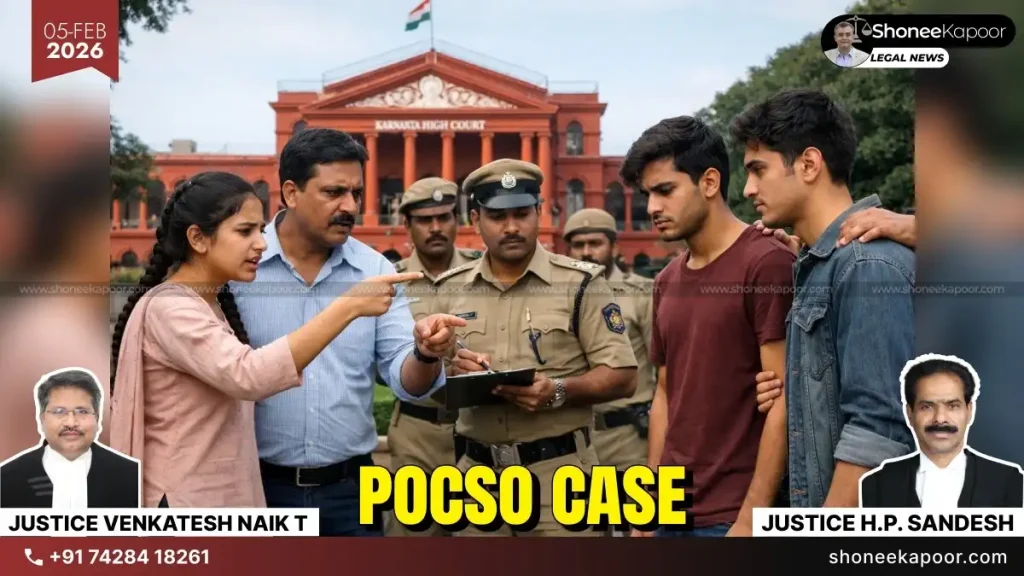
The Karnataka High Court dismissed the State’s appeal in a POCSO case, holding that the victim’s statements were inconsistent and unsupported by medical or age-proof evidence. The Court reaffirmed that serious criminal charges cannot survive without clear, reliable, and corroborated testimony.
BENGALURU: The Karnataka High Court at Bengaluru, in a Division Bench comprising Justice H.P. Sandesh and Justice Venkatesh Naik T, dismissed the State government’s appeal and upheld the acquittal of the accused in a serious case involving allegations under the POCSO Act, rape, and sexual assault provisions of the IPC.
The case arose from an incident alleged to have taken place on 25 April 2022, where the prosecution claimed that the victim girl, said to be a minor, was subjected to sexual assault by two accused persons at different places on the same day.
After a full trial, the Sessions Court had acquitted the accused, mainly due to lack of reliable evidence. The State challenged this acquittal before the High Court, arguing that the Trial Court had wrongly appreciated the evidence.
The High Court closely examined the entire record, including witness testimonies, medical reports, and the statement of the victim recorded under Section 164 of the CrPC.
A key issue before the Court was the age of the girl. The judges noted that the prosecution failed to conclusively prove that the girl was a minor on the date of the alleged incident. The Court observed that except for a medical opinion mentioning her age as 17 years and 6 months, no legally reliable proof was produced.
The Court specifically noted that no ossification test was conducted, which is necessary when age is disputed. It also recorded that the victim herself admitted during evidence that she was around 18 years at the relevant time, while her father stated she was 17, showing clear inconsistency.
Due to these contradictions, the Court agreed with the Trial Court that the prosecution failed to prove the age of the girl beyond doubt.
On the allegation of sexual assault, the Court found serious gaps in the prosecution case. The judges noted that in her testimony and in her statement before the Magistrate, the victim did not clearly allege forcible sexual intercourse.
The Court relied on the victim’s own words where she stated that
“Except touching her hand and leg, not made anything”.
The Bench further observed that even in the statement recorded under Section 164 CrPC, the victim did not allege that she was subjected to forcible sexual act. The medical evidence also did not support the prosecution’s version.
The Court held that the father’s evidence was purely hearsay and could not strengthen the case when the victim herself did not support the allegations.
The judges clearly noted that:
“When P.W.1 herself has not stated anything about subjecting her for forcible sexual act, the evidence of P.W.2 will not come to the aid of the prosecution”.
Taking an overall view of the evidence, the High Court held that the victim’s testimony was inconsistent and unreliable, and that there was no cogent or corroborative material on record.
The Bench concluded that:
“Question of invoking the offence under Sections 366(A), 376(1) and 354(A)(1)(i)(2) and (D) of IPC and Section 3 read with Sections 4, 7 read with Section 8, 11(iii) read with Section 12 of the POCSO Act, 2012 does not arise in the absence of cogent evidence before the Court”.
Explaining why the acquittal could not be interfered with, the Court held that the Trial Court had properly appreciated the evidence and that no legal error or perversity was shown by the State to justify reopening the case.
Accordingly, the criminal appeal filed by the State was dismissed, and the acquittal of the accused was confirmed, reinforcing the principle that serious criminal charges must be supported by clear, consistent, and legally reliable evidence.
Explanatory Table: Laws And Sections Involved
| Law & Section | Purpose | How Applied in This Case |
| IPC Section 366A | Prevents inducement of minor girl for sexual purpose | Charge failed due to lack of proof of inducement and age |
| IPC Section 376(1) | Punishes rape | No allegation or evidence of forcible intercourse |
| IPC Section 354A | Addresses sexual harassment | Victim denied acts beyond touching |
| IPC Section 363 | Punishes kidnapping | No proof of force or unlawful taking |
| POCSO Section 3 | Defines penetrative sexual assault | Not proved by evidence or testimony |
| POCSO Section 4 | Punishment for Section 3 | Not applicable as offence not proved |
| POCSO Section 7 | Defines sexual assault by touching | Weak case due to victim’s own statement |
| POCSO Section 8 | Punishment for Section 7 | Charge failed with Section 7 |
| POCSO Section 11(iii) | Defines sexual harassment of child | No consistent evidence |
| POCSO Section 12 | Punishment for harassment | Not sustained |
| Section 164 CrPC | Records victim’s statement before Magistrate | No rape allegation made |
| Section 94 JJ Act | Procedure to determine age | Age not conclusively proved |
| Rule 12(3) JJ Rules | Sets priority for age proof | Prosecution failed to follow |
Case Details
- Case Title: State of Karnataka vs Manikanta @ Manu & Others
- Court: High Court of Karnataka at Bengaluru
- Case Number: Criminal Appeal No. 800 of 2025
- Neutral Citation: 2026:KHC:4824-DB
- Date of Judgment: 29 January 2026
- Bench:Hon’ble Mr. Justice H.P. Sandesh & Hon’ble Mr. Justice Venkatesh Naik T
- Counsels:
- For Appellant (State of Karnataka): Smt. Rashmi Patel, High Court Government Pleader
- For Respondent No. 1: Sri K. Prasanna Shetty, Advocate
- For Respondent No. 2: Sri Tejas N., Advocate, and Sri Sachin G., Advocate
- For Respondent No. 3: Smt. Renuka Devi, Advocate (Absent)
Key Takeaways
- Serious criminal charges cannot survive on assumptions; proof of age and offence must be clear, consistent, and legally reliable.
- When the complainant’s own statements are contradictory or diluted, criminal law cannot be stretched to secure convictions.
- Age determination is not a formality; failure to conduct proper medical or documentary verification weakens the entire case.
- Hearsay statements by relatives cannot replace direct, credible testimony of the alleged victim.
- Misuse or overextension of stringent gender-specific laws ultimately damages genuine cases and destroys innocent men’s lives before guilt is proven.
This Could Change Your Case-Get FREE Legal Advice-Click Here!
Disclaimer: The views and opinions expressed in this article are those of the Indian courts and do not necessarily reflect the official policy or position of “ShoneeKapoor.com” or its affiliates. This article is intended for informational and educational purposes only. The content provided is not legal advice, and viewers should not act upon this information without seeking professional counsel. Viewer discretion is advised.