

A Bengaluru court granted an urgent injunction restraining a daughter-in-law from entering the disputed property. The father-in-law secured relief through Tripaksha Litigation Partners, after being counselled and guided by Men’s Rights Activist Shonee Kapoor.
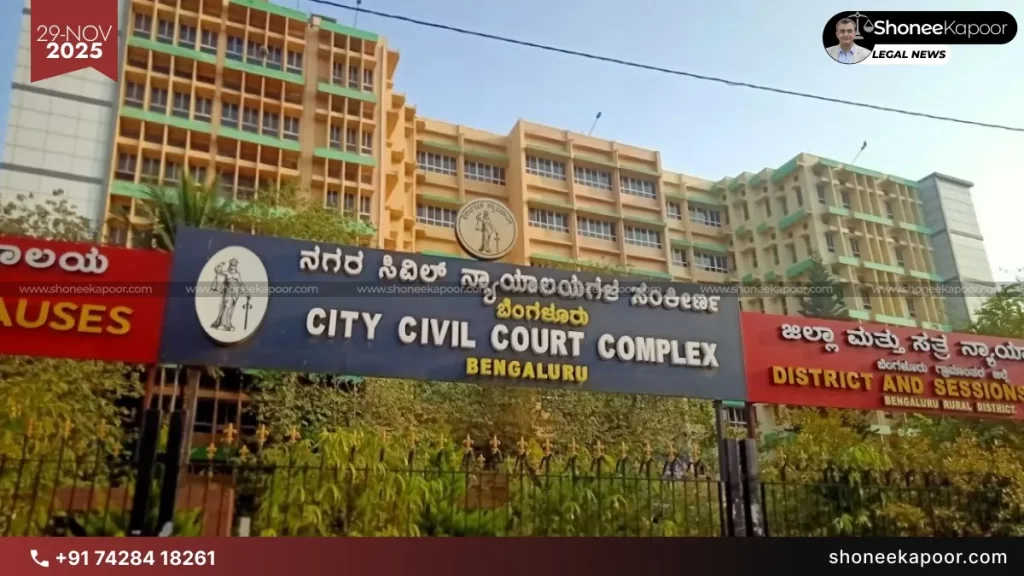
KARNATAKA: A property dispute within a family reached the Bengaluru City Civil Court, where a father-in-law sought urgent protection over his gifted property.
The case was handled by Advocate M. Vinod Kumar (Tripaksha Litigation Partner), and the father-in-law was guided and counselled by Men’s Rights Activist Shonee Kapoor, who supported him throughout the case and helped him understand his rights.
The Order Sheet dated 21.11.2025 shows that the plaintiff argued he is the absolute owner of the house.
As recorded by the court:
“The plaintiff counsel submitted that, he is the absolute owner of the plaint schedule property by virtue of gift deed dated 30.01.200213 executed by his brother Sonal Deoraj.”
The plaintiff stated that the defendant is his daughter-in-law, and she was not cordial with him or his son.
The order states:
“The Plaintiff counsel further submitted that, the daughter in law of the plaintiff is the defendant who is not cordial with plaintiff and his son and she deserted her husband i.e., son of plaintiff on 23.04.2025 and finally divorce petition filed.”
He explained to the court that even after a mediation attempt where the couple lived separately, the daughter-in-law again left the son.
The order notes:
“The plaintiff filed O.S.No.4863/2025 and then both son and defendant started to live together in Separate house as per the mediation so the plaintiff withdraw that suit but from there also the defendant left her husband i.e., son of plaintiff.”
The plaintiff also feared that the daughter-in-law and her relatives might trespass or create disturbance inside the house.
The court recorded:
“The plaintiff counsel further submitted that, the plaintiff apprehended that defendant along with her relatives and associates trespassing and creating nuisance in the plaint schedule property.”
To prove ownership and urgency, the plaintiff submitted Aadhar card, the gift deed, call records, psychological reports, and other documents.
This appears in the order:
“The plaintiff has produced Aadhar card, Gift deed dated 30.01.2013, EC, Uttara Patra, property tax receipt, electrical bill, photographs, out patient receipt from the hospital, call records which pertains to the last seven months, psychological assessment report and counseling report.”
He also submitted Encumbrance Certificates from 01.04.2004 to 14.11.2025, showing the property is in his name:
“per EC produced pertaining from 01.04.2004 to 14.11.2025.”
The plaintiff argued that without an immediate injunction, many legal complications would arise and the harm would be permanent.
The court summarised this as:
“Thus, the Plaintiff has proved prima faciely that she is having the right and if the temporary injunction is not granted in favour of him multiplicity of proceedings will be occurred and so many litigants will appeared and this case will not come to an end and will create irreparable loss.”
After reviewing all documents, the Judge agreed that the plaintiff showed a strong prima facie case, and delaying the order would cause serious hardship.
The order adds:
“Thus at this stage Plaintiff proved prima facie case and balance of convenience in his favour to allow the ad-interim ex-parte injunction as against Defendants.”
“If appropriate order is not passed before issuing notice on I.A.No.I then the rights of the plaintiff will be affected by causing the delay in service of notice.”
“In such circumstances, the plaintiff will put to great hardship and injustice will be caused to the plaintiff.”
Finally, the court granted an urgent ad-interim ex-parte injunction, completely restraining the daughter-in-law from entering or disturbing the property. The operative part of the order states:
“The plaintiff is directed to comply the mandatory provisions of Order 39 Rule 3 of C.P.C on I.A.No.I. Returnable by: 17-12-2024.”
With the coordinated efforts of Tripaksha Litigation Partners and the guidance of Men’s Rights Activist Shonee Kapoor, the father-in-law successfully secured legal protection and prevented further disturbance on his property.
Explanatory Table Of All Laws & Sections Mentioned
| Law / Provision | Full Name | Simple Meaning (Easy Indian English) | Why It Was Used in This Case |
| Order VII Rule 1 CPC | Civil Procedure Code | Lists what must be included in a civil plaint (name, facts, relief, valuation). | Plaintiff filed injunction suit under this rule. |
| Order VII Rule 2 CPC | Civil Procedure Code | Requires the plaintiff to clearly state the exact amount or nature of relief claimed. | Used for presenting a clear claim regarding injunction. |
| Order VI Rule 14A CPC | Civil Procedure Code | Requires parties to give their complete address for service of summons. | Plaintiff filed memo under this rule to cure office objections. |
| Order XXXIX Rule 1 CPC | Civil Procedure Code | Allows the court to give temporary injunction to stop harm or prevent injustice. | Plaintiff asked for temporary stay to stop defendant from entering property. |
| Order XXXIX Rule 2 CPC | Civil Procedure Code | Allows injunction to restrain someone from committing any act that causes injury. | Used to restrain alleged trespass/nuisance by daughter-in-law. |
| Order XXXIX Rule 3 CPC | Civil Procedure Code | After granting injunction, plaintiff must serve documents and comply with procedural steps. | Court directed plaintiff to follow this rule before next date. |
| Ad-interim Ex-parte Injunction | Temporary relief granted without hearing the other side | Emergency order to prevent immediate harm. | Court blocked daughter-in-law from entering property until next hearing. |
Case Summary
Case Title: Umesh Deoraj vs. Monika Deoraj
Registration & Filing Details
- Case Type: Injunction Suit (U/o VII Rule 1 and 2 of CPC)
- Filing Date: 21-11-2025
- I.A. No.: I.A. No. 1 (Temporary Injunction)
- Next Date / Returnable: 17-12-2024
Court & Bench
- Court: XxxXIX Additional City Civil & Sessions Judge, Bengaluru City
- Bench: Presiding Judge (Signature visible but name not clearly typed in PDF) — Judge of the XXXIX Addl. City Civil & Sessions Court, Bengaluru
Counsel for Plaintiff
M. Vinod Kumar, Advocate
- Plaintiff was advised, guided and counselled by:
Shonee Kapoor (Men’s Rights Activist)
Legal Representation Team
- Tripaksha Litigation Partners represented the father-in-law (plaintiff).
- Defendant
- Monika Deoraj (Daughter-in-law)
Key Facts
- Plaintiff is absolute owner of property through gift deed dated 30.01.200213.
- Defendant (daughter-in-law) deserted plaintiff’s son on 23.04.2025 and a divorce case was filed.
- Plaintiff earlier filed O.S. No. 4863/2025, withdrew after mediation, but defendant again left husband.
- Plaintiff alleged trespass and nuisance by defendant and her relatives.
- Plaintiff submitted documents:
- Aadhaar
- Gift deed
- Electrical bill
- EC (01.04.2004 to 14.11.2025)
- Photographs
- Call records
- Hospital/outpatient documents
- Psychological report
- Counseling report
- Court found:
- Prima facie case
- Balance of convenience in plaintiff’s favour
- Risk of irreparable loss
- Court passed ad-interim ex-parte temporary injunction restraining defendant from entering the property.
Key Takeaways
- A father-in-law had to go to court simply to protect his own gifted property from interference by his daughter-in-law.
- The court found a clear prima facie case and stopped the daughter-in-law from entering or disturbing the house.
- Documents, evidence and the plaintiff’s consistency mattered more than emotional allegations from the other side.
- The case shows how easily men and their families face harassment through domestic disputes, trespass, and misuse of relationships.
- With proper legal guidance and timely action, even ordinary men can secure protection and prevent misuse of the system.
This Could Change Your Case-Get FREE Legal Advice-Click Here!
Disclaimer: The views and opinions expressed in this article are those of the Indian courts and do not necessarily reflect the official policy or position of “ShoneeKapoor.com” or its affiliates. This article is intended for informational and educational purposes only. The content provided is not legal advice, and viewers should not act upon this information without seeking professional counsel. Viewer discretion is advised.