
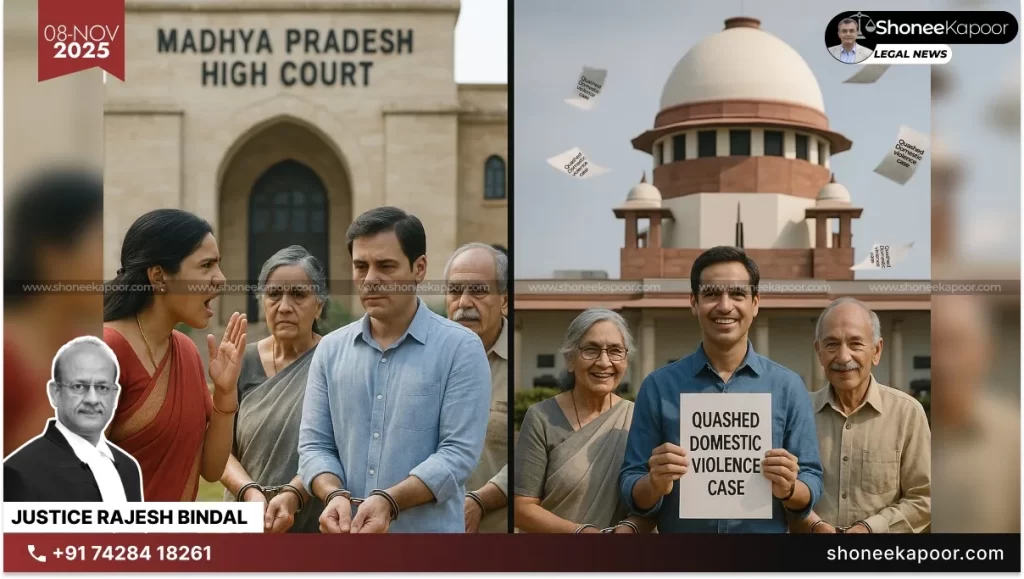
The Court clarifies that petitions under Section 528 BNSS (formerly Section 482 CrPC) to quash DV Act cases need not wait for a final order from the Magistrate.
NEW DELHI: The Supreme Court has held that petitions seeking to quash proceedings under the Protection of Women from Domestic Violence Act, 2005 (DV Act) are maintainable at any stage, including before any final or interim order is passed by the Magistrate. These ruling overturns a previous view of the Madhya Pradesh High Court, which had held that such quashing petitions were premature unless an order had already been issued under the DV Act.
A Bench of Justice Rajesh Bindal and Justice Manmohan, while deciding an appeal filed by V. Krishnamma & Others, clarified that the inherent powers of the High Court under Section 528 of the Bharatiya Nagarik Suraksha Sanhita (BNSS), 2023 corresponding to Section 482 CrPC cannot be restricted merely because the DV proceedings are still pending at the Magistrate stage.
Facts of the Case
The matter arises out of proceedings initiated under Section 12(1) of the Protection of Women from Domestic Violence Act, 2005 before a Magistrate in Madhya Pradesh. The respondent-wife had filed a complaint alleging acts of domestic violence not only against her husband but also against her in-laws, including her husband’s parents and other relatives — who later became the appellants before the Supreme Court.
Marriage & Living Arrangement:
After her marriage, the complainant-wife and her husband began living in a separate rented accommodation in Bengaluru, which was under the wife’s name. During this period, the wife was engaged in independent professional and business activity.
Allegations Raised by Wife:
Despite living separately from the in-laws, the wife filed a Domestic Violence Complaint against all of them, alleging: Cruelty, Harassment, Mental abuse, and interference in her marriage.
The allegations included claims that decisions about her personal life, finances, and marriage were being controlled by her husband’s family members. However, no specific incidents, dates, or evidence were provided in the DV application to indicate direct involvement of the in-laws or their presence in the alleged shared household.
Proceedings Before the Magistrate:
The Magistrate took cognizance of the DV complaint under Section 12(1) of the DV Act and issued notices to all respondents, including the in-laws.At this stage no final or interim order had been passed the case was still at the “preliminary stage”.
Petition Before the High Court:
The in-laws filed a petition before the Madhya Pradesh High Court under: Section 528 BNSS, 2023 (Earlier Section 482 CrPC) seeking:
Quashing of the entire DV proceedings, primarily on the grounds that:
- They never lived in the shared household with the wife (thus, “no domestic relationship” under Section 2(f) DV Act).
- No specific allegations were made against them.
- The proceedings were an abuse of process intended to pressurize the family during marital discord.
High Court’s View (Later Overturned)
The High Court dismissed the quash petition, reasoning that:
- Since no final order had yet been passed by the Magistrate,
- The petition to quash the DV complaint was “premature”.
The High Court held that quashing under Section 528 BNSS / 482 CrPC was available only after some adjudication or order existed under the DV Act. This is the view the Supreme Court was asked to examine.
What Came Before the Supreme Court?
The appellants argued that: The Domestic Violence Act is procedurally governed by CrPC/BNSS,
Therefore, the High Court’s inherent powers to prevent abuse of process cannot depend on whether a Magistrate has passed an order or not and forcing them to wait for years while the DV case proceeds would itself amount to miscarriage of justice.
The respondent-wife argued that: DV Act proceedings are civil in nature initially, they become criminal only upon violation of orders, so quashing at the start is not maintainable. The Supreme Court addressed this legal conflict.
Conclusion from Facts:
The core factual issue was:
- Whether relatives who never lived with the complainant and were accused only in broad, generalized terms must undergo the entire DV trial,
Or
- Whether they could approach the High Court immediately to seek quashing.
The Supreme Court answered:
- Yes, they can challenge it immediately.
- They do not need to wait for any order from the Magistrate.
Court’s Findings
A Bench of Justice Rajesh Bindal and Justice Manmohan held that the inherent jurisdiction of the High Court cannot be restricted merely because proceedings under the Domestic Violence Act are “at an early stage” or because no interim/final order has yet been passed by the Magistrate.
The Court observed:
“The power under Section 528 of the BNSS (earlier Section 482 CrPC) is not dependent upon the passing of any order in the proceedings under the Domestic Violence Act. The High Court may exercise its inherent jurisdiction at any stage to prevent abuse of process of law.”
The Bench clarified that the High Court’s power is independent and constitutional in nature, and therefore:
“It is not necessary for the accused to wait for the proceedings to culminate in an order before invoking the inherent jurisdiction of the High Court.”
Referring to its earlier ruling in Shaurabh Kumar Tripathi vs. Vidhi Rawal (2025), the Court stated:
“This Court has already held that a petition to quash proceedings under Section 12(1) of the Domestic Violence Act is maintainable. The contrary view of the High Court cannot be sustained.”
On the High Court’s reasoning that DV proceedings are civil at first and criminal only after violation, the Court remarked:
“The nature of the proceedings under the Domestic Violence Act does not dilute the applicability of inherent powers. The High Court is empowered to quash proceedings where continuation itself amounts to injustice.”
Finally, the Supreme Court set aside the Madhya Pradesh High Court’s decision and directed reconsideration:
“The impugned order is unsustainable in law and is accordingly set aside. The matter is remitted to the High Court for fresh adjudication on merits.”

Explanatory Table: Sections & Case Laws Applied
| Law / Case | Legal Principle | What the Law Requires / Establishes | How The Supreme Court Applied It |
| Section 528 BNSS, 2023 (corresponding to Section 482 CrPC) | High Courts have inherent power to prevent abuse of process and secure justice. | The High Court may quash criminal proceedings at any stage, even before final orders. | SC held that petitions to quash DV Act proceedings are maintainable even before Magistrate passes an order. |
| Section 12(1), Domestic Violence Act, 2005 | Enables an aggrieved woman to seek relief before a Magistrate. | DV proceedings begin once an application is filed; orders may follow later. | SC held that pendency of proceedings does not bar quashing under Section 528 BNSS / 482 CrPC. |
| Section 32, DV Act + Rule 15 | Proceedings under DV Act are governed by CrPC unless stated otherwise. | DV Act proceedings are not isolated; CrPC applies to procedure and challenges. | SC stated that since CrPC applies, the inherent powers under 528 BNSS/482 CrPC also apply. |
| Shaurabh Kumar Tripathi v. Vidhi Rawal (2025) (Supreme Court) | DV Act proceedings can be challenged at any stage. | The stage of DV case does not prevent quashing. | SC relied on this precedent and said MP High Court’s contrary interpretation was legally unsustainable. |
| State of Haryana v. Bhajan Lal (1992) (Seven-Category Test for Quashing) | Quashing is justified where allegations are absurd, mala fide, or abuse of process. | Courts must prevent misuse of criminal law. | SC stated High Courts must consider whether complaint discloses offence, not blindly allow proceedings. |
| Inder Mohan Goswami v. State of Uttaranchal (2007) (SC) | Criminal law must not be used for vengeance or harassment. | Courts must protect individuals from misuse of legal process. | SC noted that in-laws living separately cannot be dragged into DV cases without evidence. |
Case Details
| Particular | Details |
| Case Title | V. Krishnamma & Others v. State of Madhya Pradesh & Another |
| Court | Supreme Court of India |
| Bench | Justice Rajesh Bindal and Justice Manmohan |
| Challenged Order | Order of the Madhya Pradesh High Court (Indore Bench) dated 10 December 2024, which held that a petition to quash DV Act proceedings was not maintainable before a final order. |
| Provision Invoked for Quashing | Section 528 BNSS, 2023 (earlier Section 482 CrPC) – Inherent powers of High Court |
| Provision Under Which DV Complaint Was Filed | Section 12(1) of The Protection of Women from Domestic Violence Act, 2005 |
| Relief Sought Before High Court | Quashing of Domestic Violence proceedings on the ground that the petitioners (in-laws) had never lived in a shared household with the complainant. |
| Reason for Dismissal by MP High Court | High Court held quashing to be premature, stating no DV order had been passed yet, so inherent powers could not be invoked. |
| Supreme Court’s Decision | High Court’s order set aside; petition to quash DV proceedings held maintainable at any stage, even before any interim or final order. |
| Key Legal Finding | Inherent powers cannot be restricted by procedural stage — High Courts may quash DV proceedings to prevent abuse of law, even before Magistrate passes orders. |
| Outcome | Case remitted back to Madhya Pradesh High Court for fresh decision on merits. Parties directed to appear before MP HC on 11 November 2025. |
Disclaimer: The views and opinions expressed in this article are those of the Indian courts and do not necessarily reflect the official policy or position of “ShoneeKapoor.com” or its affiliates. This article is intended for informational and educational purposes only. The content provided is not legal advice, and viewers should not act upon this information without seeking professional counsel. Viewer discretion is advised.