
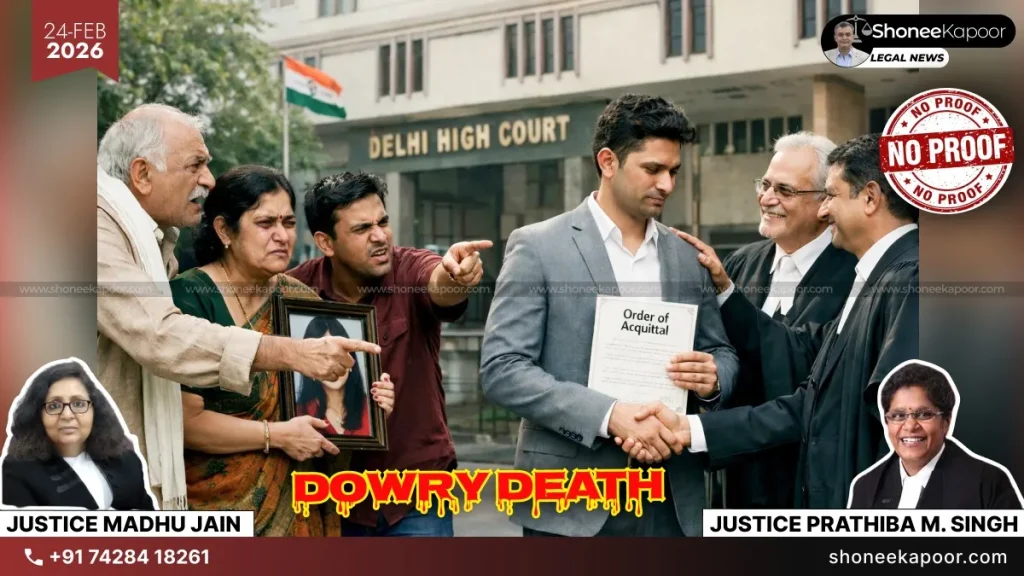
Can allegations from a previous marriage be used to convict a man in a dowry death case?
The Delhi High Court says NO and explains why evidence, not emotion, decides criminal liability.
Dowry Death: The Delhi High Court, in a judgment delivered by Justice Prathiba M. Singh and Justice Madhu Jain, dismissed the State’s appeal and affirmed the acquittal in a case involving the death of a young married woman within months of marriage.
The court examined whether allegations of dowry harassment and murder were supported by reliable evidence and concluded that the prosecution failed to establish guilt beyond reasonable doubt.
The case originated after the woman was taken to the hospital in an unconscious condition by her husband and was declared dead. Initial allegations from the parental family suggested dowry harassment and the responsibility of in-laws for her death.
However, the trial court had earlier acquitted the accused, prompting the State to challenge the verdict before the High Court.
During appeal proceedings, the High Court analysed testimonies of family members who alleged dowry demands, including a motorcycle, cash and a car. The court noted inconsistencies, lack of specific incidents, and improvements in statements over time.
The judgment recorded that allegations were “in the nature of general and vague allegation” and lacked details of any proximate cruelty before death.
Medical evidence played a decisive role as doctors confirmed the cause of death as “Asphyxia as a result of antemortem hanging.”
The forensic distinction between hanging and strangulation was explained in testimony stating that in hanging “the ligature mark is oblique incomplete and situated higher up on the neck” whereas strangulation presents different internal findings.
It was also alleged that the husband had a previous marriage, which was concealed. Witnesses related to the former wife were examined to suggest a pattern of dowry-related conduct in that earlier relationship. However, the High Court clearly held that alleged disputes or accusations arising out of a prior marriage could not substitute for proof of cruelty in the present marriage.
The court emphasised that past matrimonial discord does not automatically establish guilt in a subsequent marriage unless there is direct and proximate evidence linked to the death in question.
The High Court emphasised that the presumption of dowry death cannot be applied mechanically without foundational facts. It observed that vague allegations and absence of contemporaneous complaints weaken prosecution claims.
The court reiterated that:
“Criminal law requires proof of a proximate and live link between the effect of cruelty based on dowry demand and the death concerned.”
In conclusion, the court held that the prosecution failed to establish the statutory ingredients necessary for conviction and that the trial court’s view was legally sustainable. The judgment stated that the presumption under law does not arise in the absence of credible proof and therefore affirmed the acquittal while dismissing the appeal.
Explanatory Table: Laws And Sections Included
| Law / Section | Purpose | How applied in this case |
| Section 378 CrPC | Allows State to appeal against acquittal | State filed appeal challenging trial court acquittal |
| Section 498A IPC | Punishes cruelty by husband or relatives | Allegations of dowry harassment examined but not proved |
| Section 304B IPC | Defines dowry death within 7 years of marriage | Core charge; court held foundational facts not established |
| Section 302 IPC | Punishment for murder | Alternative charge rejected due to medical evidence of suicide |
| Section 34 IPC | Liability for acts done with common intention | Applied to multiple accused but not sustained |
| Section 113B Evidence Act | Presumption of dowry death when cruelty shown soon before death | Court held presumption not triggered due to vague evidence |
| Section 161 CrPC | Recording of witness statements by police | Later statements found to contain improvements and inconsistencies |
| Dowry Prohibition Act (Section 2) | Defines dowry for legal interpretation | Used to assess alleged dowry demands in testimonies |
Case Details
- Case Title: State (Govt of NCT of Delhi) v Aftab & Anr.
- Court: High Court of Delhi at New Delhi
- Case Number: CRL.A. 561/2016
- Neutral Citation: 2026:DHC:1334-DB
- Date of Decision: 17 February 2026
- Bench: Justice Prathiba M. Singh | Justice Madhu Jain
- Counsels:
- For Appellant/State: Mr. Ritesh Kumar Bahri, APP with Ms. Divya Yadav and Mr. Lalit Luthra, Advocates
- For Respondents: Mr. R. K. Tarun, Mr. Reyazul Haque, Ms. Capt. Subedita Rani, Ms. Aditi Shivadhatri, Ms. Khushi Gupta and Mr. Hemant Jain, Advocates
Key Takeaways
- Vague and omnibus allegations without specific dates, incidents, or independent evidence cannot justify criminal conviction in matrimonial disputes.
- Medical and forensic evidence plays a decisive role, and courts rely heavily on objective science over emotional narratives.
- Statutory presumptions in dowry cases apply only when foundational facts like clear cruelty “soon before death” are proven.
- Improvements and contradictions in witness statements weaken prosecution credibility and reinforce benefit of doubt.
- Criminal law must protect individuals from wrongful implication, emphasizing presumption of innocence and strict proof standards in family-related offences.
This Could Change Your Case-Get FREE Legal Advice-Click Here!
Disclaimer: The views and opinions expressed in this article are those of the Indian courts and do not necessarily reflect the official policy or position of “ShoneeKapoor.com” or its affiliates. This article is intended for informational and educational purposes only. The content provided is not legal advice, and viewers should not act upon this information without seeking professional counsel. Viewer discretion is advised.