
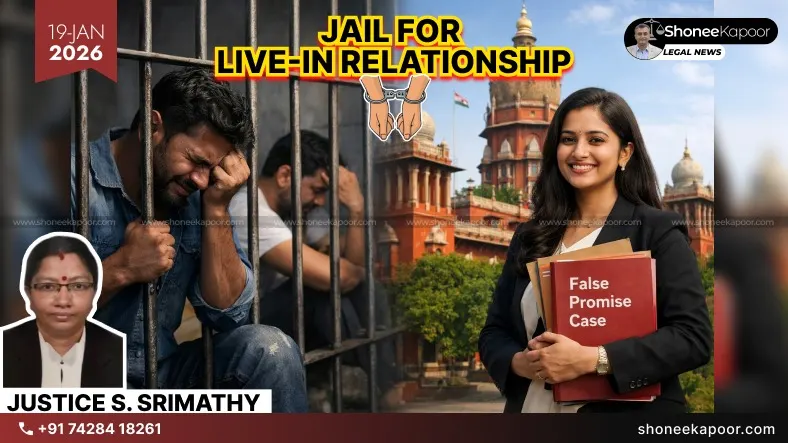
The Madras High Court called live-in relationships a cultural shock and suggested granting women the status of “wife” to protect them. Refusing anticipatory bail, the Court held that a man who refuses marriage after intimacy must face prosecution under Section 69 of BNS.
CHENNAI: The Madras High Court made observations on the growing trend of live-in relationships in India and the legal vacuum surrounding them, especially when disputes arise.
The Court highlighted:
“Women often suffer legal and social consequences in such relationships, while men are able to walk away without accountability, leading to serious mental trauma and misuse of criminal law on both sides.”
Justice S. Srimathy observed that live-in relationships, though increasingly common, remain a cultural shock to Indian society. The Court noted that many young women enter such relationships believing they are progressive and modern, but later realise that these arrangements do not provide the legal protection available under marriage.
“Infact live-in relationship is a cultural shock to the Indian Society, but it is happening widely everywhere. The girls assume that they are modern and opt for live in relationship. But after some time when they realize that live-in relationship is not granting any protection as granted under marriage, the reality catches as fire and start burning them,”
-the court observed.
The Court stressed that women caught in the modern culture of live-in relationships are left vulnerable. While minor girls are protected under the POCSO Act, married women have rights relating to maintenance and residence, and even divorced women have statutory protection, women in live-in relationships fall into a grey area with almost no legal safeguards.
This gap, the Court noted, creates emotional distress and social stigma, and eventually results in criminal litigation where both parties suffer.
“In live-in relationship the women ought to be protected by granting the status of “wife” under Gandharva marriage / love marriage, so that the women in live-in relationship, even if it is under turbulence, may be provided with rights as “wife”,”
-the court said.
The Court referred to ancient Indian traditions and pointed out that Gandharva marriage, recognised in Hindu law as a form of love marriage, could be used as a legal framework to protect women in live-in relationships.
According to the Court, recognising such relationships as similar to Gandharva marriages would ensure dignity and rights for women, while also bringing clarity and responsibility into relationships that currently operate without legal structure.
The observations were made while hearing an anticipatory bail petition filed by a man who feared arrest in a case involving alleged false promise to marry. According to the prosecution, the complainant woman and the petitioner were in a relationship for several years.
The man allegedly had sexual relations with her on the promise of marriage. When his family opposed the relationship due to caste differences, the couple left their homes and went to Trichy with the intention of marrying. They rented a house and lived together.
The prosecution further stated that after the woman’s father filed a missing complaint, the police brought both parties to the station, where the petitioner again promised to marry her. However, his family objected strongly and allegedly threatened to kill both of them due to the inter-caste nature of the relationship.
The petitioner, on the other hand, claimed that the allegations were false and fabricated. He argued that he had ended the relationship long ago and that the complaint was filed only after the relationship ended. He also submitted that he had no job or income, was dependent on his parents for daily expenses, and therefore did not consider marriage feasible. On these grounds, he sought anticipatory bail, claiming that no offence was made out against him.
The Court examined the provisions of the Bharatiya Nyaya Sanhita and noted that Section 69 was specifically introduced to criminalise sexual intercourse by deceitful means, including false promise of marriage. The Court observed that this provision was meant to address situations where sexual relations occur on assurances that are never intended to be fulfilled.
“69. Whoever, by deceitful means or by making promise to marry to a woman without any intention of fulfilling the same, has sexual intercourse with her, such sexual intercourse not amounting to the offence of rape, shall be punished with imprisonment of either description for a term which may extend to ten years and shall also be liable to fine.
Explanation.—“deceitful means” shall include inducement for, or false promise of employment or promotion, or marrying by suppressing identity.”
The Court noted that in the present case, although there was an admitted relationship and sexual intercourse, the petitioner had now clearly refused to marry the woman. The Court held that in such a situation, the law leaves only two options: either the woman must be recognised as a wife, or the man must face prosecution for making a false promise to marry.
“If marriage is not possible then the men ought to face the wrath of legal provisions. Now the only section that grants protection to women is under section 69 of BNS and the men ought to face the wrath of the Section 69 of BNS.”
The Court also took note of the failed mediation attempts. It recorded that even when compensation or maintenance was suggested, the woman refused, fearing social branding and character assassination, which highlighted the deeper social damage caused by such disputes.
“Infact live-in relationship is a cultural shock to the Indian Society, but it is happening widely everywhere.”
Considering the seriousness of the allegations, the existence of prima facie evidence, and the refusal of the petitioner to marry after a long relationship, the Court held that custodial interrogation was necessary. It therefore declined to grant anticipatory bail and dismissed the petition.
The ruling underlines the growing tension between modern relationship choices and existing legal frameworks, and raises important questions about accountability, protection, and misuse of criminal law. While the Court focused on safeguarding women, the judgment also indirectly reflects how unclear laws around live-in relationships often push men into criminal prosecution when relationships fail, instead of encouraging clear civil remedies and responsibility at the start itself.
Explanatory Table: Laws & Sections Involved
| Act / Law | Section | Purpose of Law | How Applied in This Case |
| Indian Penal Code (IPC) | Section 417 | Punishes cheating | Alleged false promise to marry used to induce relationship |
| Indian Penal Code (IPC) | Section 420 | Cheating and dishonestly inducing delivery of property | Considered as part of deceit-based allegations |
| Indian Penal Code (IPC) | Section 506(i) | Criminal intimidation | Alleged threats linked to inter-caste relationship |
| Bharatiya Nyaya Sanhita (BNS) | Section 351(2) | Criminal intimidation by anonymous communication | Added due to intimidation allegations |
| Bharatiya Nyaya Sanhita (BNS) | Section 69 | Sexual intercourse by deceitful means, including false promise of marriage | Court directed police to add this section after petitioner refused marriage |
| Protection of Children from Sexual Offences Act (POCSO) | — | Protects minors from sexual offences | Referred to for contrast; not applicable as victim was a major |
| Bharatiya Nagarik Suraksha Sanhita (BNSS) | Section 482 | Inherent powers of High Court | Used for seeking anticipatory bail |
Case Details
- Case Title: Prabhakaran v. The State
- Court: Madurai Bench of the Madras High Court
- Bench: Hon’ble Mrs. Justice S. Srimathy
- Date of Order: 11 November 2025
- Case Number: CRL.OP(MD). No.6147 of 2025
- Police Station & Crime Number: All Women Police Station, Manaparai, Trichy District. Crime No.35 of 2024
- Petitioner: Prabhakaran
- Respondent: State represented by Inspector of Police, All Women Police Station, Manaparai
- Counsels:
- For Petitioner: Mr. M. N. Rajapanth
- For Respondent (State): Mr. S. S. Manoj, Government Advocate (Criminal Side)
- For Defacto Complainant: Mr. A. Joel Paul Antony
- Nature of Petition: Anticipatory Bail under Section 482 BNSS
- Outcome: Anticipatory bail dismissed
Key Takeaways
- Live-in relationships in India remain legally undefined, turning personal relationship failures into criminal cases against men.
- Absence of clear civil remedies pushes courts to use criminal law, exposing men to arrest instead of proportionate accountability.
- Refusal to marry after a consensual relationship is now being treated as potential criminal intent, not a personal choice.
- Economic reality of men, including unemployment or dependency, is often ignored once intimacy is admitted.
- Without gender-neutral live-in laws, men continue to face legal risk while women are routed only through criminal protection.
This Could Change Your Case-Get FREE Legal Advice-Click Here!
Disclaimer: The views and opinions expressed in this article are those of the Indian courts and do not necessarily reflect the official policy or position of “ShoneeKapoor.com” or its affiliates. This article is intended for informational and educational purposes only. The content provided is not legal advice, and viewers should not act upon this information without seeking professional counsel. Viewer discretion is advised.